
Private Label Bubble Tea Checklist for Wholesale Buyers
A private label bubble tea checklist should verify the co-packer, US food-safety duties, third-party food-safety certification, pearl and milk-tea stability, shelf-life evidence, packaging and can-seam records, MOQ and lead time, batch release, and import paperwork. For shelf-stable low-acid canned products sold in the US, buyers should also verify FDA establishment registration and scheduled process filings where they apply.
Private label bubble tea carries technical and supply risks that a general beverage checklist often misses. Tapioca or konjac pearls must maintain an appealing chew without hardening, dissolving, or releasing excess liquid after commercial thermal processing and ambient storage. Milk tea emulsions must stay homogenous without fat separation, protein curdling, or sediment formation. Furthermore, packaging seals, can seams, batch records, and customs clearance paperwork must precisely align with US regulatory standards.
Whether you are a supermarket procurement team, an independent distributor, a restaurant group, or a franchise founder vetting contract manufacturers, this comprehensive buyer verification checklist provides the essential regulatory, quality assurance, and commercial criteria required before approving commercial production runs.
Quick answer: A private label bubble tea audit must verify co-packer facility credentials, FDA canning registrations (FCE/SID), GFSI certifications (BRCGS Issue 9 / SQF Edition 9), thermal process validation, pearl texture stability, real-time/accelerated shelf-life data, double-seam integrity, batch release COAs, minimum order quantities (MOQs), and container logistics before issuing a purchase order.
Private label bubble tea checklist at a glance
| Audit Area | Core Buyer Verification Checks |
|---|---|
| 1. Regulatory Fit & FDA Duties | Confirm US regulatory classification based on equilibrium pH and water activity. Verify 21 CFR Part 117 preventive controls and low-acid canned food (LACF 21 CFR Part 113) or acidified food filings where applicable. |
| 2. Food-Safety Certification | Request current GFSI-benchmarked audit certificates (BRCGS Food Safety Issue 9 or SQF Food Safety Code Edition 9). Validate that the site address and beverage category scope match your exact product lines. |
| 3. Product & Process Validation | Evaluate pearl elasticity and texture post-retort, emulsion stability, Brix, pH, colour, and flavour. Confirm that the thermal process is established by a recognised process authority. |
| 4. Shelf-Life Evidence | Review real-time ambient stability studies supported by validated accelerated protocols (e.g. 90 days at 40°C / 75% RH). Require sensory, physical, and microbiological test parameters with defined acceptance thresholds. |
| 5. Packaging Integrity & Batch Release | Inspect double-seam teardown logs, optical seam measurements, BPA-NI liner specifications, lot-specific Certificates of Analysis (COA), microbiological release criteria, and supply-chain traceability. |
| 6. Commercial & Import Logistics | Confirm format-specific MOQs (shrink-sleeve vs direct printed cans), manufacturing lead times, Incoterms (EXW, FOB, CIF), freight plans, and preliminary HTS tariff classification (HTS 2202.99). |
How to vet a wholesale bubble tea co-packer
Finding a reliable contract manufacturer or OEM partner requires evaluating both their food-safety management systems and their technical capability to handle complex suspended inclusions like boba pearls. Before signing a manufacturing agreement or placing a deposit, request a comprehensive buyer audit file containing the following documentation:
- Current Third-Party Food Safety Certificate: Detailed audit report and scope document from a GFSI-recognised certification body.
- FDA Facility & Canning Registrations: Food Facility Registration Number and Food Canning Establishment (FCE) registration records.
- Scheduled Process Filings (SID): Submission Identifier documents for each specific product recipe, container geometry, and volume.
- Food Safety Plan / HACCP System: Documented hazard analysis, Critical Control Points (CCPs), and preventive control parameters for biological, chemical, and physical risks.
- Thermal Process & Pearl Texture Validation: Process authority validation letters confirming commercial sterility targets without degrading pearl integrity.
- Documented Shelf-Life Studies: Real-time ambient retention data and accelerated test logs validating quality over 12 to 24 months.
- Can-Seam Inspection Logs: Statistical process control (SPC) data for double-seam overlap, tightness, and visual inspection frequencies.
- Representative Certificate of Analysis (COA): Standard release testing criteria covering standard plate count, yeast, mould, coliforms, pH, and Brix.
- Commercial SLA Terms: Defined MOQ thresholds, pilot batch scheduling, artwork change controls, and production lead times.
- Customs & Export Compliance: Commercial invoices, packing lists, Prior Notice documentation, and country-of-origin phytosanitary declarations.

While generic co-packer guides emphasize standard contract terms, the unique challenge in bubble tea lies in formulation stability under commercial retort conditions. For a broader comparison of operational models, see our detailed guide on Ready-to-Drink vs Fresh Bubble Tea.
FDA and FSMA checks for canned bubble tea
Exporting or distributing ready-to-drink bubble tea in the United States requires strict adherence to US Food and Drug Administration (FDA) regulations. The exact regulatory framework depends on the beverage's equilibrium pH, water activity ((a_w)), packaging type, and thermal treatment.
Under US federal regulations (21 CFR Part 113), a low-acid canned food (LACF) is defined as any food (other than alcoholic beverages) with a finished equilibrium pH greater than 4.6 and a water activity greater than 0.85, packaged in a hermetically sealed container. Most traditional dairy-based milk teas with pearls fall squarely into the LACF category. Commercial processors of shelf-stable low-acid canned foods must register their facility and file scheduled thermal processes with the FDA.
21 CFR Part 117 and low-acid canned food compliance
The FDA Food Safety Modernization Act (FSMA) established 21 CFR Part 117, governing Current Good Manufacturing Practice (CGMP), Hazard Analysis, and Risk-Based Preventive Controls for Human Food. Facilities manufacturing low-acid canned foods that fully comply with 21 CFR Part 113 receive a limited exemption from Part 117 Subparts C (Hazard Analysis and Risk-Based Preventive Controls) and G (Supply-Chain Program) solely for biological hazards controlled by thermal processing.
However, all other provisions of Part 117 remain in full effect. The facility must maintain validated preventive controls for chemical hazards (such as milk and dairy allergens), physical hazards (foreign object filtration), and sanitation controls. A buyer should request documentation demonstrating full compliance across both Part 113 thermal controls and Part 117 allergen and supply-chain requirements.
FCE registration, scheduled process filings, and SID records
Foreign and domestic commercial processors manufacturing shelf-stable low-acid canned foods for US distribution must complete two critical regulatory steps:
- Food Canning Establishment (FCE) Registration: Register the manufacturing facility via FDA Form 2541.
- Scheduled Process Filing (SID): File a scheduled thermal process via FDA Form 2541d for each specific product formulation, container material (aluminium can, glass, retort pouch), container dimensions (diameter and height), and sterilization method. Each approved filing generates a unique Submission Identifier (SID).
Buyer Warning: A generic FDA Food Facility Registration Number does not satisfy LACF requirements. Importers must ensure the co-packer provides the specific FCE number and SID corresponding exactly to the private label SKU and can size being imported.
Do not use one universal retort time
A common misconception among first-time private label buyers is assuming that all canned bubble tea operates under a standardized retort schedule (such as 121°C for 18 minutes to achieve an (F_0) value (ge 4.0)). In industrial thermal processing, universal recipes do not exist.
Thermal heat penetration rates vary widely depending on can geometry, product viscosity, fat content, tea solid concentration, and the specific density and starch structure of the pearls. FDA regulations require that every scheduled process be scientifically established by a qualified Process Authority—an expert with specialized knowledge in thermal processing and commercial sterility validation.
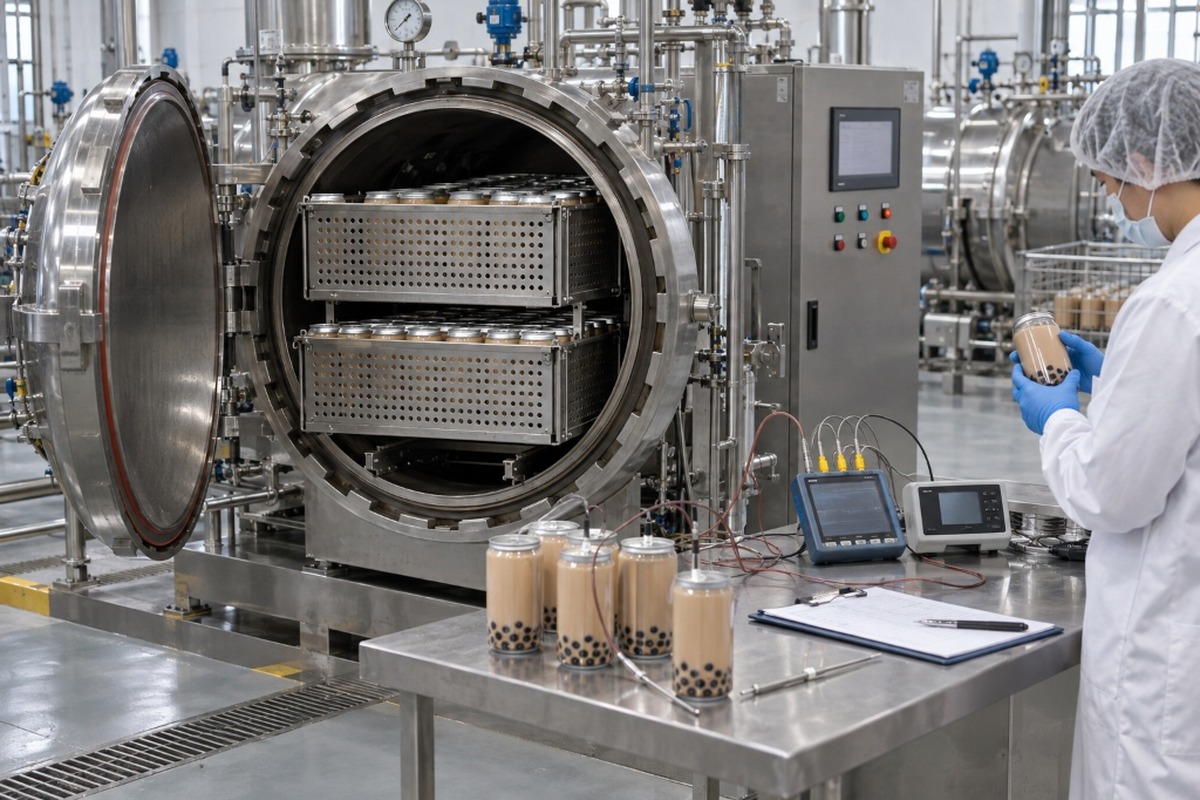
Procurement teams should require the co-packer to provide the formal Process Authority letter certifying the validated scheduled process for the exact SKU, container volume, and processing equipment used.
Food-safety certification: what to request in 2026
Major retail supermarket chains and institutional buyers require suppliers to hold third-party certification benchmarked by the Global Food Safety Initiative (GFSI). GFSI sets benchmarking standards but does not issue certificates directly; accredited certification bodies conduct audits against GFSI-recognised standards such as SQF and BRCGS.
- SQF (Safe Quality Food): SQF Edition 10 was published in March 2026, but the SQF Institute has mandated that official audits against Edition 10 will not commence until January 2, 2027. Therefore, audits conducted throughout 2026 operate under SQF Food Safety Code Edition 9.
- BRCGS (British Retail Consortium Global Standards): Facilities are audited against BRCGS Food Safety Issue 9. Audit outcomes are graded from AA down to D (with a "+" indicating an unannounced audit). Demanding a minimum Grade A or AA is a standard commercial buyer quality threshold.
Always verify the scope statement on the certificate. Ensure it explicitly lists "beverage manufacturing with retort processing" or "canned acidified/low-acid beverages" rather than a vague generic food packing scope.
Audit pearl texture and milk-tea stability
Thermal sterilization places severe physical and chemical stress on beverage ingredients. Unlike fresh bubble tea served immediately in cafés, canned ready-to-drink boba must endure heat processing followed by months of ambient distribution.
Preventing pearl breakdown and syneresis
Traditional cassava tapioca pearls tend to hydrate, dissolve, retrogradate, and turn mushy or rubbery when exposed to prolonged retort temperatures and aqueous storage. Successful RTD bubble tea formulas utilize modified starches or konjac glucomannan formulations engineered to retain elastic, resilient chewiness (Q-bounce) over extended ambient storage. Audits must evaluate:
- Texture retention: Chewiness and firmness measured via texture profile analysis (TPA) before and after retort, and across storage milestones.
- Syneresis & Liquid Release: Ensuring pearls do not release excess water or absorb tea liquid, altering beverage volume and sweetness.
- Physical Integrity: Verifying zero pearl fragmentation, clumping, or clouding of the liquid base.
Emulsion stability and buffering
Milk tea contains dairy proteins, fats, polyphenols (tannins from black/green tea), and acids that can destabilize during thermal processing, leading to unsightly flocculation, creaming, or curdling. Co-packers often incorporate food-grade buffering salts and emulsifiers, such as:
- Dipotassium Phosphate (( ext{K}_2 ext{HPO}_4)): Buffers pH to prevent protein coagulation under thermal stress.
- Mono- and Diglycerides / Sodium Stearoyl Lactylate (SSL): Stabilize lipid-water emulsions and prevent surface fat rings.
- Gellan Gum / Microcrystalline Cellulose (MCC): Provide suspension yield stress, keeping pearls evenly dispersed without rapid settling.
Approve the processed product after the bench sample
Never sign off on a formulation based solely on benchtop kitchen samples. Follow this structured 4-stage approval workflow:
- Bench Formulation: Finalize flavour profiles, sweetness levels (Brix 7.0–11.0°Bx), pH, and visual appearance in small laboratory batches.
- Thermal Pilot Trial: Subject sealed test cans to the full scheduled retort cycle matching commercial manufacturing parameters.
- Post-Process Quality Review: Re-evaluate taste, colour degradation, aroma volatilization, emulsion smoothness, and pearl bite against baseline targets.
- Commercial Pilot Run: Run a limited pilot batch (5,000–10,000 units) on the commercial line to validate line speeds, filling tolerances, and seaming consistency.
Shelf-life testing needs product-specific evidence
Establishing shelf life requires robust scientific evidence rather than generic assumptions. A common accelerated shelf-life testing (ASLT) protocol involves storing sample cans at 40°C and 75% relative humidity for 90 days, theoretically modeling 12 months of ambient storage at 20–25°C based on the Arrhenius reaction rate relationship ((Q_{10})).
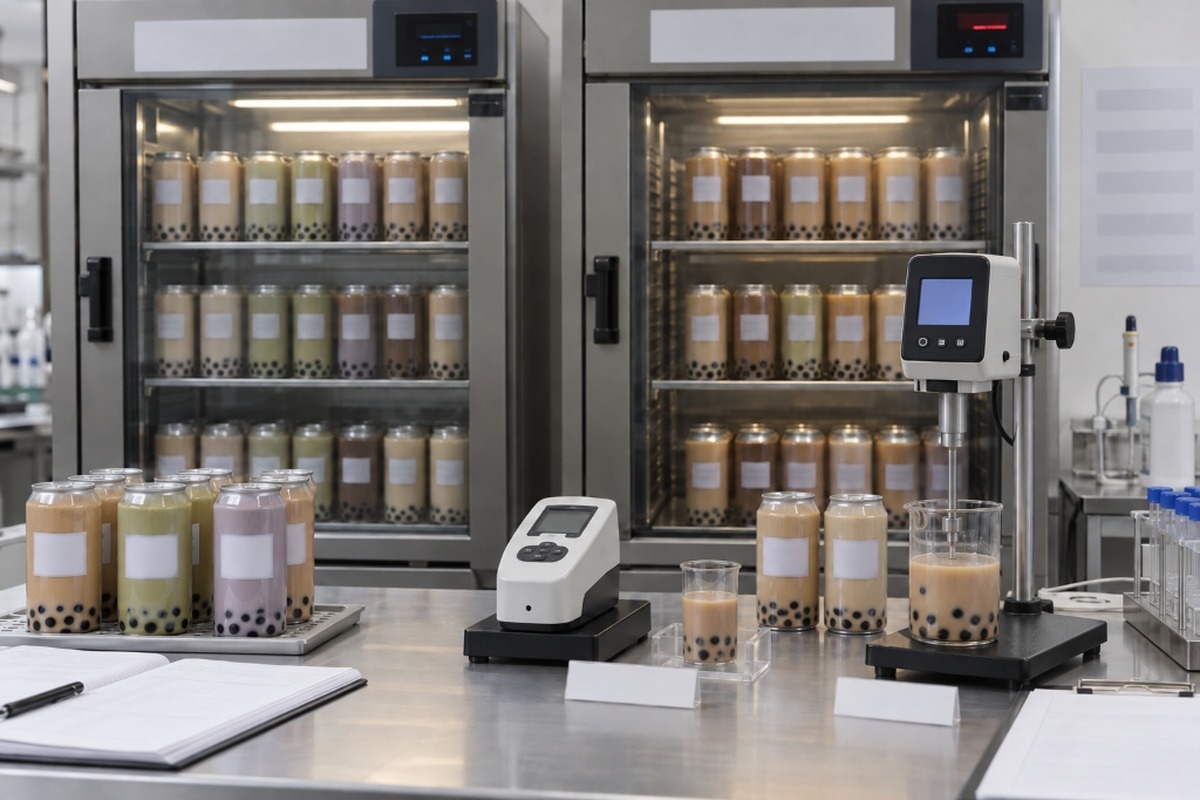
However, food science authorities warn that accelerated elevated temperatures can induce artificial protein denaturation, non-enzymatic browning (Maillard reaction), and packaging degradation that would not occur during normal ambient storage. Buyers should require both accelerated validation and concurrent real-time ambient testing. For comprehensive testing protocols, review our dedicated guide on Ready-to-Drink Bubble Tea Shelf Life.
A complete shelf-life audit dossier should document:
- Batch number, production date, and initial baseline analytical data.
- Environmental conditions for ambient (20–25°C) and accelerated (37–40°C) chambers.
- Scheduled testing intervals (e.g. Day 0, 30, 60, 90, 180, 270, 360, 540).
- Analytical parameters: aerobic plate count, yeast/mould, pH shift, Brix stability, colour change ((Delta E)), viscosity, and sensory scorecards.
- Clear acceptance criteria defining the end-of-shelf-life quality boundary.
Private label boba MOQ and packaging choices
Minimum Order Quantities (MOQs) and per-unit production costs are primarily dictated by the chosen packaging format, can decoration technique, and factory changeover scheduling.
| Production Tier | Typical MOQ (Cans) | Packaging & Decoration Route | Strategic Application |
|---|---|---|---|
| Pilot / Test Launch | 5,000 – 10,000 cans | Shrink-sleeve on bright (unprinted) cans | Regional market validation, specialty retail tests, and limited seasonal runs. Higher per-unit packaging cost but low upfront inventory risk. |
| Standard Commercial | 30,000 – 50,000 cans | Direct-printed aluminium cans (Dry offset lithography) | Standard retail distribution across supermarkets, convenience stores, and beverage wholesalers. Optimum balance of unit cost and working capital. |
| High-Volume Enterprise | 100,000+ cans (Full Containers) | High-speed direct print with custom ends & embossed cartons | National grocery chains, global private label programs, and international distribution networks achieving maximum COGS efficiency. |
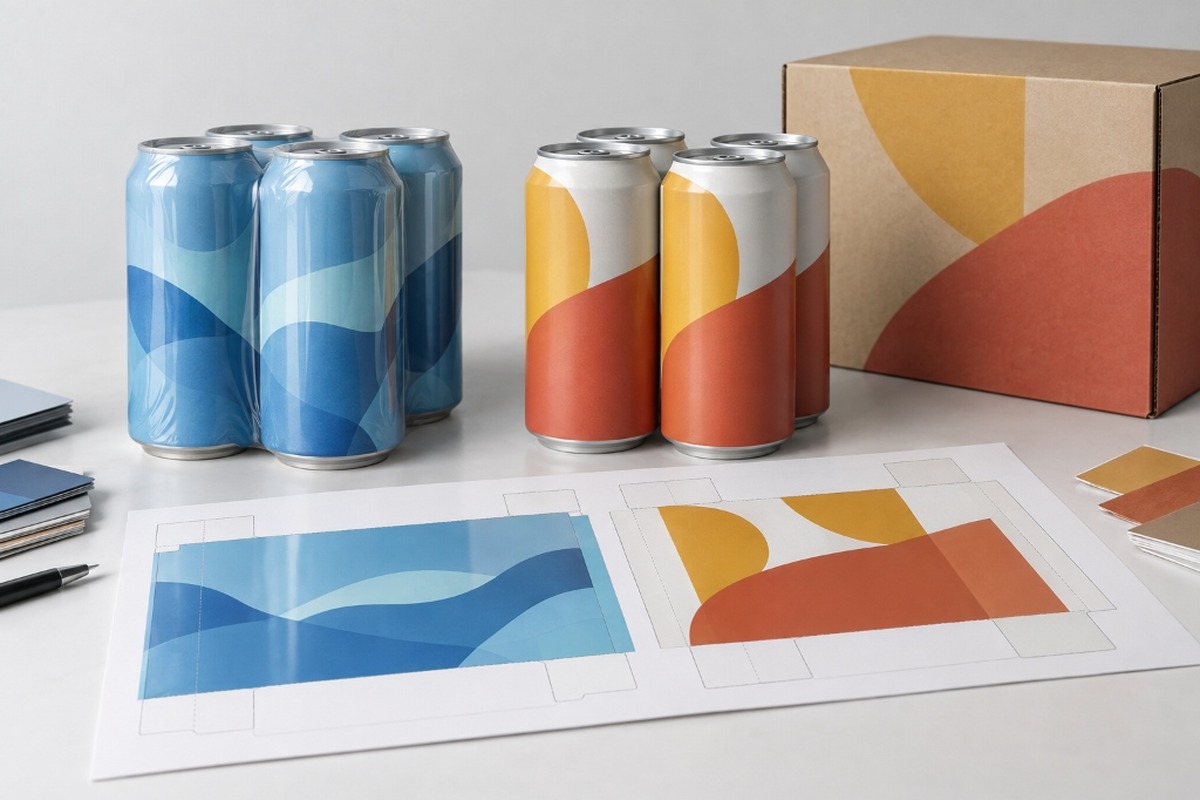
For a detailed breakdown of packaging performance and cost differences, read our guide on Bubble Tea Cups vs Cans vs Bottles and review financial modeling in How Much Does Bubble Tea Cost?.
Can seam checks and packaging release
Double-seam integrity is the single most critical defense against post-process microbiological contamination and beverage leakage in canned drinks. During high-temperature retort sterilization, internal pressure rises, placing stress on the can end and double seam.
Co-packers must perform continuous statistical seam monitoring throughout every production run. Key parameters to audit include:
- Seam Overlap: Standard target (ge 55%) (calculated via optical video seam imaging or mechanical teardown formulas).
- Seam Tightness / Wrinkle Rating: Standard target (ge 85%) wrinkle-free rating on the cover hook.
- Countersink Depth & Seam Thickness: Maintained within tight (pm 0.05 ext{ mm}) tolerances per can maker specifications.
- Internal Can Liner Integrity: Ensuring BPA-NI (Non-Intent) epoxy or polyester internal coatings resist corrosion from tea acids and sugars.
Always request the double-seam teardown inspection logs corresponding to your specific production batch as part of the pre-shipment release package.
COA and batch release protocols
Every commercial production batch must be accompanied by a lot-specific Certificate of Analysis (COA) confirming that the finished goods satisfy all technical and food-safety specifications before leaving the factory. A sample or template COA is never sufficient proof of compliance.
The COA must clearly state the production lot number, manufacturing date, and expiry date matching the bottom-can inkjet coding, along with verified laboratory results for:
- Microbiological Safety: Total Viable Count (TVC < 10 CFU/g), Yeast and Mould (< 10 CFU/g), Coliforms (Negative / 0.1 ml), E. coli (Negative / 25 g), and commercial sterility confirmation.
- Physicochemical Properties: Soluble solids (Brix ± 0.5°Bx), pH (± 0.2 units), specific gravity, and net fill volume / drained weight.
- Sensory & Organoleptic Evaluation: Standard pass/fail confirmation for appearance, aroma, flavour profile, and pearl texture chewiness.
Commercial agreements and service levels
A rigorous Manufacturing and Supply Agreement (MSA) protects both parties and eliminates ambiguity regarding quality, pricing, and operational execution. Key contractual clauses should specify:
- Detailed Product Specifications: Legally binding formulation recipes, target ingredient tolerances, and approved packaging drawings.
- Volume Commitments & Tiered MOQs: Clearly stated order quantities by flavour SKU and packaging format.
- Production Lead Times: Agreed manufacturing windows (typically 6–8 weeks from PO and artwork sign-off to ex-factory readiness).
- Non-Conforming Product & Quality Liability: Clear protocols defining financial responsibility, recall insurance, and replacement procedures for out-of-spec batches or packaging failures.
- Formulation Ownership & Change Control: Strict rules prohibiting the manufacturer from altering ingredients, suppliers, or process parameters without prior written buyer approval.
- Shipping Terms & Risk Transfer: Defined Incoterms 2020 rules (e.g. EXW factory, FOB shipping port, or CIF destination port).
How long does private label bubble tea take?
From initial recipe concept to receiving the first commercial container, a realistic private label beverage timeline spans 16 to 24 weeks:
- Weeks 1–4 (Formulation & Benchtop Sampling): Custom flavour matching, sweetness balancing, tea selection, and initial pearl texture profiling.
- Weeks 5–8 (Retort Pilot Trials & Process Authority Filing): Pilot retort batches, sensory evaluation, FCE/SID process filing documentation, and accelerated shelf-life initiation.
- Weeks 9–12 (Packaging Design & Cylinder/Plate Engraving): Dieline artwork layout, FDA-compliant nutrition facts panel validation, cylinder engraving, and proof approval.
- Weeks 13–16 (Commercial Manufacturing & QA Hold): Mass production run, double-seam monitoring, 14-day QA microbiological incubation hold, and COA generation.
- Weeks 17–22 (Ocean Freight & Customs Clearance): Full-container shipping (FCL), customs entry filing (HTS 2202.99), FDA Prior Notice clearance, and domestic warehouse delivery.
Logistics, customs and import planning
Optimizing freight logistics and container utilization is crucial for maintaining competitive landed margins on imported RTD bubble tea:
- Container Loading Capacity: Standard 20 ft standard containers typically hold approximately 1,600 to 1,800 cases (38,000–43,000 cans of 320 ml), while 40 ft high-cube (HC) containers carry up to 3,200 cases (75,000–80,000 cans), subject to road weight limitations.
- Harmonized Tariff Schedule (HTS): RTD bubble tea is commonly classified under HTS 2202.99 (other non-alcoholic beverages). Specific sub-headings vary depending on milk solids, sugar content, and fruit juice percentages; always confirm the final classification with a licensed customs broker.
- FDA Prior Notice & Entry Documentation: Ensure your customs broker files FDA Prior Notice before ocean vessels arrive, submitting accurate FCE and SID numbers to avoid border delays or automatic holds.
For retail distribution strategies and planogram optimization once product arrives, see our guide on Bubble Tea Retail Merchandising.
Bobalicious private label and OEM support
Bobalicious provides end-to-end OEM and private label manufacturing solutions for global retail brands, supermarket chains, and food-service operators:
- Multi-Format Packaging Lines: Automated filling and retort processing across aluminium slim cans (320 ml), ready-to-drink sealed cups (360–500 ml), and ambient PET bottles.
- Export-Ready Capacity: High-speed manufacturing lines delivering over 200 shipping containers per month with full international export compliance.
- Certified Quality Systems: Fully certified under GFSI standards (BRCGS Issue 9 / SQF), complete FDA FCE/SID documentation, and comprehensive HACCP food-safety plans.
- Flexible Supply Terms: Scalable production starting from one full container load (FCL), supported by standard 2-month wholesale lead times and flexible EXW, FOB, or CIF shipping arrangements.
For private label inquiries, technical specification sheets, or pilot batch quotations, contact our B2B wholesale team or explore our equipment-free business guide on How to Sell Bubble Tea Without Equipment.
Frequently asked questions
What should I check before choosing a private label bubble tea manufacturer?
Verify the manufacturer's GFSI food-safety certificate (BRCGS/SQF), US FDA registrations (FCE number and product-specific SID filings), thermal process validation from a recognised process authority, pearl texture stability post-retort, real-time shelf-life data, double-seam teardown records, batch release COA criteria, MOQs, and international shipping terms.
What is the typical MOQ for private label canned bubble tea?
For shrink-sleeved pilot runs on blank cans, MOQs typically start at 5,000 to 10,000 units. For direct-printed aluminium cans, standard production MOQs range from 30,000 to 50,000 cans per flavour. High-volume enterprise runs operate from one full container load (approx. 40,000 to 80,000 cans).
What does the FDA require for canned bubble tea in the US?
Under 21 CFR Part 113, shelf-stable low-acid canned foods (pH > 4.6, aw > 0.85) require Food Canning Establishment (FCE) registration and a filed scheduled process with a Submission Identifier (SID) for each container size and recipe. Facilities must also satisfy 21 CFR Part 117 requirements for allergen control and preventive food safety.
What are FCE and SID records?
An FCE (Food Canning Establishment) number registers the processing plant with the FDA. An SID (Submission Identifier) is a unique filing code assigned to a specific product formulation, container geometry, and validated scheduled thermal process. Both are mandatory for legal US commercial entry of low-acid canned foods.
Does every canned bubble tea use the same retort schedule?
No. There is no universal retort time or temperature. Each scheduled process must be scientifically evaluated and validated by a recognized Process Authority based on specific can dimensions, beverage viscosity, pearl composition, and heating characteristics to guarantee commercial sterility.
Which GFSI food-safety certifications are recognized in 2026?
In 2026, the primary GFSI-benchmarked standards for beverage plants are BRCGS Food Safety Issue 9 and SQF Food Safety Code Edition 9. While SQF Edition 10 was published in March 2026, official audits against Edition 10 do not start until January 2, 2027.
How long does the private label development process take?
A complete private label launch generally takes 16 to 24 weeks. This includes 4 weeks for recipe development, 4 weeks for retort pilot testing and SID filing, 4 weeks for packaging plate engraving, 4 weeks for commercial manufacturing and QA hold, and 4 to 6 weeks for ocean freight and customs entry.
What is a Certificate of Analysis (COA)?
A Certificate of Analysis (COA) is an official quality-assurance document confirming that a specific manufactured batch meets microbiological standards (TVC, yeast, mould, pathogens), physicochemical parameters (pH, Brix), and sensory specifications prior to shipping release.
Can accelerated testing alone prove a 12-month shelf life?
Accelerated testing (e.g. 90 days at 40°C) provides valuable predictive data during development, but food science guidelines recommend pairing accelerated studies with ongoing real-time ambient testing to definitively validate long-term stability and sensory quality.
What can-seam records should a buyer request?
Buyers should request statistical double-seam teardown inspection logs and optical cross-section measurements for their specific production run, verifying seam overlap (≥ 55%), tightness rating (≥ 85%), and countersink depth against packaging manufacturer tolerances.
Sources and industry references
This private label procurement checklist references technical standards, regulatory mandates, and quality frameworks from the following food industry authorities:
- US FDA: Acidified & Low-Acid Canned Foods Regulatory Guidance (21 CFR Part 113).
- US FDA: FSMA Preventive Controls for Human Food (21 CFR Part 117).
- Global Food Safety Initiative (GFSI): Recognised Certification Programme Owners.
- Safe Quality Food Institute (SQFI): SQF Food Safety Code Standards.
- BRCGS: Global Standard for Food Safety Issue 9.
- Campden BRI: Shelf-Life Evaluation & Accelerated Testing of Foods and Beverages.


 Badge-157x140.png)
Comments