
How to Sell Bubble Tea Without Equipment
You can sell bubble tea without a cup sealer, automatic shaker, fructose dispenser or commercial pearl cooker. A small menu can run with stockpots, measuring pumps, hand shakers, insulated tea containers and secure cup lids.
A starter kit may cost less than $500 if you already have approved preparation space, refrigeration and some kitchen tools. Permits, stall fees, insurance, stock, transport and labour can raise the opening cost. Check those costs before buying supplies.
This guide covers the full setup: equipment choices, menu planning, safe storage, service steps, pricing and legal checks. It suits market stalls, short pop-ups, private events and early product tests.
Quick answer: Start with 3 to 5 drinks, 1 cup size and 1 or 2 toppings. Brew tea in batches, measure every ingredient, shake drinks by hand and use snap-on lids that pass a leak test. Register the food business and agree your food-safety plan with the local authority before trading.
How to sell bubble tea without equipment: the short plan
Replace each commercial machine with a simple measured process. Use matched cups and snap-on lids in place of a sealer. Use calibrated pumps for syrup, a stockpot and timer for pearls, 530 ml Boston shakers for mixing and insulated containers for brewed tea.
The stall still needs food-safe tools, temperature control and approved hygiene facilities. Test the manual process at low volume, record the slowest task and buy a machine only when several events show that it will repay its cost.
Can you sell bubble tea without commercial machines?
Yes. Most bubble tea machines repeat simple jobs. A cup sealer closes cups, a shaker mixes drinks and a dispenser measures syrup. You can perform each job by hand during a small service.
Manual service has limits. It takes more staff time, and results can vary if workers guess quantities. Written recipes, measured pumps, labelled containers and a simple station layout keep drinks consistent.
You still need suitable food equipment. Food-contact items must be clean, in good condition and safe for their intended use. You also need a way to wash hands, protect ingredients, control temperatures and manage waste.
Bubble tea equipment alternatives
The research report compares a machine-led shop with a manual pop-up. Its prices are planning estimates, so request current quotes in your area.
| Job | Common commercial machine | Manual option | Report estimate for manual option |
|---|---|---|---|
| Close the cup | Cup-sealing machine | PET or PP cup with a tested snap-on lid | $45 per 500 cups and lids |
| Measure syrup | Automatic fructose dispenser | Food-safe pump bottle or measuring cup | $15 for 3 pumps |
| Cook tapioca pearls | Commercial pearl cooker | Heavy stockpot, long spoon, timer and thermometer | $40 |
| Mix the drink | Automatic shaker | Two 530 ml stainless-steel Boston shakers | $25 |
| Hold brewed tea | Heated tea urn | Insulated 10-litre drink dispenser | $65 |
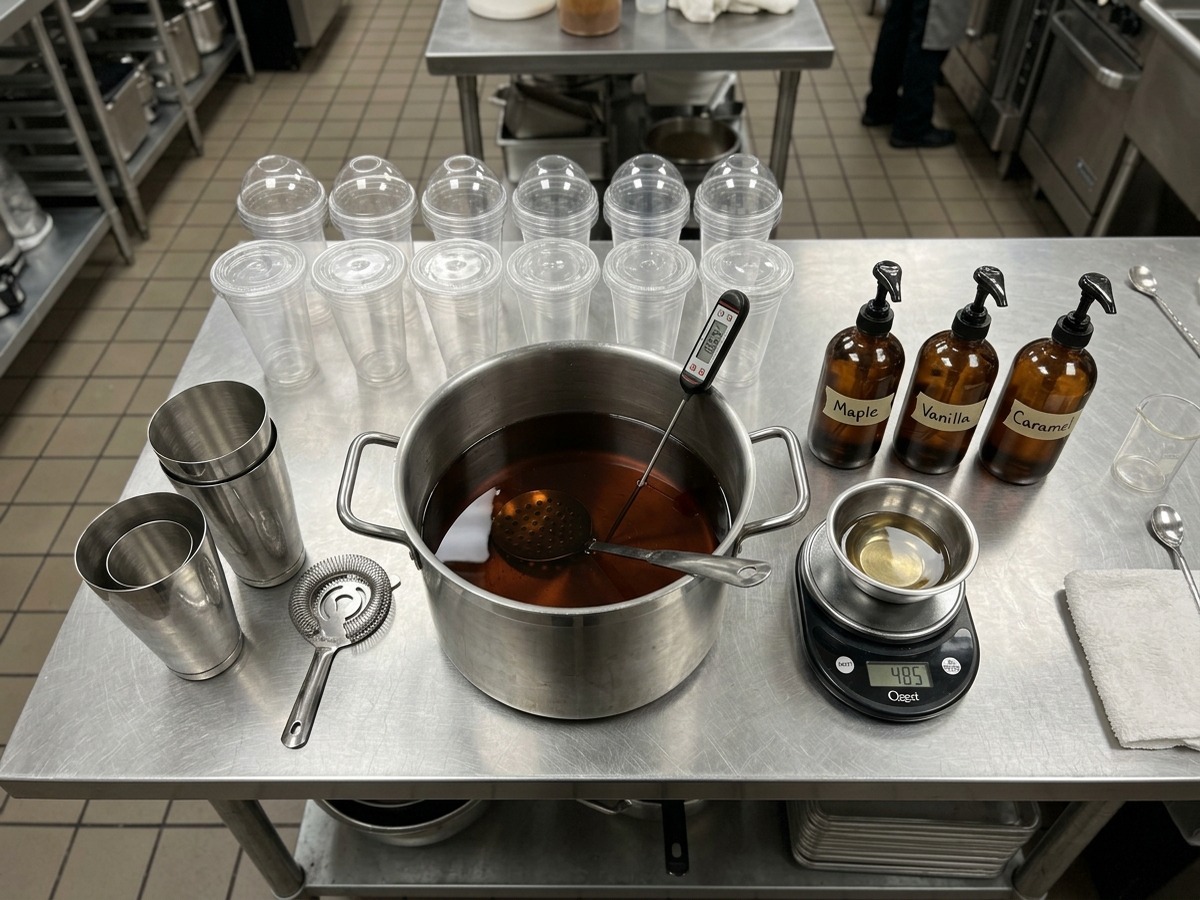
The report places the main manual tools at about $190 to $350. That figure excludes many startup costs. Add refrigeration, sinks or handwashing gear, potable-water containers, waste tanks, tables, a canopy, signs, card reader, transport boxes and a fire extinguisher where required.
Basic tools for a small stall
- 2 stockpots with lids
- Long-handled spoon and fine tea strainer
- Digital scales
- Measuring jugs and marked pumps
- Probe thermometer and food-safe sanitiser
- Insulated tea containers
- Hand shakers with tight lids
- Perforated boba ladle
- Food-grade ingredient tubs with lids
- Cool boxes or a commercial fridge suitable for the site
- Ice scoop and covered ice bin
- Cups, secure lids and wide straws
- Labels, timers and batch sheets
- Handwashing setup accepted by the organiser and local authority
- Separate arrangements for utensil washing, potable water and wastewater
Ask the event organiser what the pitch includes. Electricity, water, drainage and tables can change both your budget and your menu.
Can you start a boba business with no money?
A legal food stall has unavoidable costs. Even if you own the pots and cool boxes, you may need to pay for ingredients, cups, registration-related work, insurance, licences, market fees and transport.
The lowest-cost route is a small paid trial at an approved event or shared kitchen. Borrow suitable non-food-contact furniture, rent costly items and buy only enough ingredients for a forecast number of drinks. Keep enough cash for waste, refunds and a slow sales day.
Do not build the budget around a best-case sales forecast. Use 3 estimates:
| Case | Drinks sold | Why it matters |
|---|---|---|
| Low | 30 | Tests whether the stall can cover its direct costs on a quiet day |
| Expected | 75 | Guides stock and staffing |
| High | 120 | Tests whether service and cold storage can handle a queue |
Change these numbers to match the event. Ask the organiser for past attendance, trading hours, competing drink stalls and any limits on product prices.
Choose a menu that works by hand
A short menu cuts waiting time, stock waste and allergen mistakes. Start with 3 tea bases or fewer. Use the same ingredients across several drinks.
A practical first menu might include:
- Jasmine fruit tea with popping boba
- Classic black milk tea with tapioca pearls
- Brown sugar milk tea
- One dairy-free version made with a named plant drink
Thai milk tea can replace one of these drinks if it suits the audience. Test its tea blend, colour ingredients and allergens before adding it to the menu.
Offer 1 cup size during the first few events. Set fixed sweetness levels or use 3 measured options. Each extra size and custom choice adds another chance for a measuring error.
Keep the first topping list short. Tapioca pearls and 1 fruit topping cover 2 common customer needs. Read what is boba before writing menu descriptions, and explore our complete bubble tea toppings guide when testing options.
Write a recipe card for every drink
Each card should state:
- Cup size
- Tea amount in millilitres
- Syrup amount in millilitres or pump count
- Milk or creamer amount
- Ice weight or scoop size
- Topping weight
- Shaking time
- Allergens
- Batch and use-by rules
Test recipes with the exact cups, ice and pumps used at the stall. A pump can deliver a different amount after a new bottle or nozzle is fitted. Check the output with a measuring cup before service.
How to sell boba at a farmers market
Market approval comes before menu printing. Rules differ by country, council, state, county and event.
UK checks
Register the food business with the local authority at least 28 days before trading or starting food operations. Registration applies to mobile and home-based food businesses. A market stall licence or street-trading consent may also be needed, and the council controls the local application and fees.
Ask the council and organiser about:
- Food-business registration
- Market or street-trading permission
- Approved preparation and storage location
- Food-safety management records
- Handwashing and utensil-washing facilities
- Potable water and wastewater disposal
- Cold and hot holding
- Public liability and employer's liability insurance
- Gas, electricity and fire-safety checks
- Waste collection
- Allergen information and staff training
If you prepare ingredients at home, include that address in your discussion with the council. A domestic kitchen can be inspected. Permission from a landlord, mortgage provider or insurer may also be needed.
US checks
Contact the local health department before buying stock. Ask whether the stall needs a temporary food permit, mobile food permit, certified food manager, commissary agreement, plan review or inspected preparation kitchen.
The FDA Food Code is a model. States and local areas adopt and change it, so its wording does not replace local rules. Get written confirmation for the exact drinks, toppings and holding method you plan to use.
Ask whether food-contact equipment must carry NSF certification or an equivalent mark from an accredited testing body. This requirement depends on the authority and the type of permit. Domestic rice cookers and other household appliances may be rejected even when they can reach the target temperature.
Food-safety records
Write down how you receive, store, prepare, transport and serve each ingredient. Keep temperature checks, cleaning records, allergen details, supplier invoices and batch labels.
A simple batch label can show:
These records support safe work and give an inspector clear evidence of your process.
Set up the stall for fast manual service
Place ingredients in the order staff use them. Keep payment away from open cups and food-contact tools. If one worker handles both money and drinks, set a clear handwashing or glove-change rule based on local guidance.
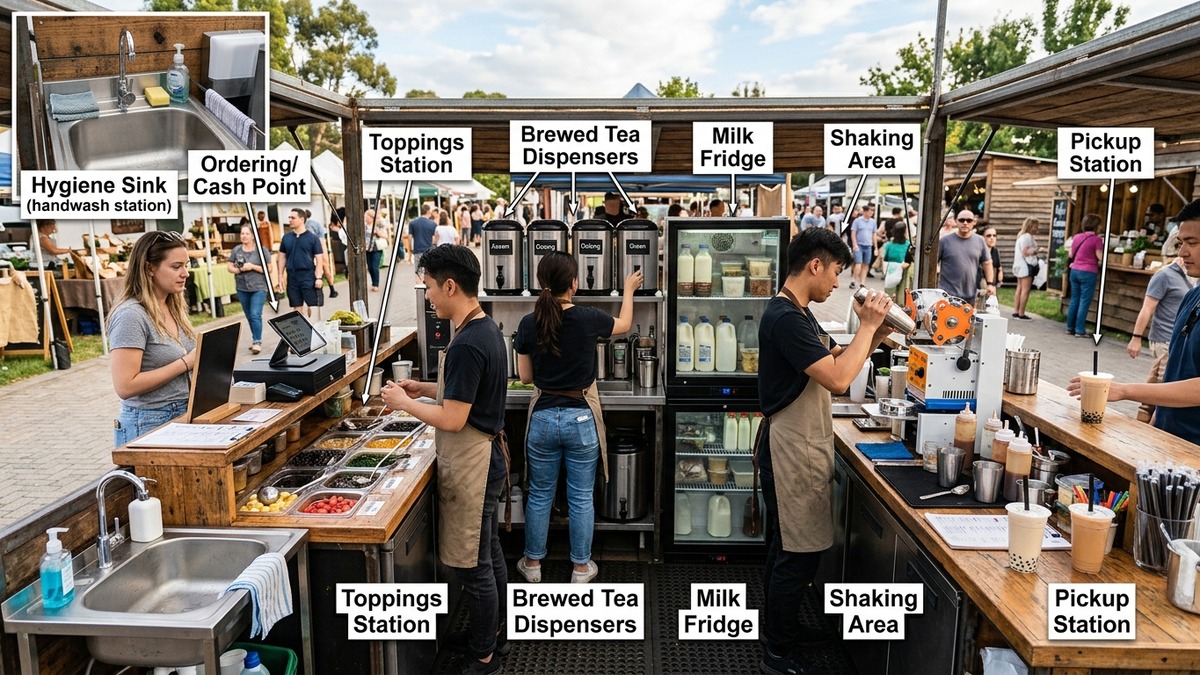
A small stall can use these work areas:
- Order and payment: menu, card reader and order tickets.
- Cup and topping: clean cups, labelled toppings and measuring scoop.
- Tea and syrup: insulated tea containers, pumps and measuring jugs.
- Milk and ice: refrigerated milk, covered ice and separate scoops.
- Shake and finish: closed hand shakers, lids, straws and collection point.
- Hygiene: handwashing, sanitiser, cloth storage, potable water and wastewater.
Leave enough space to separate dirty tools from clean tools. Store chemicals away from ingredients and packaging.
A manual bubble tea service routine
The report proposes a 45-second build. Treat that time as a trial target. Speed depends on the recipe, staff, queue and stall layout.
Before service
- Brew the tested tea bases in approved preparation space.
- Record each batch time and recipe.
- Transfer tea to clean insulated containers or chill it under the approved food-safety plan.
- Cook only the amount of pearls likely to sell within the safe holding period.
- Label milk, syrups, toppings and prepared tea.
- Check the probe thermometer and record storage temperatures.
- Run a cup leak test.
For each order
- Add the measured topping to the cup: The report uses 50 g of pearls as its sample portion, though your recipe and cost sheet should set the final amount.
- Measure tea, syrup, milk or creamer and ice into a shaker.
- Close the shaker and shake for about 10 seconds, or for the tested recipe time.
- Pour the drink without touching the cup rim.
- Fit the lid and wipe the outside of the cup.
- Add the correct straw and call the order. The report specifies a 12 mm straw for tapioca pearls; test the opening against the largest topping you sell.
Keep one clean spare shaker ready. Put used tools into the agreed wash process. Never rinse equipment in the handwashing container.
Brew tea in batches without a tea urn
Insulated drink containers can hold tea for a short service. Brew strength changes with leaf type, water temperature, steep time and dilution. Test the recipe by weight rather than relying on labels such as double strength.
The report suggests a tea-to-water ratio of 1:25. Use that as a test batch, then record the ratio that gives the right flavour after syrup, milk and ice are added.
For example, 40 g of tea with 1 litre of water gives a 1:25 ratio. Strain the leaves at the set time. A long steep can add bitterness and slow service if staff must correct the drink with more syrup.
The report names jasmine, black and Thai tea as its 3 batch bases. Its phrase "3x double-strength tea concentrates" is unclear. Brew each base from a written ratio and record the final dilution. Do not combine a three-times strength claim with a separate double-strength claim unless the tested recipe defines both terms.
Use separate utensils for each tea if flavour transfer matters. Clean and disinfect the containers between batches. Chai bubble tea needs its own spice and allergen checks, while Jasmine Green Tea needs lower brewing temperatures in many recipes.
Cook and hold tapioca pearls safely
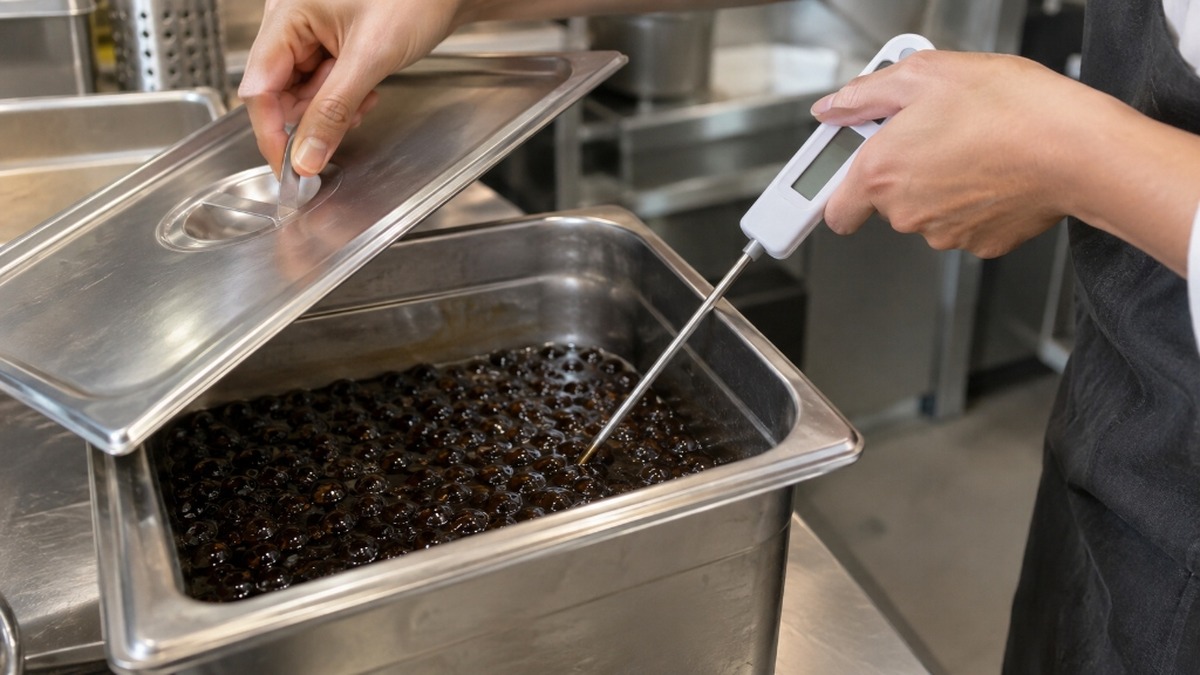
Fresh tapioca pearls have a soft, springy chew often called QQ. Cooked starch changes as it cools, and the pearls can become firm. Long holding can also make the outside too soft.
Sugar syrup slows water loss and adds flavour. The report suggests a syrup near 60° Brix. In a plain sucrose-and-water solution, that is about 60 g of sucrose per 100 g of solution. Other dissolved ingredients can change the reading. Check the pearl maker's directions and test texture across the planned service. A refractometer gives a more useful reading than visual judgment.
Food safety controls the holding plan. Do not assume that warm syrup makes cooked pearls safe.
UK hot-holding rule
UK Food Standards Agency guidance says hot-held food should stay at 63°C or above. If hot food falls below that level, the normal tolerance is a single period of up to 2 hours. After that, follow the approved cooling, reheating or disposal process.
The report recommends a rice cooker on its warm setting at 60°C to 65°C. That range can fall below the UK hot-holding level. Use a calibrated probe, confirm the actual product temperature and agree the method with the local authority. A rice cooker that cannot hold the required temperature is unsuitable for this job.
US time control
The FDA Food Code contains a 4-hour time-as-a-public-health-control option for certain ready-to-eat foods. It requires written procedures, time marking and correct starting conditions. Local adoption varies.
Ask the local health department whether cooked tapioca pearls count as time/temperature control for safety food in your area and whether your process qualifies. Mark every batch and discard it at the approved time.
Quality checks during service
Check a small sample at set times, such as 30, 60, 90 and 120 minutes. Record texture, temperature and waste. Make smaller batches if quality drops before the legal limit. A safety limit is not a freshness promise. Your own quality limit may be shorter.
Keep milk, ice and toppings safe
Keep dairy milk and other foods that need chilling at the temperature set by local law. In England, Wales and Northern Ireland, cold food generally needs to stay at 8°C or below, and many businesses set fridges at 5°C or below to leave a safety margin. Check the rules that apply where you trade.
Use a probe or suitable fridge thermometer. Open cool boxes only when needed, keep them shaded and carry spare ice packs. Do not use drink ice to chill bottles or food containers.
Treat ice as food. Buy it from an approved source or make it from potable water. Store the scoop outside the ice with its handle protected from contact.
Fruit purées, jellies and popping boba need the storage conditions on their labels. Once opened, write the opening date and discard date on each container.
Manage allergens clearly
Milk is a common bubble tea allergen. Other possible allergens include soya, nuts, peanuts, cereals containing gluten and sulphites, depending on the powder, creamer, syrup and topping.
Read the full supplier specification for every ingredient. Product names can be misleading, and recipes can change. Keep an allergen list at the stall and update it when any brand or recipe changes.
For UK non-prepacked food, give allergen information for every item. Written information supported by a staff conversation gives customers a clear way to check. Train staff to avoid guessing.
Cross-contact can happen through scoops, shakers, pumps and cloths. State what your small stall can control. Do not claim a drink is allergen-free unless the full process supports that claim.
Choose cups and lids that do not leak
Snap-on lids remove the need for a cup sealer. Match the lid to the cup manufacturer, rim size and material. Similar-looking parts from 2 suppliers may fit poorly.
Test a sample from every delivery:
- Fill the cup with water and ice to the normal line.
- Fit the lid using the same motion used during service.
- Turn it upside down over a sink for 10 seconds.
- Shake it gently and check the rim.
- Leave a filled cup on its side for 5 minutes.
- Repeat with at least 10 cups from the case.
Use a lid with a wide-straw opening for tapioca pearls. Choose packaging that meets local food-contact rules, and store it covered off the floor.
Work out cost, margin and break-even sales
The report estimates a direct ingredient and packaging cost of $0.75 to $1.10 for a drink sold at $6 to $7.50. Those figures may not match your recipes, supplier terms or market. Calculate each drink from current invoices.
Use this formula:
Example: A drink sells for $6.50 and its tea, milk, syrup, topping, ice, cup, lid and straw cost $1.10.
($6.50 - $1.10) / $6.50 * 100 = 83.1% gross margin
Gross margin differs from profit. The 83.1% figure excludes card fees, labour, stall rent, transport, insurance, licences, cleaning supplies, energy, spoilage and tax.
Calculate contribution per drink after variable selling costs:
Then calculate the number of drinks needed to cover the event:
If the pitch, travel, ice and staff cost $320 and each drink contributes $4.80, the stall needs to sell 67 drinks to cover those event costs. Round up, because you cannot sell part of a drink.
Cost sheet fields
Track these items for every recipe:
- Ingredient pack price and usable amount
- Grams or millilitres used per drink
- Cup, lid, straw and napkin cost
- Expected waste rate
- Card fee
- Selling price
- Tax treatment
- Contribution per drink
Review the sheet whenever a supplier changes its price or pack size.
Plan stock for the event
Start with expected drink sales, then split demand across the menu. Add a small buffer for cups and shelf-stable items. Use tighter limits for milk, brewed tea and cooked pearls because excess stock becomes waste.
For 75 expected drinks, a first draft could be:
- 80 cups, lids and straws
- Tea and syrup for 80 drinks
- Chilled milk for the forecast milk-tea share plus a measured buffer
- Pearls for small batches across the service
- Extra dry pearls stored according to the label
Do not prepare all 75 portions of cooked pearls at opening. Use early sales to guide the next batch. Record sold, wasted and returned stock after each event.
Common manual-stall problems
- Drinks taste different between staff: Use one recipe card, measured pumps and a marked ice scoop. Check pump output at opening.
- Pearls turn hard: Reduce batch size and holding time. Check product temperature, syrup ratio and the pearl maker's directions.
- Pearls become too soft: Cook smaller batches, avoid excessive holding and confirm the cooker is not overheating the outer layer.
- Tea becomes bitter: Weigh the leaves, control water temperature and use a timer. Remove the leaves at the tested steep time.
- Lids pop off: Use cups and lids sold as a matched set. Run the leak test on every new case and stop using damaged rims.
- The queue grows: Reduce custom choices, pre-label cups, keep 2 shakers in service and assign one worker to payment. Record the slowest step before buying a machine.
- Too much stock is left: Cut the next event forecast by the unused percentage. Prepare perishable items in smaller batches.
When should you buy commercial equipment?
Buy a machine after sales records show which manual task limits output or consistency. One busy event can give a false result, so compare several services.
Consider a cup sealer when secure lids slow service or spill rates stay high. Consider an automatic shaker when hand mixing limits orders per hour or causes staff strain. A pearl cooker may suit repeated high-volume batches where temperature and timing records show a clear gain.
Check electrical load, cleaning time, maintenance, spare parts and counter space before buying. The purchase must save more money or time than it costs.
Frequently Asked Questions
Do I need a cup sealing machine to sell boba?
No. A matched cup and snap-on lid can work for a small stall. Test every shipment for leaks and confirm that the packaging is suitable for food use.
How do I keep boba warm at a market?
Use approved hot-holding equipment and check the pearls with a clean probe thermometer. In the UK, hot-held food should generally remain at 63°C or above. If you use time rather than temperature, follow a written method accepted by the local authority.
How much money do I need to start a boba booth?
The report estimates $190 to $350 for core manual tools and suggests a setup under $500 may be possible. Your full opening cost can be much higher once you add permits, insurance, refrigeration, handwashing, stall fees, ingredients and transport.
Can I sell bubble tea from home?
Rules depend on location. In the UK, a home food business must register with the local authority at least 28 days before trading, and the preparation space may be inspected. US cottage-food rules often exclude drinks that need temperature control, so ask the local health department.
Can I sell bubble tea at a farmers market?
Yes, if the organiser accepts the product and you meet local food, trading, insurance and site rules. Get approval before paying for stock.
Do cooked tapioca pearls have a 4-hour limit?
There is no safe universal answer. Some US authorities may allow a 4-hour written time-control process. UK hot-holding guidance uses a temperature above 63°C and a 2-hour tolerance when hot food is held below that level. Confirm how your authority classifies and controls cooked pearls.
Can I use a rice cooker to hold tapioca pearls?
Only if the unit holds the product at the required temperature, can be cleaned safely and is accepted for the site. Check the centre of the pearls with a probe. A warm button does not prove the food is at a safe temperature.
How many bubble tea flavours should a new stall sell?
Start with 3 to 5 drinks. A short menu makes stock, training and allergen control easier. Add a drink after sales data shows demand.
What is the best bubble tea equipment alternative?
For a small trial, a hand shaker gives a direct replacement for an automatic shaker at low cost. Secure snap-on lids can also remove the need for a sealer. The best choice depends on the slowest part of your own service.
How long can brewed tea stay at a stall?
Set the limit through your food-safety plan, supplier guidance and local rules. Label each batch, control its temperature and use a shorter quality limit if the flavour fades.
Sources and Editorial Notes
The equipment comparisons, estimated costs, manual workflow, keyword plan and competitor gaps came from the supplied Deep Research report. Prices and margins are estimates and need current supplier quotes.
- Food Standards Agency (UK): Register a food business.
- Food Standards Agency (UK): Safe hot holding and temperature control.
- GOV.UK: Market stall licence guidance.
- US Food and Drug Administration (FDA): FDA Food Code 2022.
- Food Standards Agency (UK): Allergen guidance for food businesses.
- Food Standards Agency (UK): Chilled food storage principles.


 Badge-157x140.png)
Comments