
Ready-to-Drink Bubble Tea Shelf Life and Storage Guide
Ready-to-drink bubble tea can last for months when a commercial manufacturer uses a suitable recipe, process and sealed package. The exact shelf life appears on the product label.
Some RTD drinks are shelf-stable before opening. Others must stay refrigerated from production to sale. A can, bottle or sealed cup does not become shelf-stable simply because it looks airtight.
After opening, refrigerate the drink if the label directs you to do so. Use the maker's stated time limit. Discard it sooner if it was left warm, handled poorly or shows signs of spoilage.
Quick answer: Many unopened commercial RTD bubble teas carry shelf lives of 9 to 18 months, though products differ. Check the label for storage and date instructions. Refrigerate after opening when directed. Do not use 48 hours as a universal rule unless the manufacturer states it.
Ready-to-drink bubble tea shelf life at a glance
| Product Format | Typical Storage Route | Benchmark Shelf Life | Key Safety & Quality Determinants |
|---|---|---|---|
| Fresh Café Bubble Tea | Served immediately after preparation | 4 to 6 hours | Recipe composition, hygienic handling, ambient holding temp & tapioca retrogradation |
| Refrigerated Fresh Cup | Continuous refrigeration (≤ 4°C) | About 24 hours | Cold-chain continuity, milk fat stability & shop sanitation SOPs |
| HPP Chilled Bottle | Strict cold-chain distribution (≤ 4°C) | 30 to 45 days | High-pressure processing parameters (600 MPa), barrier bottle & cold preservation |
| Retort Canned RTD | Ambient distribution (15°C – 25°C) | 12 to 18 months | Commercial sterility (F0 ≥ 4.0), double seam hermetic seal & heat-stable konjac pearls |
| Aseptic RTD Bottle / Carton | Ambient distribution (15°C – 25°C) | 9 to 12 months | UHT thermal profile (140°C), sterile cleanroom bottling & multi-layer barrier resin |
The timelines above represent commercial manufacturing standards. Always check the specific expiration date and storage instructions printed on the container in your hand.
How long does canned boba last?
An unopened canned boba drink typically carries a best-before or expiration date between 12 and 18 months from its production date. Commercial manufacturers establish this timeline through formal thermal process validation, package barrier stress tests, and real-time incubation studies.
Before purchasing or consuming canned bubble tea, inspect the following packaging points:
- Printed Date Code: Check the base or lid of the can for clear date markings.
- Storage Directions: Confirm whether the label specifies "Shelf-Stable / Store at Room Temperature" or "Keep Refrigerated".
- Lot Batch Code: Traceable production number for manufacturer quality assurance.
- Can Seam & Structural Integrity: Ensure there are no rim dents, droops, score fractures, or pinhole punctures.
- Visual Spoilage Signs: Check for end doming, can bulging, liquid seepage, or corrosion.
- Retail Presentation: If a canned milk tea was merchandised in a chilled dairy case, verify if refrigeration is legally required for that formulation.
Safety Warning: If a canned beverage label directs "Keep Refrigerated", storing it at room temperature is unsafe even before the can is opened.
Does canned bubble tea expire?
Yes. Every commercial food and beverage product carries mandatory date labelling tailored to its target regulatory market.
A "Best-Before" date indicates the timeframe during which the manufacturer guarantees peak flavor, aroma, color, and pearl texture. A "Use-By" date governs microbiological food safety in jurisdictions such as the UK and EU. Never assume a canned drink is safe past its expiration date simply because the external metal shell appears intact.
Shelf-stable and refrigerated RTD drinks
A beverage is truly shelf-stable only when its formulation, thermal processing schedule, and hermetic packaging have been scientifically validated to prevent microbial pathogen growth under ambient warehouse conditions.
In contrast, refrigerated RTD drinks rely on pasteurisation or High-Pressure Processing (HPP) combined with an unbroken cold chain (2°C – 4°C). Retailers must never move refrigerated RTD drinks to ambient grocery shelves, and consumers should never assume ambient stability for unlabelled products.
Ambient storage parameters
Ambient storage does not mean uncontrolled extreme temperatures. Warehouses, distributors, and retail stockrooms should maintain canned stock within 15°C to 25°C (59°F – 77°F). Sustained exposure to heat above 35°C degrades tea catechins, hydrolyzes milk proteins, accelerates tinplate/can corrosion, and softens internal can liners.
How commercial sterilisation works
Commercial sterilisation applies thermal heat to destroy all pathogenic organisms—specifically heat-resistant bacterial spores such as Clostridium botulinum—and spoilage organisms capable of growing under expected non-refrigerated distribution conditions.
Commercial sterility does not mean absolute chemical sterility (the destruction of every single living microbe). Rather, it guarantees that surviving extremophile spores cannot germinate, grow, or produce toxins during ambient product life.
Retort processing for bubble tea
Retort processing functions like an industrial autoclave, subjecting sealed cans or retort-grade pouches to saturated steam or pressurized hot water under precise time-temperature recipes.
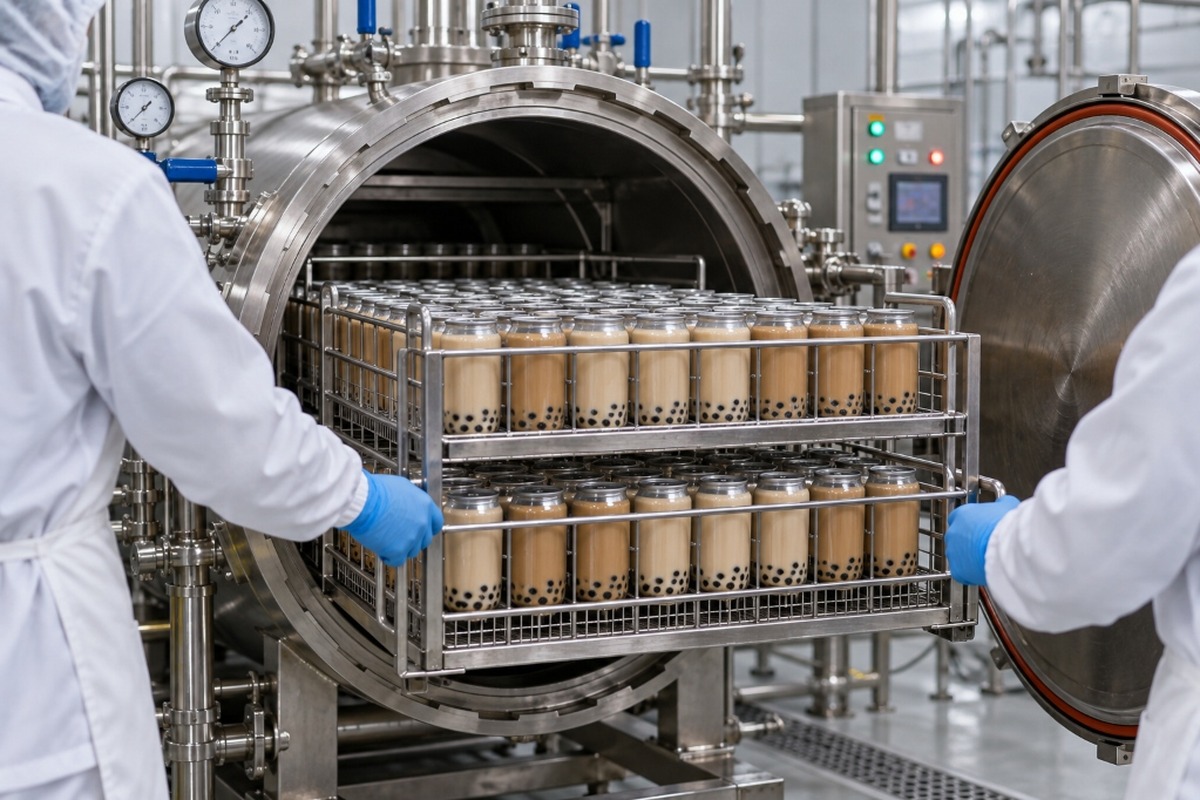
A commercial retort processing sequence involves 8 controlled stages:
- Tea Base Formulation: Blending brewed tea extract, dairy/non-dairy creamer, sweeteners, and pH stabilizers.
- Inclusion Dosing: Adding volumetric portions of heat-tolerant konjac pearls or jelly cubes.
- Container Filling: Metering liquid with strict headspace control.
- Headspace Deaeration: Liquid nitrogen dosing to displace oxygen.
- Hermetic Double Seaming: Interlocking can body flange and end with 5 layers of metal.
- Overpressure Retorting: Heating under counter-pressure (typically 121.1°C at ~15-20 psi for 15 to 22 minutes).
- Cascade Water Cooling: Rapidly chilling packages below 40°C to halt thermal degradation.
- Drying, Coding & Incubation Quarantine: Drying cans, laser-etching lot codes, and holding lots for quality release.
Aseptic filling and UHT processing
In an aseptic manufacturing system, the beverage liquid and the packaging containers are sterilized independently before being married in a sterile cleanroom environment.
The liquid undergoes Ultra-High Temperature (UHT) continuous-flow thermal treatment (typically 138°C – 145°C for 4 to 10 seconds), followed by rapid flash cooling. The sterile liquid is then filled into pre-sterilized PET bottles, aluminium cans, or multi-layer aseptic cartons (Tetra Pak) and sealed hermetically without post-packaging cooking.
F0 lethality values and food safety
The thermal lethality of a commercial heat process is quantified by its F0 value—the equivalent time in minutes at 121.1°C (250°F) delivered to the slowest-heating cold spot inside the container.
Because milk bubble tea is a low-acid food (pH > 4.6), international food safety regulations mandate a minimum thermal process delivering a 12-log reduction (12D) of Clostridium botulinum spores, requiring an F0 value of at least 3.0 to 4.5 minutes. Process authorities calculate exact F0 targets based on can geometry, product viscosity, and heat penetration curves.
Water activity and pH in canned boba
Food preservation science classifies beverages based on equilibrium acidity and free water availability:
- pH (Acidity): Milk teas generally register a neutral pH of 6.2 to 6.8 (low-acid food), requiring full retort or aseptic processing. Acidified fruit bubble teas (pH ≤ 4.6) can utilize milder hot-fill pasteurisation.
- Water Activity (aw): Ready-to-drink bubble tea exhibits a high water activity (aw > 0.98), providing an optimal environment for microbial proliferation if thermal sterilization is incomplete.
Double seams and hermetic seals
Aluminium beverage cans rely on a mechanical double seam to form a hermetic, airtight barrier against environmental bacteria, yeasts, and molds. A sound seam interlocks five metal folds, compressed with sealing compound.
Can seam quality control requires regular optical and mechanical teardown measurements, evaluating seam width, seam thickness, body hook, cover hook, countersink depth, and percentage overlap (≥ 70%). For an in-depth packaging comparison, explore our guide on Bubble Tea Cups vs Cans vs Bottles.
Residual oxygen and nitrogen dosing
Oxygen trapped in the can headspace accelerates polyphenol oxidation, degrades milk lipids, and browns tea pigmentation over time. Commercial canning lines deploy automated liquid nitrogen dosing just before seaming. A cryogenic droplet of liquid nitrogen vaporizes rapidly into gaseous nitrogen, expanding 700-fold to purge ambient oxygen and pressurize the can to under 1.5% residual oxygen.
Cooling and thermophilic spoilage
Following retort cooking, cans must be quickly cooled with chlorinated water to below 40°C (104°F). Rapid cooling prevents heat-induced flavour degradation and prevents the germination of heat-resistant thermophilic spores (such as Geobacillus stearothermophilus), which thrive in warm environments between 45°C and 65°C.
Why RTD products use konjac or popping boba
Traditional cassava starch tapioca pearls cannot survive commercial retort heat or extended liquid storage. Under 121°C retort temperatures, starch granules rupture completely, turning into a gelatinous, disintegrated sludge. During prolonged ambient storage, residual starch undergoes retrogradation, recrystallizing into hard, chalky lumps.
To deliver an authentic boba experience in shelf-stable packaging, food scientists formulate with heat-tolerant alternative inclusions:
- Konjac Glucomannan (Crystal Boba): Plant-derived konjac fiber de-acetylated with calcium hydroxide forms a rigid, thermo-irreversible gel that withstands retort sterilization and maintains its snappy, bouncy chew for over 18 months.
- Popping Boba: Juice pearls encapsulated in a calcium alginate gel membrane that resist dissolving in chilled or mild-processed fruit teas.
- Nata de Coco: Fermented bacterial cellulose cubes with exceptional heat stability and fibrous chew.
- Grass Jelly & Aiyu Jelly: Pectin and herbal gel extracts formulated for thermal canning stability.
High-pressure processing (HPP)
High-Pressure Processing subjects flexible plastic bottles of bubble tea to hydrostatic pressures up to 600 MPa (87,000 psi) in chilled water. HPP inactivates vegetative pathogens and spoilage enzymes without heat, preserving raw tea aroma and fresh milk taste. However, HPP cannot destroy bacterial endospores; therefore, all HPP bubble tea products require continuous refrigeration (2°C – 4°C) and carry a 30-to-45-day shelf life.
Quality control and incubation testing
Commercial beverage co-packers validate shelf stability through rigorous microbiological sampling and incubation holds:
- Incubation Holds: Random samples from each production lot are held in climate chambers at 37°C (98.6°F) for 14 days and inspected for can swelling or pH drops.
- Microbiological Testing: Standard specifications require total aerobic plate counts < 10 CFU/ml with zero detectable coliforms, yeasts, or molds.
FIFO warehouse storage and rotation
Warehouses and retail stockrooms must enforce strict First-In, First-Out (FIFO) stock rotation:
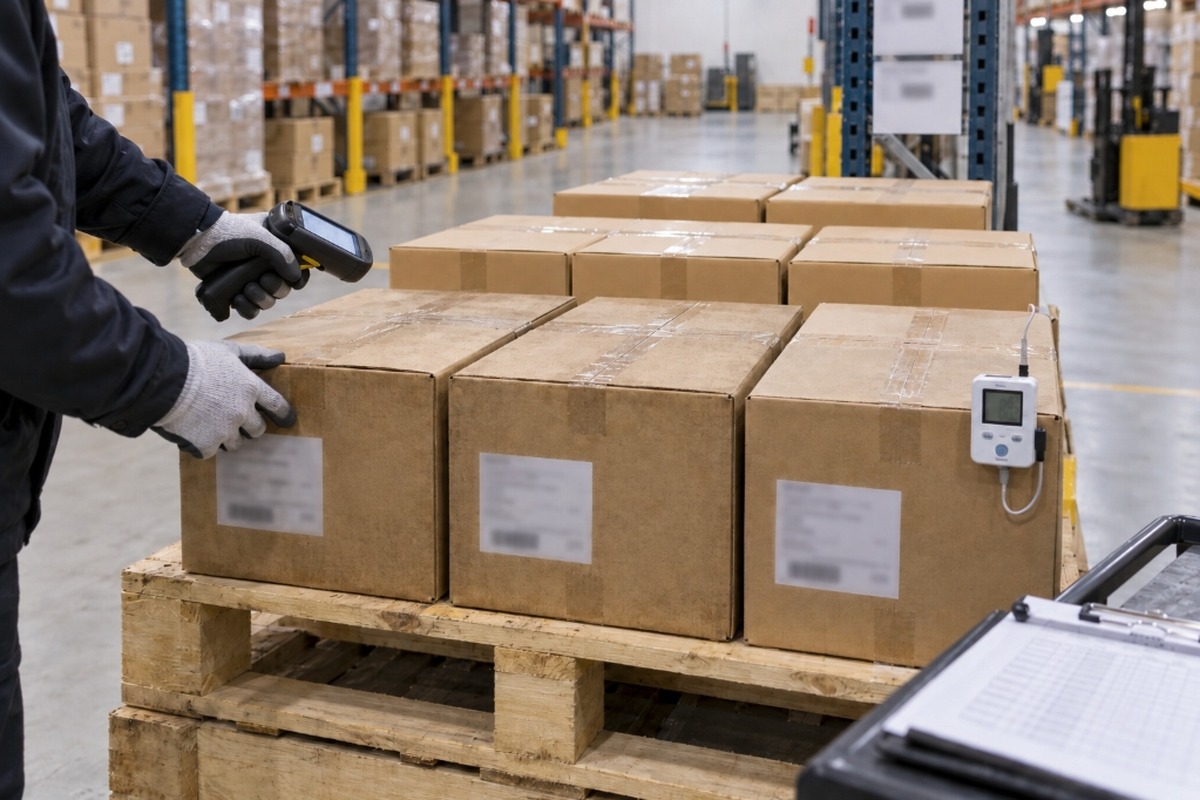
For supermarket and convenience store merchandising best practices, review our detailed guide on Bubble Tea Retail Merchandising.
What happens after opening?
Once the hermetic double seam or bottle cap seal is broken, the beverage is immediately exposed to ambient air, airborne molds, and environmental bacteria. Opened canned bubble tea must be refrigerated immediately at 4°C or below and consumed within 24 to 48 hours. Never drink directly from a can if you plan to store the remaining liquid.
How to spot spoiled canned bubble tea
Never taste a beverage to test its safety. Examine the container and liquid for these critical spoilage indicators:
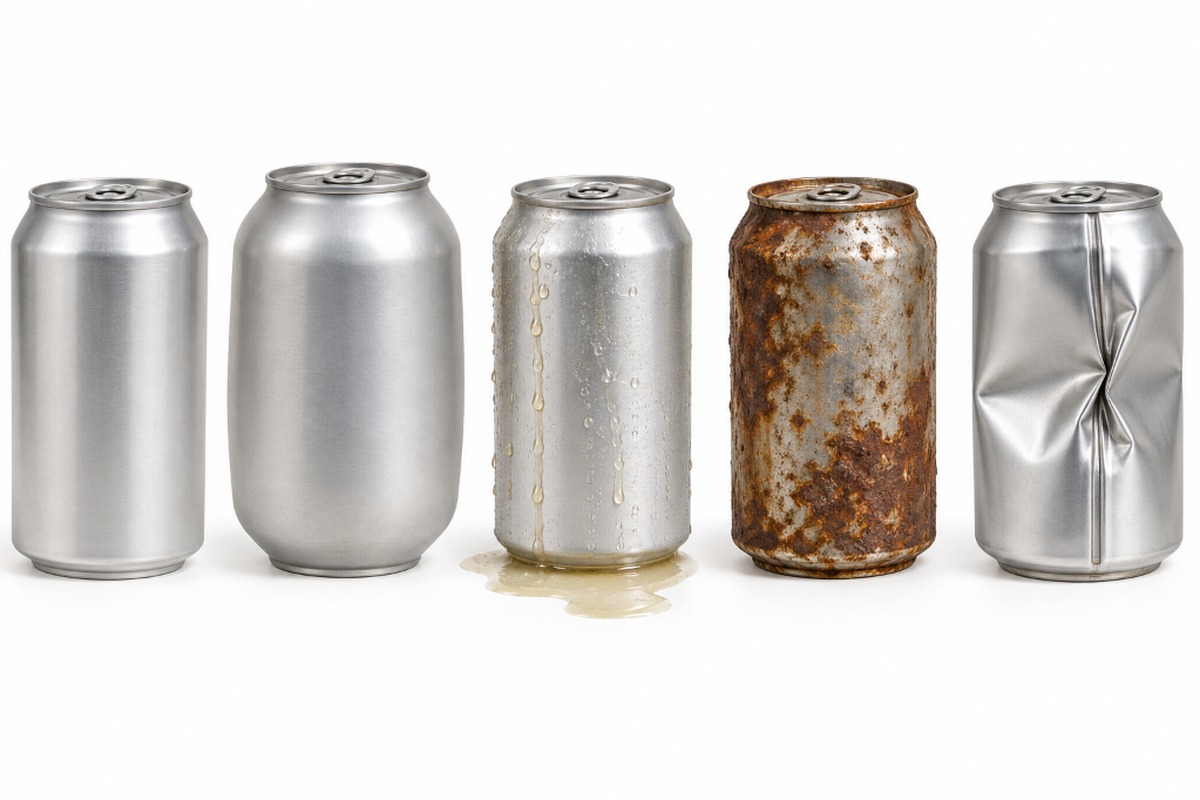
- Can Bulging / Swelling: Domed ends caused by bacterial gas production (carbon dioxide or hydrogen).
- Seam Leakage or Pinhole Weeping: Sticky syrup residues around the top rim or side seam.
- Deep Seam Dents: Impact dents that deform the double seam and allow micro-air ingress.
- Violent Hissing or Foaming on Opening: High internal pressure release in non-carbonated drinks.
- Milk Curdling or Clumping: Acid coagulation or protein separation forming solid white curd.
- Sour, Putrid or Chemical Odour: Off-aromas indicating microbiological spoilage.
Retailer shelf-life verification checklist
Supermarket category buyers and beverage distributors should demand the following technical documentation prior to onboarding any RTD bubble tea brand:
- Official Process Authority Scheduled Process Letter (FDA 21 CFR Part 113 / FCE-SID filing)
- Third-party real-time and accelerated shelf-life stability test reports
- Complete double seam inspection reports and can liner compatibility certification (BPA-NI)
- Nutritional panel verification and verified allergen statement
- Product recall protocol and lot traceability system documentation
Frequently asked questions
How long does ready-to-drink bubble tea last?
Unopened commercial retort-canned bubble tea lasts 12 to 18 months at room temperature. Aseptic bottles last 9 to 12 months, HPP chilled bottles last 30 to 45 days, and fresh café bubble tea should be consumed within 4 to 6 hours.
How long does canned boba last after opening?
Once opened, canned bubble tea must be refrigerated at or below 4°C and consumed within 24 to 48 hours. Discard immediately if left at room temperature or if curdling occurs.
Does canned bubble tea need refrigeration before opening?
Shelf-stable retort-processed canned bubble tea does not require refrigeration before opening. However, pasteurised or HPP-processed drinks do require continuous refrigeration. Check the container label.
Can you drink canned bubble tea past its expiration date?
Never consume products past a strict "Use-By" date. If past a "Best-Before" date, inspect for can doming, leaks, rust, or dents. If any defect is present, discard the product immediately.
Why does canned bubble tea say refrigerate after opening?
Opening the hermetic seal breaks the sterile barrier, allowing environmental microbes and air into the nutrient-rich milk tea. Refrigeration slows bacterial multiplication and prevents rapid spoilage.
Is canned bubble tea sterile?
Canned bubble tea is commercially sterile, meaning all microorganisms and heat-resistant bacterial spores capable of growing under ambient storage conditions have been destroyed.
Why does RTD boba use konjac pearls instead of tapioca?
Traditional cassava pearls disintegrate under high retort temperatures and harden during storage. Konjac glucomannan pearls are heat-stable and retain their firm, chewy texture throughout an 18-month shelf life.
Can canned bubble tea spoil before its expiration date?
Yes. Micro-fractures in the double seam, rough transit drops, extreme warehouse heat (> 35°C), or defective can liners can compromise seal integrity and cause premature spoilage.
What temperature should canned boba be stored at?
Unopened shelf-stable canned boba should be stored in a cool, dry warehouse between 15°C and 25°C (59°F – 77°F), away from direct sunlight, moisture, and extreme temperature fluctuations.
Does canned bubble tea require added chemical preservatives?
No. Retort and aseptic thermal processing achieve long-term shelf stability through heat sterilization and airtight packaging alone, eliminating the need for added chemical preservatives.
Sources and regulatory standards
This technical food safety and shelf-life guide references thermal processing regulations and packaging standards from the following authorities:


 Badge-157x140.png)
Comments