
Bubble Tea Retail Merchandising for Supermarkets & C-Stores
Bubble tea retail merchandising should make the product easy to notice, easy to identify and easy to drink. For canned boba, the store also needs to show shoppers that pearls are inside the can and give them a practical way to drink them.
Quick answer: Bubble tea retail merchandising should place ready-to-drink products where shoppers can see them easily, usually at eye or arm level, with clear shelf signs and enough facings. For canned boba, add a suitable wide straw and test secondary placement near grab-and-go food.
Refrigerated single-serve cans, eye-level cooler positions, high-visibility point-of-sale callouts, wide boba straws, and secondary merchandising near fresh grab-and-go lunch food drive category velocity. Retail research supports using eye-level placement, multiple facings, shelf signs, and cross-promotions to maximize product discovery and basket size.
This guide is for supermarket category buyers, convenience-store operators, grocery beverage directors, and retail distributors planning high-velocity ready-to-drink (RTD) bubble tea assortments.
Put the main range where shoppers can see it
The standard cooler strike zone spans 48 to 60 inches from the retail floor. This eye-level and arm-level band represents the primary visual focal point for supermarket and c-store shoppers. While cooler dimensions, fixture depths, and customer demographics vary across store formats, positioning ready-to-drink bubble tea within this prime field of view ensures immediate product discovery.
Use the 48-to-60-inch range as a baseline placement test. Audit weekly sales velocity, rate of sale per facing, and out-of-stock frequency before establishing permanent corporate planograms.
Supermarket boba display planogram
A standard 30-inch glass-door supermarket beverage cooler typically features a 5-shelf layout. Positioning the core bubble tea assortment on the central middle shelf (Shelf 3) captures shopper eye lines, while secondary tea blends and multipacks occupy surrounding tiers.
| Shelf Tier | Height from Floor | Merchandising Role & Category Assortment |
|---|---|---|
| Shelf 1 (Top) | 68 to 72 in | Premium or specialty bottled organic teas & niche single-origin infusions |
| Shelf 2 (Upper Eye) | 58 to 64 in | Cold brew coffees, RTD matcha lattes, and functional iced tea beverages |
| Shelf 3 (Prime Strike Zone) | 48 to 56 in | Core Bobalicious RTD Brand Block with side-mounted wide boba straw clip strip |
| Shelf 4 (Lower Reach) | 36 to 44 in | Secondary fruit tea flavours, seasonal LTOs, and complementary milk tea varieties |
| Shelf 5 (Base) | 18 to 32 in | Multipacks (4-packs / 6-packs), larger take-home cartons, and bulk multi-buys |
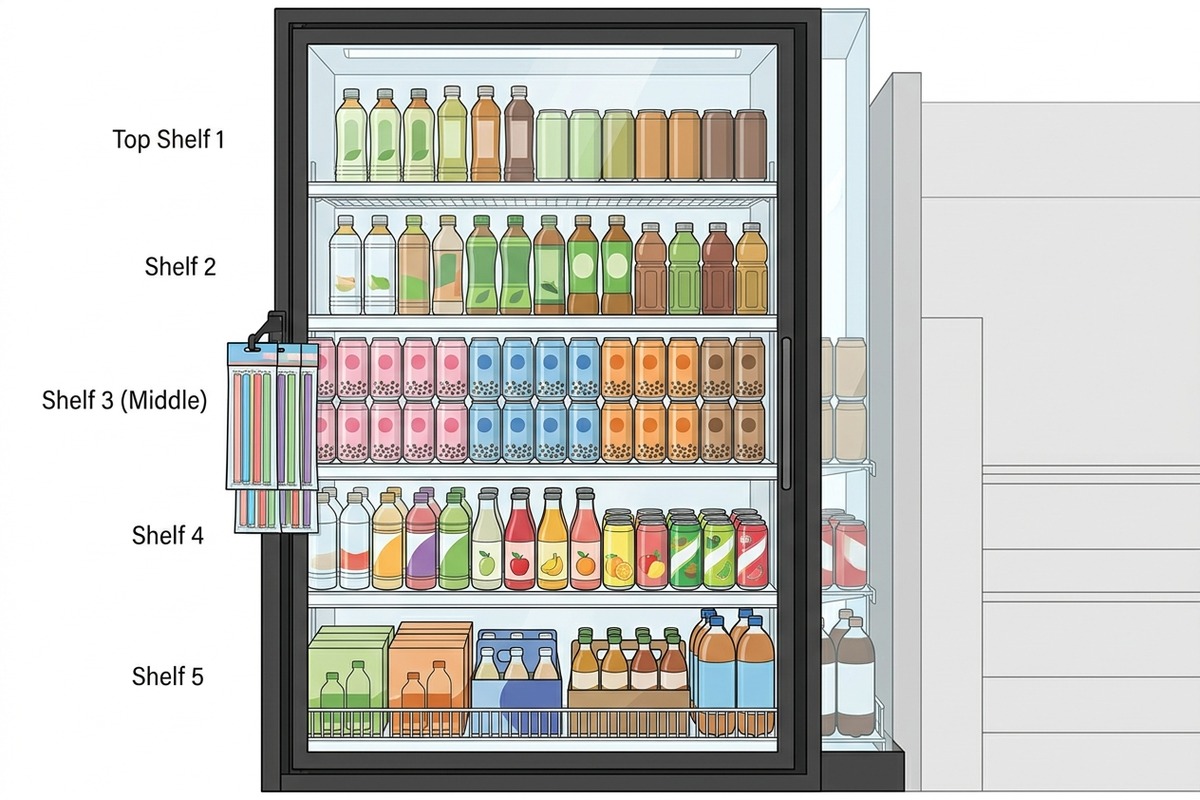
In a standard 30-inch door set, allocate 3 facings to top-selling Brown Sugar Milk Tea, and 2 facings each to high-demand secondary SKUs like Taro Milk Tea and Mango Green Tea. Category analytics from NielsenIQ demonstrate that allocating shelf share proportionally to SKU velocity minimizes stockouts and maximizes gross margin return on space.
Use facings to build a clear brand block
A facing represents a single front-facing product line visible to the shopper. Merchandising bubble tea with at least 2 to 3 facings per SKU creates a cohesive "brand billboard" that arrests visual attention in high-traffic beverage aisles.
Supermarket retail studies confirm that brand blocking improves shopper find-time and reduces aisle abandonment. Review facing allocations every 30 days: expand shelf allocation for top-performing lines experiencing out-of-stocks, and compress underperforming varieties.
C-store boba placement in the cold vault
Convenience stores thrive on rapid impulse transactions. The path from cooler door discovery to checkout register is often under 90 seconds. To maximize c-store velocity:
- Position single RTD boba cans in the central refrigerated cold vault alongside cold brew coffees and premium energy drinks.
- Ensure price tags and flavor callouts are prominently displayed on shelf-edge channel strips.
- Provide integrated straw access immediately adjacent to the product.
- Cross-merchandise near the fresh bakery or morning coffee counter to capture breakfast commuters.
Move RTD bubble tea beyond one specialty aisle
Historically, canned bubble tea was relegated to ambient international food aisles. However, modern consumer buying habits treat RTD bubble tea as an immediate-consumption cold refreshment.
While ambient specialty aisles remain effective for pantry-stocking multipacks and DIY kits, the primary single-serve RTD product must be positioned inside the main refrigerated beverage cooler alongside ready-to-drink coffees, kombuchas, and iced teas where mainstream consumers actively search for cold drinks.
Solve the opaque-can problem at the shelf
Aluminium cans provide superior light and oxygen barriers, but they hide the beverage's visual signature: the chewy boba pearls. A first-time shopper unfamiliar with canned bubble tea may hesitate if they cannot see what is inside.
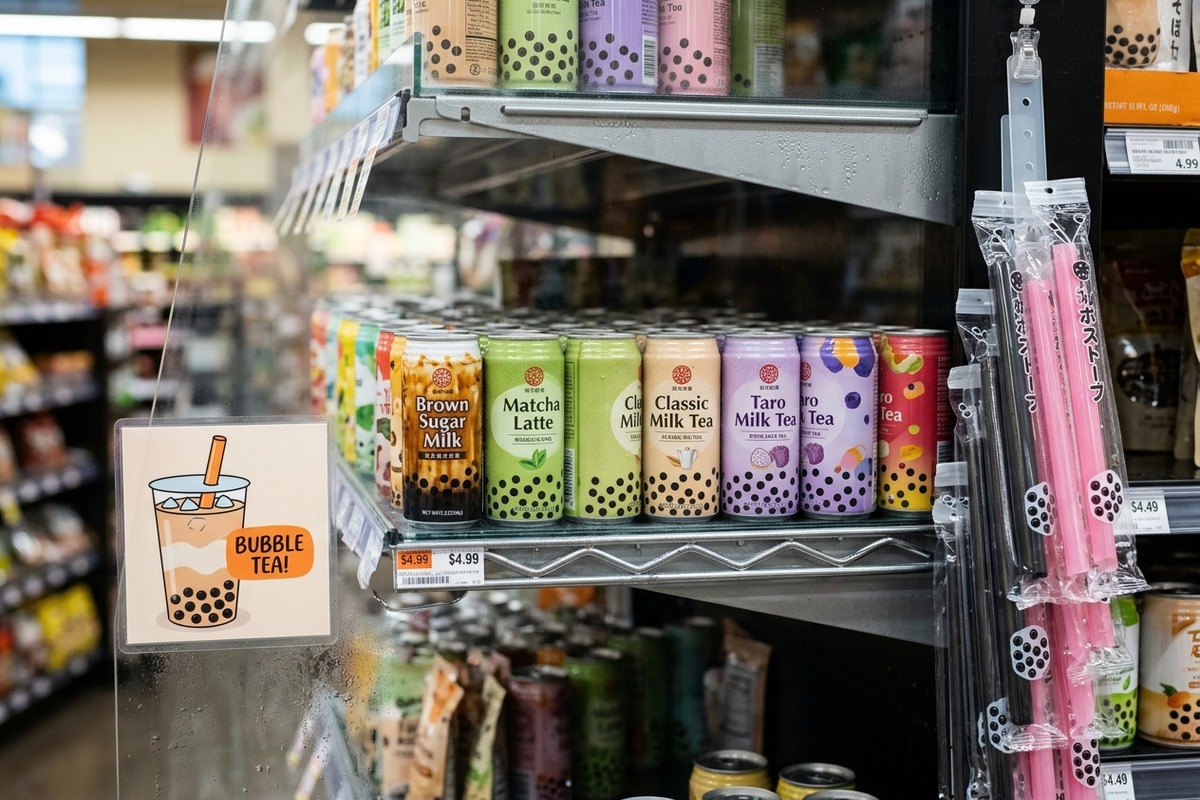
Eliminate consumer purchase hesitation by deploying clear shelf-edge communication:
- Cutaway Drink Graphic: Display a full-color cross-section illustration showing the rich tea layer and boba pearls at the base.
- Serving Instructions: Add a brief "Shake Gently & Sip with Wide Straw" prompt.
- Topping Callout: Explicitly state the inclusion type (e.g., "Real Brown Sugar Pearls Inside" or "Popping Boba Inclusions").
Make the straw easy to find
Canned bubble tea cannot be consumed properly through standard 6 mm beverage straws. Customers require a 12 mm wide-bore boba straw to draw up pearls, jellies, and popping boba without blockage.
Retailers should provide individually wrapped 12 mm boba straws attached via an on-pack straw tape, or suspended directly on a clip strip hanging from the shelf edge adjacent to the cans. Forcing customers to search across different aisles for a compatible straw directly depresses repeat purchase rates.
Cross merchandise bubble tea with grab-and-go food
Secondary chilled placement pairs ready-to-drink bubble tea with high-affinity grab-and-go lunch items. In grocery supermarkets and urban convenience stores, placing a secondary refrigerated endcap or wire basket display next to fresh sushi counters, salad bars, and deli bento boxes drives incremental impulse sales.
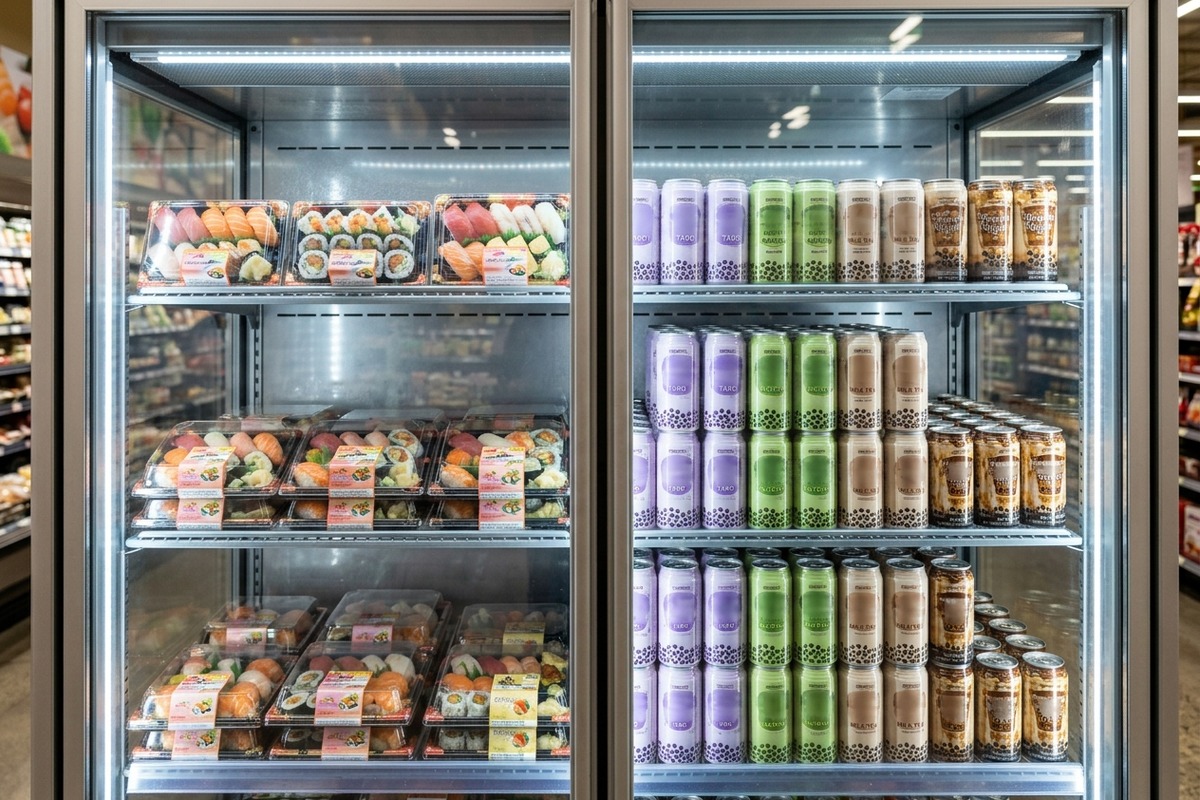
Track retail scanner basket data to measure cross-merchandising performance across these key lunch pairings:
- Fresh Supermarket Sushi Sets: High demographic overlap among Gen Z and millennial shoppers.
- Bakery & Pastry Cases: Sweet milk teas paired with afternoon snacks and pastries.
- Hot Food & Delicatessen Counters: Refreshing fruit teas paired with savoury fried chicken or noodles.
- Asian Snack Displays: Endcap bundles featuring popular crackers, chips, and snacks.
Refrigerated singles and ambient multipacks serve different jobs
Retailers should execute a dual-placement strategy when product formulation allows ambient storage:
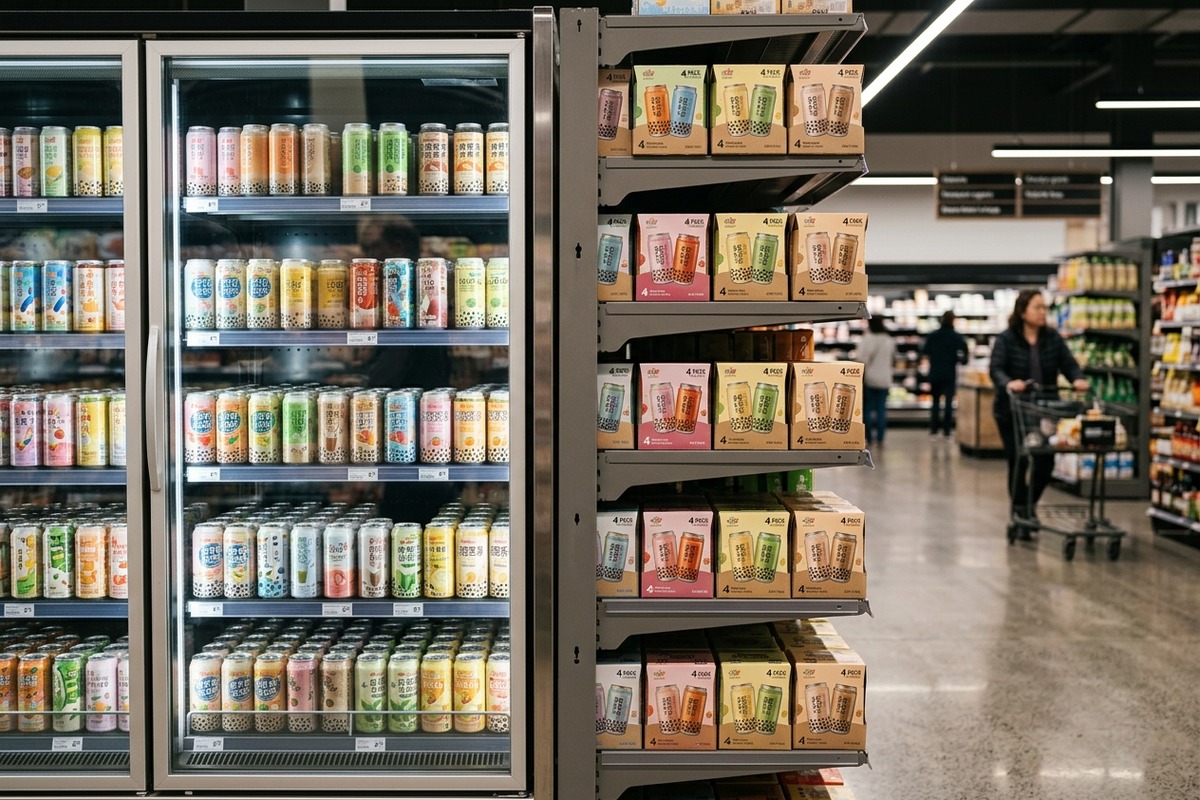
- Chilled Singles (Front-of-Store Cooler): Cater to immediate impulse consumption, single-serve meal deals, and on-the-go refreshment.
- Ambient Multipacks (Centre-Store Beverage Aisle): Cater to weekly family grocery shopping, bulk pantry stocking, and home entertaining at a lower cost per ounce.
Important Storage Rule: Always adhere to on-pack manufacturer storage requirements. If a dairy milk tea formulation requires continuous refrigeration (2°C – 4°C), never merchandise it in ambient aisles.
Retail channel playbook
Optimize your merchandising strategy based on the specific retail format and customer purchase mission:
| Retail Channel | Primary Cooler Placement | Secondary Test Location | Primary Shopper Mission |
|---|---|---|---|
| Convenience Store (C-Store) | Main cold beverage vault (Shelf 3) | Coffee station counter or hot food bar | Fast impulse grab-and-go drink purchase |
| Supermarket / Grocery | Main chilled specialty beverage cooler | Fresh sushi bar or prepared deli grab-and-go | Lunch meal add-on & pantry multipack purchase |
| Asian / Specialty Grocery | Chilled drinks cooler & front endcap | Snack aisle & instant noodle section | Brand exploration & high-volume bulk purchase |
| University / Campus Store | Front checkout grab-and-go chiller | Bento cooler & library study snack rack | Between-class treat & late-night study energy |
A 4-step store setup
Implement this standard 4-step operational routine when onboarding a new retail account:
| Step | Action Item | Execution Standard |
|---|---|---|
| 1. Shelf Placement | Set the main RTD brand block near eye level | Target 48 to 60 inches from the floor on Shelf 3 |
| 2. Facing Allocation | Give lead SKUs proportional shelf presence | Allocate 3 facings to top seller, 2 facings to secondary flavours |
| 3. Straws & Signage | Provide clear shelf talkers and wide boba straws | Mount 12 mm wrapped boba straws on side clip strip beside shelf sign |
| 4. Secondary Display | Establish cross-merchandising location | Deploy secondary chilled display beside sushi, deli bento, or bakery |
Measure the display with store data
Planograms should be dynamic and data-driven. Regularly audit point-of-sale scanner metrics to refine shelf allocations:
- Unit Sales Velocity by SKU: Identify high-velocity flavours versus slow-moving lines.
- Rate of Out-of-Stock Days: Eliminate lost revenue caused by insufficient facing depth.
- Secondary Display Lift: Compare unit movement in main coolers versus cross-merchandised grab-and-go displays.
- Basket Attachment Rate: Evaluate the percentage of transactions where bubble tea is purchased alongside fresh food.
Run test planograms for a minimum of 4 to 6 weeks to capture normalized weekly purchasing cycles before finalizing shelf resets.
How packaging changes the retail display
Different container formats require tailored merchandising strategies. Cans offer light protection and compact pallet stacking but need shelf-edge illustration. Bottles provide high clarity and screw-cap resealability. Sealed plastic cups provide the traditional café look but require careful handling during transport.
For a complete technical breakdown of beverage containers, read our comprehensive guide on Bubble Tea Cups vs Cans vs Bottles. If you are exploring automated 24/7 retail models, review our operational guide to the Bubble Tea Vending Machine Business.
Retail support Bobalicious provides
To support wholesale retail partners and supermarket category buyers, Bobalicious provides a complete retail merchandising onboarding kit:
- Pre-configured 3-shelf, 4-shelf, and 5-shelf cooler planograms (.PDF & .CAD)
- High-resolution shelf-talker artwork with cutaway ingredient illustrations
- Individually wrapped 12 mm boba straws and clip-strip merchandising hardware
- Barcoded outer case packaging (SRP - Shelf Ready Packaging) for rapid shelf stocking
- Temperature monitoring and cold-chain compliance documentation
Frequently asked questions
Where should ready-to-drink bubble tea sit in a supermarket?
RTD bubble tea should be merchandised in the main chilled specialty beverage cooler at eye or arm level (48 to 60 inches from the floor). Retailers should also test secondary chilled placement near grab-and-go deli food or sushi bars.
Should bubble tea stay in a specialty international food aisle?
Single-serve RTD cans should be placed in mainstream chilled beverage coolers where consumers look for immediate refreshment. Ambient specialty aisles are better suited for bulk multipacks and DIY kits.
Should bubble tea be sold refrigerated or ambient?
Always follow the manufacturer's storage instructions. If the product is shelf-stable, merchandise chilled singles for immediate consumption and ambient multipacks for take-home grocery baskets.
How many facings should each bubble tea flavour receive?
A recommended baseline is 3 facings for top-selling lead SKUs (such as Brown Sugar Milk Tea) and 2 facings each for secondary varieties. Adjust allocations based on scanner sales velocity and out-of-stock rates.
What shelf height should a retailer test for bubble tea?
Retailers should test a height range of 48 to 60 inches from the floor (Shelf 3 in a 5-shelf cooler), aligning directly with natural adult eye level and reach zones.
Should a retailer prioritize Shelf 3 or Shelf 4?
Prioritize physical sight line over shelf numbers. Shelf 3 at 48 to 56 inches is optimal for lead SKUs, while Shelf 4 at 36 to 44 inches is suitable for secondary varieties.
What should a canned boba shelf sign show?
Shelf signage should feature a cutaway drink illustration showing the pearls inside, clearly state the flavour profile, and provide a gentle shake-and-sip instruction.
What straw size must be provided for canned bubble tea?
A 12 mm wide-bore boba straw is required to draw up tapioca pearls, popping boba, and jellies smoothly. Provide wrapped straws on on-pack tape or adjacent clip strips.
How should bubble tea be cross-merchandised with food?
Cross-merchandise chilled bubble tea beside prepared sushi, fresh deli sandwiches, Asian snacks, and bakery items to drive meal-deal basket attachment.
What metrics should category managers track after a planogram reset?
Track SKU unit velocity, sales per facing, out-of-stock frequency, secondary display volume, and cross-purchase basket attachment rates to continuously optimize space allocation.
Sources and industry references
This retail merchandising guide references grocery merchandising methodologies and consumer behavior research from the following industry sources:
- Foster GD et al. Placement and promotion strategies to increase sales of healthier products in supermarkets. American Journal of Clinical Nutrition.
- Kraak VI et al. Influence of Food and Beverage Companies on Retailer Marketing Strategies and Consumer Behavior. International Journal of Environmental Research and Public Health.
- NielsenIQ (NIQ). Shelf Space Optimization and Category Management Best Practices for SMB CPG Brands.
- Harris E et al. Beyond bundles: Choosing product bundles increases shopping basket size. Journal of Retailing and Consumer Services.


 Badge-157x140.png)
Comments