
Bubble Tea Vending Machine Guide: Cost, Profit and Setup
A bubble tea vending machine can sell packaged drinks or prepare drinks inside an automated kiosk. The choice affects cost, labour, cleaning, permits, utilities and product range.
A chilled machine for cans and bottles is usually simpler to run. A robotic kiosk can mix fresh drinks and give customers more choices, though it needs more equipment, daily food work and technical support.
Sales depend on the location and offer. A busy site can still fail if rent is high, drinks expire, the machine goes offline or customers cannot collect their orders.
Quick answer: A chilled packaged-drink vendor may cost about $4,500 to $9,500, based on the report. A robotic bubble tea kiosk may cost $35,000 to $75,000 or more. These are planning ranges. Buyers need current quotes, local permits, product tests and a location sales forecast before investing.
What is a bubble tea vending machine?
A bubble tea vending machine sells tea drinks without a staff member taking each order. Machines fall into 2 broad groups:
- Refrigerated packaged vendor: Stores pre-sealed cans, bottles or cups prepared off-site.
- Robotic fresh-drink kiosk: Stores bulk raw ingredients and prepares/mixes custom drinks on demand after payment.
The first model operates much like chilled convenience retail. The second model operates closer to a compact automated food-service kiosk. Both require regular restocking, sanitisation, technical repairs, payment gateway processing and customer support, though the operational labour volume differs substantially.
Packaged RTD vendor vs robotic boba kiosk
RTD means ready to drink. An RTD vending machine dispenses pre-packaged, pre-labelled, and sealed drinks that arrive fully finished from a central commissary or certified co-packer.
A robotic kiosk brews or dispenses concentrated tea bases, blends dairy or plant milks and flavoured syrups, portions ice cubes, and dispenses toppings into cups. Advanced kiosks often utilize a multi-axis robotic arm with sanitary peristaltic dosing pumps. A peristaltic pump transfers liquid by squeezing flexible silicone tubing, preventing beverage contact with mechanical pump gears. Other systems deploy servo conveyors, volumetric rotary valves, and pneumatic cup cappers.
| Decision Point | Chilled Packaged RTD Vendor | Robotic Fresh-Drink Kiosk |
|---|---|---|
| Product Type | Sealed cans, bottles or film-sealed cups | Fresh drinks mixed to order inside the unit |
| Report Cost Range | $4,500 to $9,500 | $35,000 to $75,000 or more |
| Footprint / Floor Space | 8 to 12 sq ft | 25 to 45 sq ft |
| Example Electrical Supply | 110 V, 15 A standard circuit | 220 V, 30 A dedicated high-current circuit |
| Water Connection | Often unnecessary for sealed products | Potable water inlet + direct drainage required |
| Daily Food Work | Limited (restocking & exterior wipe-down) | Extensive (ingredient loading, CIP line flush & waste disposal) |
| Typical Dispense Time | 8 to 12 seconds per transaction | 60 to 90 seconds per transaction |
| Machine Holding Capacity | 240 to 380 finished packs | 150 to 250 servings before replenishment |
| Menu Flexibility | Limited to stocked packaged SKUs | High customisation (sweetness, ice & topping levels) |
| Primary Operational Risk | Cabinet refrigeration failure & spiral/tray jams | Food safety compliance, dosing nozzle clogs & mechanical breakdowns |
The figures above represent planning benchmarks from industry reports. Exact dimensions, utility draws, holding capacities, and pricing will vary based on manufacturer specifications and location requirements.
Canned bubble tea vending machines
A canned bubble tea vending machine offers the lowest initial capital cost and operational complexity. The machine simply stores finished, sealed products, verifies payment, and dispenses the selected can via an automated drop or elevator system.
Because products arrive pre-sealed, there is zero raw ingredient handling inside the machine cabinet. Each can displays commercial nutrition facts, use-by dates, allergen statements, and lot batch codes directly on the label.
However, the packaging format must be carefully matched to the dispensing mechanism. Heavy drops can dent aluminium cans, crack plastic seams, or rupture cup films. Our detailed technical guide on Bubble Tea Cups vs Cans vs Bottles covers barrier ratings, seam integrity, and transit durability across all beverage formats.
Robotic boba vending machine cost
Commercial robotic bubble tea kiosks generally retail between $35,000 and $75,000+ per unit. However, the purchase price represents only a fraction of total startup expenditure.
Operators must budget for the following capital and operational line items:
- International freight, customs clearance & delivery rigging: $2,500 – $6,000
- Site surveys and specialised electrical wiring: Dedicated 220V/30A installation
- Potable water filtration & backflow prevention plumbing: Commercial line connections
- Cellular / IoT telemetry & POS gateway integration: Nayax or Cantaloupe card terminals
- Custom architectural machine wrap & GUI touch-screen branding: UI localization
- Opening raw ingredients, cups, lids, and sanitation canisters: Initial inventory stock
- Staff training on robotic CIP (Clean-In-Place) procedures: Operational onboarding
- Spare parts inventory: Replacement peristaltic tubes, optical sensors, seals & motors
- Health department permits, site inspections & commercial liability insurance: Regulatory compliance
- Location security deposit or landlord exclusivity fees: Site lease agreements
Operators must also verify ongoing recurring costs, such as monthly cloud telemetry subscriptions, software licensing, and remote technical support fees before finalizing equipment contracts.
Bubble tea vending machine price and payback
Financial viability is driven by net operating cash flow after deducting all fixed and variable expenses. Gross revenue figures can be misleading without factoring in complete operational overhead.
Monthly Gross Sales = Daily Units Sold × Average Retail Price × Operating Days per Month
Net Operating Profit = Gross Sales − COGS (Beverage Cost) − Location Commission − Payment Gateway Fees − Restock Labour − Utilities − Waste/Spoilage − Maintenance/Repairs − Telemetry Software − Insurance − Taxes
Consider a commercial benchmark selling 50 canned drinks per day at an average retail price of $4.00:
- Monthly Gross Revenue: 50 drinks × $4.00 × 30 days = $6,000.00
- Cost of Goods Sold (at $1.25 per unit): $1,875.00
- Location Rent / Commission (at 15% of gross): $900.00
- Gross Operating Margin Remaining: $3,225.00
From this remaining $3,225.00 margin, operators must fund credit card processing fees (~3-4%), restock route logistics, electrical consumption, product spoilage, insurance premiums, and telemetry fees. Net monthly profit for a high-performing site typically settles between $2,200 and $3,200.
Build a break-even forecast
Before entering long-term lease commitments, model financial scenarios across conservative, moderate, and optimistic foot-traffic volumes:
| Financial Metric | Conservative Case | Expected Case | Optimistic Case |
|---|---|---|---|
| Daily Volume (Drinks Sold) | 10 drinks / day | 25 drinks / day | 50 drinks / day |
| Average Selling Price | $4.00 | $4.25 | $4.50 |
| Product Landed Cost (COGS) | $1.35 | $1.25 | $1.15 |
| Monthly Location Rent / Commission | $250 fixed or 15% | 15% of revenue | 15% of revenue |
| Estimated Spoilage / Waste Rate | 4.0% | 2.0% | 1.0% |
| Monthly Telemetry & Merchant Fees | $85.00 | $145.00 | $240.00 |
To determine the minimum sales threshold required to cover operating expenses:
Break-Even Units = Monthly Fixed Overhead ÷ Contribution Margin per Drink
If you are exploring alternative, lower-capital expansion models, compare these automated figures with our guide on How to Sell Bubble Tea Without Equipment.
Location scouting for a boba vending machine
High foot traffic alone does not guarantee vending sales. The best vending placements combine appropriate consumer demographics, high dwell time, clear line-of-sight visibility, and unobstructed service access.
Prime commercial venues include:
- University student unions & campus dormitories: High youth demographic and late-night demand
- Regional shopping malls & fashion retail centres: Sustained daytime weekend footfall
- Hospital waiting lounges & staff cafeterias: 24/7 demand with limited late-night dining options
- Corporate office parks & co-working hubs: Tech and corporate beverage spenders
- Train stations, bus interchanges & airports: High commuter density seeking grab-and-go convenience
- Cinema lobbies, gaming arcades & entertainment complexes: Impulse treat purchases
- Multi-building residential complexes & student halls: Captive consumer base
Questions for the site owner
Prior to signing site agreements, verify the following facility parameters:
- What are the building's operating hours and public access policies?
- Is there dedicated 110V/220V power available at the exact proposed placement?
- Who covers electricity consumption costs (landlord vs operator meter)?
- Can restocking personnel access the unit outside public trading hours?
- Is cellular reception (4G/5G) strong at the specific indoor spot?
- Where can waste receptacles and spill mitigation stations be positioned?
- Does the property provide 24/7 CCTV surveillance covering the machine?
- Are there competing bubble tea shops or beverage vendors within a 200-metre radius?
Rent and commission agreements
Commercial site hosts typically require either a fixed monthly space rental, a revenue-share commission (often 10% to 20% of net sales), or a hybrid structure. Ensure the lease includes a 60-to-90-day trial clause allowing cost-effective machine relocation if minimum sales benchmarks are not met.
Cold-chain control
Dairy milk teas, plant milks, and fresh tea infusions are perishable foods requiring strict temperature controls. Commercial refrigeration units must maintain internal product temperatures between 2°C and 4°C (35.6°F – 39.2°F).
Smart vending controllers must actively monitor cabinet thermistors and trigger an automated health-control lockout if the refrigeration system fails or temperatures exceed safe regulatory thresholds.
Temperature sensors and placement
Temperature probes must be positioned in the cabinet's warmest air zone (typically near the top front glass), rather than immediately adjacent to the cold evaporator discharge vent. Standard operating procedures should include regular calibration checks against a certified reference digital thermometer.
The 40°F (4.4°C) regulatory lockout rule
Under NSF/ANSI 25 and US FDA Food Code standards for temperature-controlled food vending, machines must automatically disable cashless transactions and lock product delivery if internal cabinet temperatures exceed 4.4°C (40°F) for more than 30 minutes. Under no circumstances should operators override health lockouts to maintain sales.
NSF/ANSI 25 and local permits
NSF/ANSI Standard 25 establishes sanitation, cleanability, materials safety, and temperature-lockout criteria for food and beverage vending equipment. In many jurisdictions, local environmental health departments mandate NSF-certified machinery prior to issuing operating permits.
While packaged RTD vending machines often qualify for streamlined retail permits, robotic fresh-drink kiosks require full commercial food-service licenses, backflow prevention certification, potable water testing, and wastewater disposal plans.
Elevator soft-drop delivery
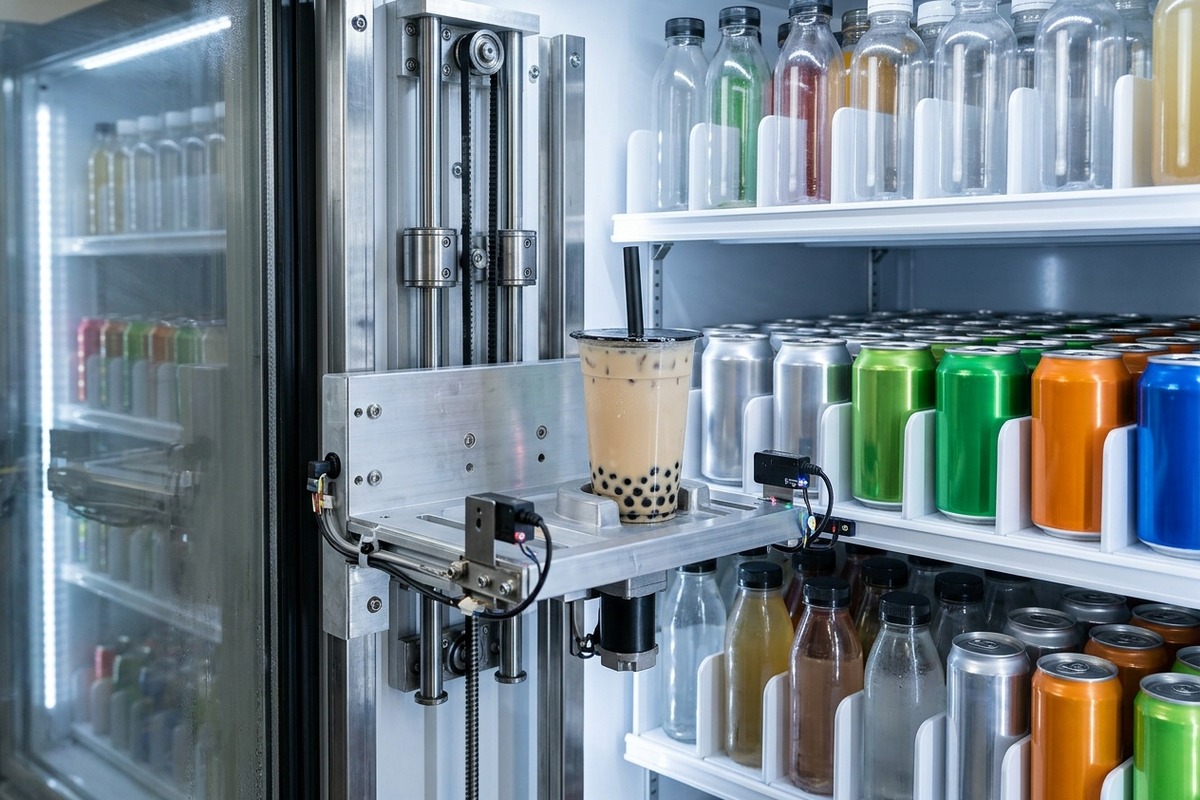
Traditional vending machines rely on spiral coils that drop beverages from upper shelves directly into a bottom retrieval bin. A 4-foot drop can burst cup sealing films, dent thin-walled aluminium cans, and rupture delicate popping boba membranes.
Modern bubble tea vending machines employ an X-Y motorised elevator platform. The elevator carriage rises smoothly to the designated shelf, gently receives the beverage container, and descends to waist height for customer retrieval.
What to test during machine commissioning
- Can seam integrity: Check for denting or rim deformation after 100 automated dispense cycles.
- Cup seal integrity: Ensure heat-sealed plastic film does not peel, leak, or burst during transfer.
- Bottle lane glide: Confirm bottle shoulder contours do not catch on lane dividers or drop gates.
- Optical sensor alignment: Verify infrared beam detection registers every package size reliably.
- Elevator carriage positioning: Calibrate vertical and horizontal servo stops across all shelf rows.
Product size and lane setup
Commercial RTD vending machines are commonly configured for 320 ml sleek aluminium cans and 250 ml to 500 ml sealed PET bottles or cups. Lane widths, pushers, and belt conveyors must be precisely adjusted to container dimensions to prevent tipping and lane jams.
Smart boba vending telemetry
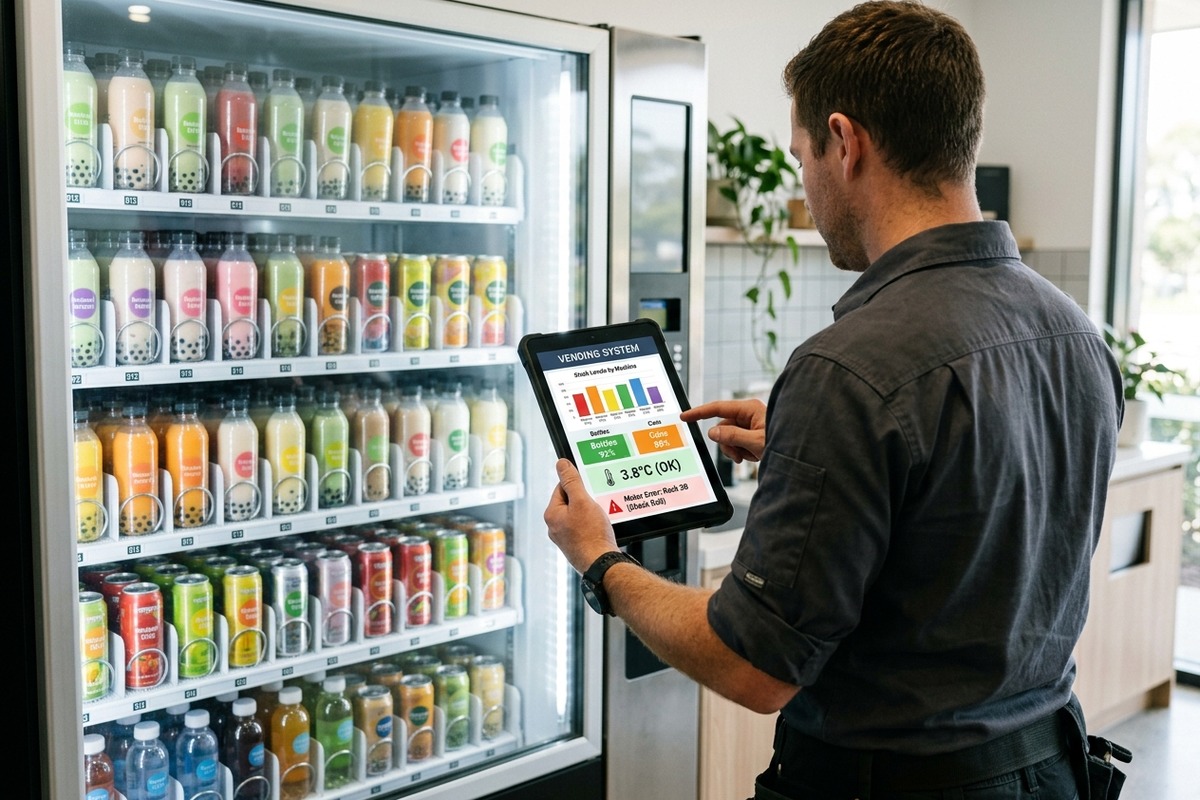
IoT telemetry systems connect machine controllers to cloud management dashboards via cellular (4G/5G) or Wi-Fi modems. Industry-standard platforms such as Nayax Core and Cantaloupe Seed provide live operational visibility.
Useful telemetry data metrics
- Real-time sales velocity by SKU and time of day
- Remaining stock counts per lane and low-inventory reorder alerts
- Continuous cabinet temperature logging and high-temperature push alerts
- Door-open sensor tracking to monitor restock and maintenance events
- Motor jam, drop sensor errors, and failed transaction notifications
- Cashless payment reader status and signal strength
Connectivity failure contingency plan
Vending hardware should feature local buffer memory to record offline transactions during intermittent cellular dropouts, automatically syncing data once signal restoration occurs.
Cashless payments and MDB protocol
The Multi-Drop Bus (MDB) protocol is the global communication standard between vending machine mainboards, bill validators, and cashless payment readers. Modern boba consumers overwhelmingly prefer contactless card, Apple Pay, Google Pay, and QR code payments.
What boba toppings can a vending machine sell?
Not all bubble tea toppings are suitable for unattended automated vending. Traditional cassava starch tapioca pearls undergo rapid starch retrogradation (hardening) within 4 to 6 hours in cold tea, making them unsuitable for extended machine storage.
Vending-compatible shelf-stable toppings include:
- Konjac / Crystal Boba: Plant-based jelly pearls that retain their snappy, crisp chew for months in chilled liquid.
- Popping Boba: Calcium-alginate fruit juice pearls that remain stable in chilled acidic fruit teas.
- Nata de Coco: Fermented coconut water cubes with a firm, fibrous bite.
- Grass Jelly & Aiyu Jelly: Traditional herbal and pectin jellies that maintain smooth texture when chilled.
- Rainbow Jelly Boba: Colourful konjac and agar strips that provide visual appeal through clear bottles.
FIFO stocking procedure
Adhering to strict First-In, First-Out (FIFO) rotation ensures drinks are consumed before quality degradation occurs:
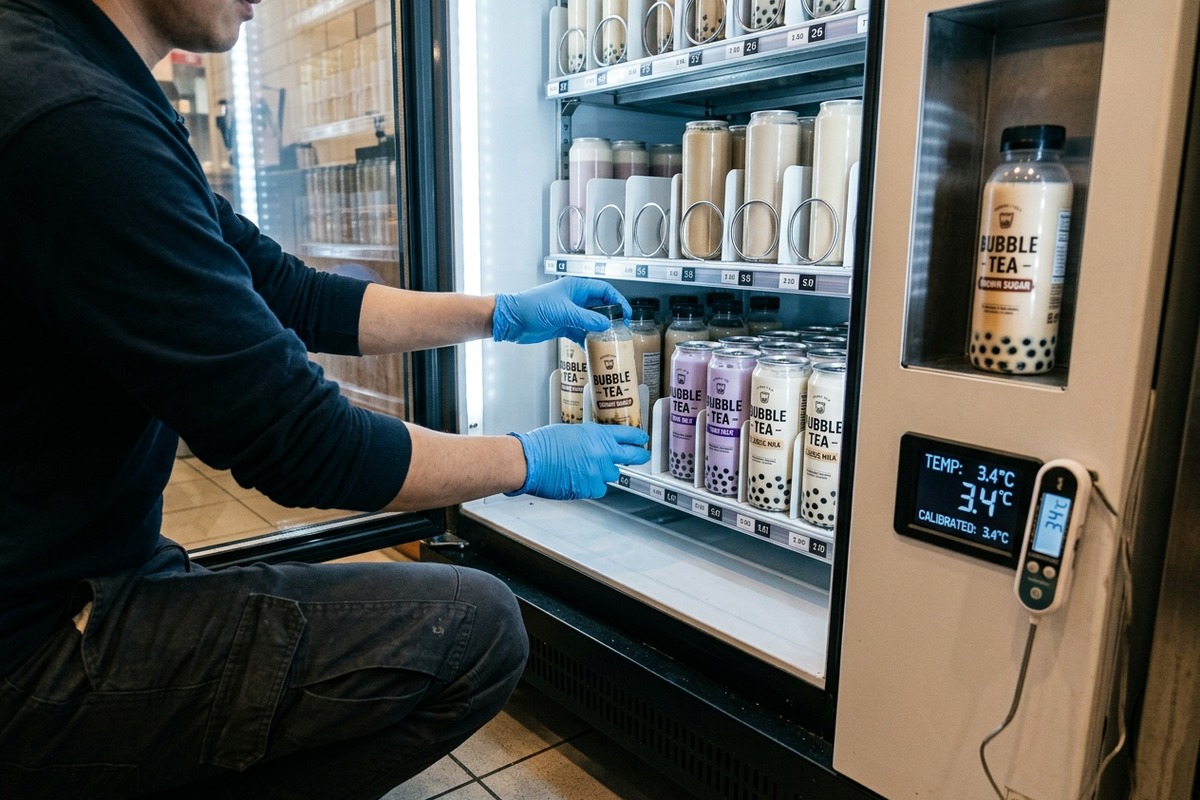
- Verify cabinet temperature on the digital controller prior to opening the door.
- Audit physical lane counts against telemetry dashboard reports.
- Inspect all inventory and pull any expired, dented, or damaged containers.
- Slide existing older stock forward toward the dispensing gate.
- Load fresh inventory behind existing stock with labels facing forward.
- Conduct a test vend on replenished lanes to ensure smooth carriage loading.
- Log restock quantities, batch numbers, and probe temperatures in the route log.
Cleaning and preventive maintenance
Packaged RTD vending machines require routine sanitation of customer touchpoints (screens, POS terminals, and retrieval doors) and interior spill containment trays. In contrast, robotic kiosks require extensive Clean-In-Place (CIP) sanitisation of internal beverage lines, syrup injectors, and topping hoppers.
Recommended maintenance schedule
- Daily Work: Review temperature logs, wipe high-touch glass and payment screens, sanitize delivery box, verify ingredient levels.
- Weekly Work: Inspect and sanitize lane guides, test emergency stop buttons, audit inventory date codes.
- Monthly Work: Clean refrigeration condenser coils to prevent compressor overheating and reduce power consumption.
- Quarterly Work: Lubricate elevator guide rails with food-grade lubricant, test optical sensors, inspect drive belts.
Robotic kiosk sanitation
Robotic kiosks require 1.5 to 2.5 hours of daily sanitisation. Milk residues, sugary syrups, and cooked starches create biofilm risks inside tubing. Operators must establish written sanitation standard operating procedures (SSOPs) detailing chemical concentrations, contact times, and verification logging.
Utilities and site preparation
Ensure facility management confirms dedicated electrical voltage, amperage, and water utility requirements in writing. Never operate high-draw refrigeration compressors or robotic heating elements on shared extension cables or domestic adapters.
Accessibility and ADA compliance
In the United States, commercial vending installations must adhere to the 2010 ADA Standards for Accessible Design. Controls, touchscreens, payment terminals, and retrieval bins must fall within operable reach ranges (typically 15 to 48 inches above finished floor level) with adequate clear floor space for wheelchair access.
Security, insurance and customer support
Protect automated assets by securing machines with high-security locks, floor anchor bolts, and tamper-resistant payment housing. Comprehensive commercial insurance should encompass general liability, machine damage, vandalism, stock spoilage, and cyber liability for POS systems. Prominently display customer support contact details and a direct refund QR code on the machine face.
How to compare vending-machine suppliers
When evaluating hardware manufacturers, request verifiable documentation on:
- Full machine engineering schematics, power draw, and NSF/CE/UL certifications
- Warranty coverage periods, spare parts availability, and guaranteed technician dispatch times
- Telemetry software subscription costs, data ownership terms, and open API access
- Demonstrated 100-cycle continuous vend test results using your specific packaging
- References and operating metrics from existing commercial route operators
Common vending-machine mistakes to avoid
- Purchasing machines before securing site leases: Machines accrue storage fees and depreciation while waiting for placement agreements.
- Relying solely on gross foot traffic: Failing to analyze demographic fit, dwell time, and nearby beverage competitors.
- Ignoring topping shelf-life physics: Loading traditional tapioca pearls that turn hard in refrigerated drinks.
- Underestimating daily sanitation in robotic kiosks: Neglecting the significant labour required for food-contact line cleaning.
- Using standard hard-drop machines: Experiencing burst cup films and dented cans due to violent drop impact.
Frequently asked questions
How much does a bubble tea vending machine cost?
A refrigerated packaged RTD vending machine generally costs between $4,500 and $9,500. A robotic fresh-drink kiosk typically ranges from $35,000 to $75,000 or more, plus freight, installation, permits, and telemetry setup.
How much profit can a bubble tea vending machine make each month?
A high-traffic location selling 50 drinks per day at $4.00 generates approximately $6,000 in monthly gross revenue. After deducting product costs, location commissions, payment fees, utilities, and maintenance, net monthly profit typically averages $2,200 to $3,200.
How do vending machines keep milk tea cold and safe?
Commercial refrigeration systems maintain cabinet temperatures between 2°C and 4°C. Certified machines include automatic health lockouts that disable sales if the temperature stays above 4.4°C (40°F) for more than 30 minutes.
What boba toppings can be sold in a vending machine?
Packaged vending machines work best with shelf-stable toppings such as konjac pearls, popping boba, grass jelly, and nata de coco. Traditional cooked tapioca pearls harden in cold storage and require fresh robotic preparation with strict holding timers.
Does a bubble tea vending machine need plumbing?
Packaged RTD vending machines do not require water lines or drainage, needing only a standard electrical connection. Robotic kiosks require dedicated potable water filtration lines and wastewater drainage.
How often should a bubble tea vending machine be restocked?
Most packaged machines are restocked 1 to 2 times per week depending on sales velocity and shelf capacity. Telemetry software provides real-time stock alerts to optimize replenishment routes.
What is smart boba vending telemetry?
Telemetry connects the machine controller to cloud software via cellular data, delivering real-time reporting on live sales, stock levels per lane, cabinet temperatures, motor errors, and payment status.
Can a normal snack vending machine sell bubble tea?
Standard coil machines often drop beverages from heights that can dent cans or rupture cup seals. Bubble tea vending requires refrigerated units equipped with elevator soft-drop platforms and adjustable product lanes.
Does a robotic boba kiosk need daily cleaning?
Yes. Robotic kiosks require 1.5 to 2.5 hours of daily sanitisation to clean beverage lines, pumps, dispense nozzles, and ingredient hoppers under a validated sanitation standard operating procedure.
Which machine is better for a first-time operator?
A refrigerated packaged RTD machine is recommended for first-time operators due to its lower capital cost, simpler permitting, minimal daily labour, and reduced mechanical failure risk compared to robotic kiosks.
Sources and regulatory standards
This commercial operational guide references equipment standards and food safety regulations from the following industry bodies:
- NSF International: Food Equipment Sanitation Standards (NSF/ANSI 25).
- US FDA Food Code: Automatic Health-Control Shutoff and Temperature Controls.
- US Department of Justice: 2010 ADA Standards for Accessible Design.
- National Automatic Merchandising Association (NAMA): Vending Industry Machine Engineering and Telemetry Standards.


 Badge-157x140.png)
Comments