
Bubble Tea Cups vs Cans vs Bottles: Best Format Guide
Choosing the right bubble tea package depends heavily on where the drink is made, sold and consumed. A café drink served fresh demands clear visual presentation, vibrant layers and a secure film seal. A retail drink needs a validated thermal or aseptic process, a reliable hermetic closure, and verified barrier protection to withstand distribution and storage.
Quick answer: Cups suit fresh café drinks and short delivery trips. Bottles suit chilled retail drinks that need product visibility and a screw cap. Cans suit tested ready-to-drink products that need strong light protection and efficient transport. Shelf life must come from product testing and a safe filling process.
Cans block light and outside gases completely through their metal walls. Bottles let customers see the drink and close it again during travel. Cups cost significantly less for drinks prepared and consumed on the same day.
The drink formula still controls the final choice. Tea catechins, milk proteins, fruit acids, sugar levels and toppings react differently during filling, heating, chilling and ambient storage. A package cannot make an unstable or under-processed recipe shelf-stable on its own.
Bubble tea cups vs cans vs bottles at a glance
| Format | Best Fit | Main Benefit | Main Limitation |
|---|---|---|---|
| Sealed Plastic Cup | Café takeaway, drive-thru and local delivery | Lowest package unit cost, high clarity, familiar wide-straw puncture action | Requires active refrigeration, non-resealable, short holding time (same-day use) |
| PET Bottle | Chilled grab-and-go, convenience retail and delivery | Crystal clear, lightweight, shatterproof and resealable screw cap | Permeable to oxygen and UV light unless specialised barrier additives are used |
| Glass Bottle | Premium chilled retail, boutique dine-in, reuse deposit schemes | Premium tactile weight, complete gas barrier, zero flavour scalping | Heavy shipping weight, shatter risk, high freight and secondary packaging cost |
| Aluminium Can | Ambient and chilled ready-to-drink (RTD) retail, vending | 100% light block, zero wall gas transmission, maximum pallet cube efficiency | Hides drink visuals, non-resealable, requires seamer tooling and liner validation |
These formats represent commercial starting points. The ideal container depends on your recipe chemistry, thermal processing method, closure integrity, distribution temperature, and target shelf life.
How to choose the best container for bubble tea
Start with the sales channel. A drink prepared to order in a shop has fundamentally different constraints from a commercial RTD product destined for multi-week warehouse distribution.
Answer these 10 questions before placing bulk container orders:
- Production model: Will staff prepare the drink in a retail shop, or will a co-packer / commercial beverage facility fill it?
- Cold chain: Will the package remain strictly refrigerated from filling to sale, or must it survive ambient retail shelves?
- Target shelf life: How long must the drink remain microbiologically safe, organoleptically fresh, and visually stable?
- Recipe acidity: Is the drink a low-acid dairy/plant-milk beverage (pH > 4.6) or an acidified fruit tea (pH ≤ 4.6)?
- Inclusions: Does it contain tapioca pearls, popping boba, or jellies that must pass through an opening or straw?
- Resealability: Will on-the-go customers need to reclose the package between sips?
- Thermal processing: Can the container wall and closure withstand cold-fill, hot-fill, retort, or tunnel pasteurisation?
- Recycling infrastructure: Which materials are widely collected and processed in your target retail geography?
- Transit stresses: What physical forces (top load, vibration, drop impact, vending drop) will the pack encounter?
- Total packed cost: What is the true landed unit cost after factoring in containers, closures, sleeves, outer cases, freight, and scrap?
If you are operating a low-overhead setup or pop-up stand, review our guide on How to Sell Bubble Tea Without Equipment for manual workflow strategies.
Cups for fresh bubble tea
Clear plastic cups remain the global standard for made-to-order bubble tea shops because customers want to admire the drink's colour gradient, ice distribution, and toppings. Wide cups also provide headroom for foam caps and cheese foam.
Polypropylene (PP) and Polyethylene Terephthalate (PET) are the two primary cup polymers. PP cups withstand higher temperatures (up to 100°C) and bond reliably with standard sealing films. PET cups offer exceptional glass-like optical clarity but soften at lower temperatures (around 60°C) and require specialised PET-compatible sealing film.
Heat-sealed film
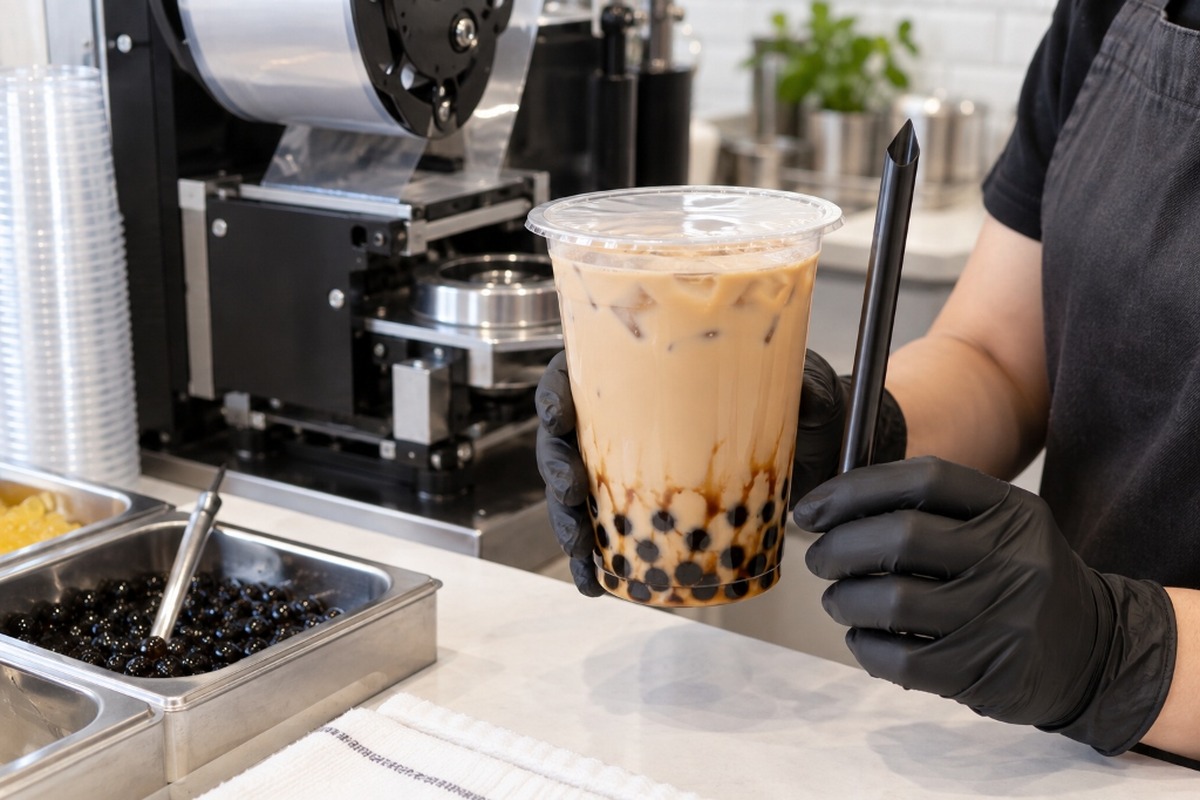
A cup-sealing machine uses heat, dwell time, and mechanical pressure to fuse a polymer-coated film to the cup lip. A sound heat seal creates a leak-resistant bond that prevents spills during customer handoff and third-party delivery courier transport.
The sealing rim must remain pristine: syrup drops, tea splashes, or condensation on the lip will cause micro-channels and seal failure. Operating temperatures typically range from 160°C to 170°C for PP cups, but machines should always be calibrated to the specific film manufacturer's specifications.
Dome lids and flat lids
When choosing between sealing film and snap-on lids, consider the drink architecture:
- Heat-sealed film: Best for delivery orders and standard iced drinks. Provides tamper evidence and maximum spill resistance.
- Dome lids: Essential when drinks feature whipped cream, tall cheese foam caps, or mounded fresh fruit toppings.
- Flat snap lids: Lower profile, ideal for pre-chilled grab-and-go cups where sealing machinery is unavailable.
For more customisation and branding options, explore our guide on Custom Bubble Tea Cups and Lids.
Cup sizes and straw access
Standard café cups typically range from 500 ml (16 oz) to 700 ml (24 oz) with a standardized 90 mm or 95 mm rim diameter. Wide boba straws (12 mm outer diameter) are engineered to easily pierce tensioned sealing film while providing enough clearance for 8.5 mm to 10 mm tapioca pearls and jelly cubes.
Holding time for cup drinks
Sealed café cups are designed for immediate consumption within 1 to 4 hours. Over extended holding times, melted ice dilutes flavor, milk fats begin to separate, tea polyphenols oxidize, and starch-based tapioca pearls undergo retrogradation (hardening). Sealed cups must be held under active refrigeration (5°C or below) if not served immediately.
Canned bubble tea packaging
Aluminium beverage cans provide an impenetrable physical barrier against visible light, ultraviolet rays, and atmospheric gases. By shielding the liquid from photo-oxidation, cans maintain tea aromatics, natural colours, and sensitive milk fats far longer than clear containers.
Double-seam integrity
Beverage cans rely on a mechanical double seam joining the can body flange with the can end (lid). The seam incorporates 5 layers of interlocking metal formed in two consecutive seamer operations.
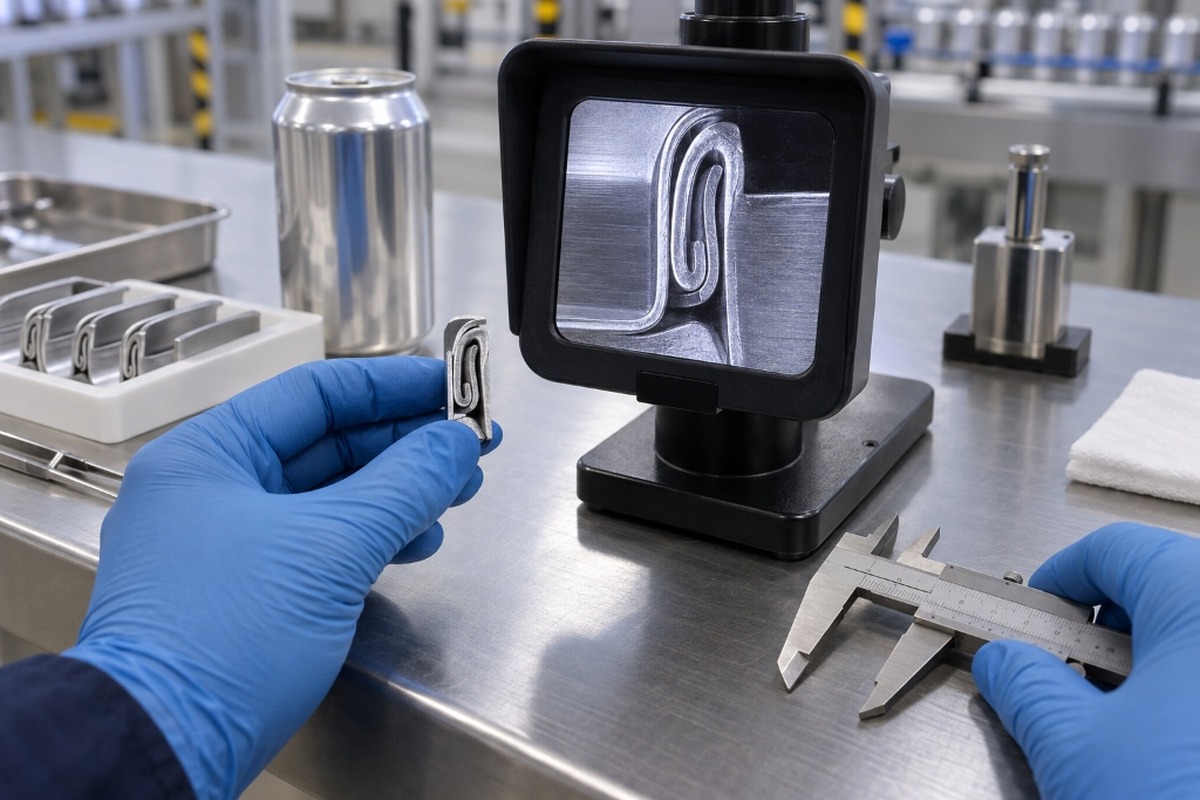
Quality control requires destructive seam teardown checks measuring:
- Body hook & cover hook lengths
- Seam thickness & seam width (height)
- Percentage overlap (minimum 70% required for beverage safety)
- Tightness rating and countersink depth
According to US FDA food-canning regulations, proper seam formation is critical to prevent post-process microbial contamination in hermetically sealed containers.
Internal can liners
Because brewed tea and fruit syrups contain organic acids and tannins that can corrode bare metal, commercial cans feature an electrostatically applied internal polymer liner. Modern beverage production specifies BPA-NI (Bisphenol A Non-Intent) epoxy or acrylic coatings validated for the beverage's exact pH, acidity, and pasteurisation profile.
Can you put real boba in a can?
Traditional cooked cassava starch pearls cannot survive canned RTD distribution. Over days in cold liquid, amylose molecules recrystallise (retrogradation), turning the chewy core hard and chalky. Furthermore, standard 202 beverage can apertures cannot pass large pearls.
Commercial RTD brands overcome this by formulating with non-retrograding inclusions, such as Nata de Coco, Grass Jelly, Aiyu Jelly, Crystal Boba (Konjac), or popping boba packed in cans featuring wide-mouth 360-degree peelable lids.
Bottles for bubble tea
Bottles offer the optimal balance of product visibility and resealability for grab-and-go convenience retail.
PET bottles
Polyethylene Terephthalate (PET) is lightweight, shatterproof, and highly transparent. However, standard monolayer PET allows trace oxygen and light transmission. For oxygen-sensitive milk teas, manufacturers can specify multi-layer bottles with nylon barrier cores, oxygen scavengers, or UV-absorbing masterbatch resin.
Glass bottles
Glass provides an impermeable gas barrier, zero chemical migration, and an ultra-premium aesthetic. However, its high tare weight dramatically increases shipping emissions and freight costs, and the risk of catastrophic breakage restricts its use in schools, outdoor events, and high-speed vending.
Caps and neck size
Bottled bubble teas require wide-mouth finishes (typically 38 mm) to facilitate pouring and allow inclusions to pass without bridging. Closures feature tamper-evident breakaway drop bands and induction or plastisol liner seals to ensure hermetic closure integrity.
Shelf life depends on the full product
Container selection alone does not establish product shelf life. Total shelf stability is governed by the complete formulation-processing-package ecosystem:
- Formulation pH & Water Activity: Low-acid milk teas (pH > 4.6) require stringent thermal sterilization (retort) or aseptic filling, whereas acidified fruit teas (pH ≤ 4.6) can be safely preserved via hot-fill or tunnel pasteurisation.
- Dissolved Headspace Oxygen: Minimised via liquid nitrogen dosing or vacuum filling.
- Package Barrier Properties: Resistance to light transmission and gas permeability.
- Cold-Chain Continuity: Maintained distribution temperatures.
For detailed scaling and production planning, see our Commercial Bubble Tea Scaling Guide.
OTR, WVTR and light transmission
Barrier science dictates how well a container shields sensitive tea compounds (such as epigallocatechin gallate / EGCG) and milk fats from photo-oxidation and rancidity.
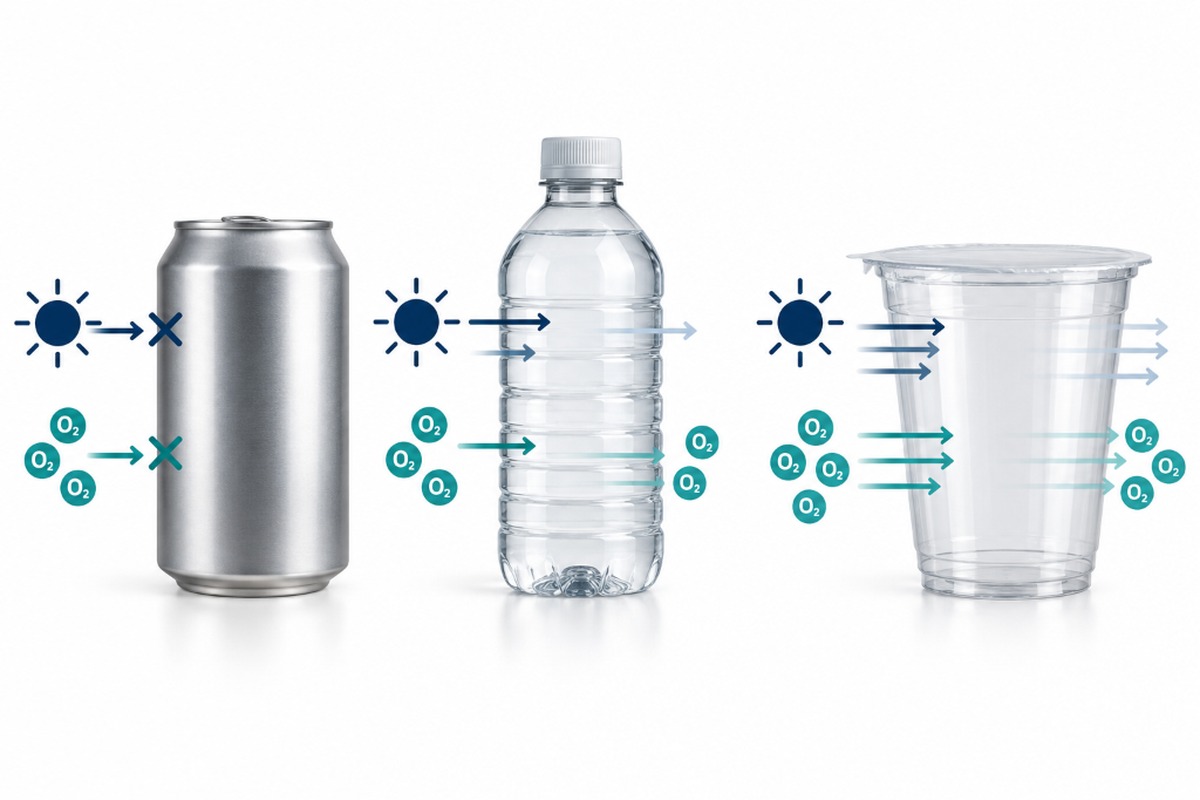
- Oxygen Transmission Rate (OTR): Measures the volume of oxygen gas passing through a square metre of package wall per 24 hours (cc/m²/day). Aluminium cans and glass bottles offer an OTR of essentially zero; standard PET ranges from 1.5 to 3.5 cc/m²/day.
- Water Vapour Transmission Rate (WVTR): Quantifies moisture loss or gain through the package substrate over time.
- Light Transmission: Ultraviolet and visible spectrum light degrade dairy proteins and bleach tea pigments. Clear cups and bottles allow full light penetration, requiring opaque secondary packaging or refrigerated dark display.
Package comparison matrix
| Decision Factor | Aluminium Can | PET Bottle | Glass Bottle | Sealed Plastic Cup |
|---|---|---|---|---|
| Product Visibility | Zero through body | High / Crystal clear | High / Crystal clear | High / Full view |
| Light Protection | 100% total block | Low (unless UV masterbatch added) | Low in clear flint glass | Low |
| Gas Barrier (Wall OTR) | Complete barrier (~0 cc) | Moderate (1.5–3.5 cc/m²/day) | Complete barrier (~0 cc) | Low / permeable |
| Resealability | Non-resealable | Yes (screw cap) | Yes (screw/swing top) | Non-resealable |
| Wide Straw Usability | Requires wide tab or peel lid | Requires 38 mm wide neck | Requires wide finish | Standard puncture straw |
| Freight Cube Efficiency | Highest (~92% pallet use) | Moderate (~78% pallet use) | Low / Heavy tare weight | Low when filled (~62%) |
| Filling Infrastructure | Rotary can filler + seamer | In-line capper + filler | In-line capper + filler | Countertop cup sealer |
Package cost and total packed cost
When calculating beverage margins, avoid comparing empty container prices in isolation. Total packed cost encompasses:
Total Packed Cost = Container + Closure + Decoration (Sleeve/Print) + Secondary Packaging (Carton/Tray) + Filling & Thermal Labour + Lab Testing + Warehousing + Outbound Freight + Wastage/Scrap
- Sealed Cup & Film: $0.08 – $0.14 per unit (low setup, high store labor).
- Aluminium Can & End: $0.22 – $0.32 per unit (high MOQ/tooling, lowest freight per liter).
- PET Bottle & Cap: $0.35 – $0.55 per unit (flexible production, moderate freight).
- Glass Bottle & Closure: $0.55 – $0.95+ per unit (highest freight and protective packaging).
Best format by sales channel
| Sales Channel | Optimal Starting Format | Key Engineering Specification | Commercial Rationale |
|---|---|---|---|
| Supermarket Chilled Aisle | Sleek Can (320 ml) or PET Bottle | Validated hermetic seal, 60–180 day shelf life | Withstands distribution distribution and retail date coding |
| Convenience / Grab & Go | 38 mm Wide-Mouth PET Bottle | Tamper-evident band, impact resistance | Resealable convenience for commuters |
| Café Takeaway & Dine-in | PP / PET Cup with Heat Seal | 95 mm matching lip, calibrated dwell temperature | Maximises drink aesthetics and custom topping flexibility |
| Delivery Apps (UberEats/DoorDash) | Heat-Sealed PP Cup or Capped Bottle | 100% burst test validation, rigid cup carrier | Eliminates motorbike delivery slosh and spill refunds |
| Automated Campus Vending | 320 ml Sleek Aluminium Can | Elevator-compatible dimensions, drop-test rating | Prevents dispenser jamming and shatter risks |
| Ambient Wholesale Export | Retorted Aluminium Can | Commercial sterility filing, 12+ month ambient stability | Permits non-refrigerated container sea freight |
Common packaging mistakes
- Choosing by appearance alone: Selecting clear PET bottles for light-sensitive matcha or dairy teas without testing for photo-oxidation off-flavours.
- Treating a sealed cup as shelf-stable: Assuming that a heat-sealed plastic film replaces pasteurisation or cold-chain storage.
- Ignoring topping retrogradation: Packing fresh tapioca pearls into canned RTD drinks without testing long-term starch hardening.
- Purchasing mismatched tooling: Buying 95 mm cups with 90 mm sealer rings or uncalibrated sealing film thickness.
- Evaluating only container unit cost: Overlooking freight tare weights, carton dividers, and delivery spill remake costs.
Frequently asked questions
Which package is best for bubble tea?
Use sealed cups for fresh café drinks, bottles for chilled resealable grab-and-go drinks, and aluminium cans for commercially processed ready-to-drink retail products requiring extended shelf life and light protection.
Why do bubble tea shops seal cups with film?
Film bonds hermetically across the cup rim, preventing spills during takeaway and delivery. Customers can cleanly pierce the tensioned film with a pointed 12 mm wide boba straw.
Can bubble tea go in an aluminium can?
Yes. Commercial canning requires a validated filling process, BPA-NI internal coating, double-seam verification, and shelf-stable inclusions such as konjac, nata de coco, or popping boba.
Are bottles better than cans for bubble tea?
Bottles provide product visibility and resealability with a screw cap. Cans offer 100% light blocking, zero gas transmission, and superior pallet stacking. The choice depends on sales channel and product sensitivity.
How long does canned bubble tea last?
Commercial canned bubble teas typically target 12 to 18 months of ambient shelf life when processed through validated retort or aseptic lines with appropriate internal liners.
Can I use a cup sealer for delivery orders?
Yes. Heat-sealed films provide the most reliable spill protection for courier delivery. Ensure the cup rim is clean, dry, and sealed with matched machine temperature settings.
What straw size works for boba?
Standard boba straws have an outer diameter of 12 mm with a diagonal pointed tip designed to puncture sealing film and draw up tapioca pearls and diced jellies cleanly.
What do OTR and WVTR mean in beverage packaging?
OTR (Oxygen Transmission Rate) measures how much oxygen permeates through the container wall over time, while WVTR (Water Vapour Transmission Rate) measures moisture migration. Lower values indicate superior barrier performance.
Are canned bubble teas recyclable?
Yes. Aluminium beverage cans are endlessly recyclable and accepted in almost all municipal curb-side recycling systems with high material recovery value.
Is glass the best choice for premium bubble tea?
Glass provides superior chemical inertness and premium tactile appeal, but its significant tare weight, freight expense, and breakage vulnerability make it less suitable for high-volume retail distribution.
Sources and regulatory standards
This technical guide references packaging engineering standards and food safety regulations from the following authorities:
- US FDA: 21 CFR Part 113 & 114 (Thermally Processed Low-Acid and Acidified Foods in Hermetically Sealed Containers).
- US FDA: Food Container Closure Evaluation and Double Seam Inspection Manual.
- US Environmental Protection Agency (EPA): Municipal Solid Waste and Material Recovery Analysis for Beverage Packaging.
- Association of Plastic Recyclers (APR): Design Guide for PET Bottle Recyclability and Barrier Scavengers.


 Badge-157x140.png)
Comments