

A 16 oz matcha milk tea can contain anywhere from 60 to 450 calories depending on whether it is prepared with pure green tea powder or a heavily sweetened cafe premix. The milk selection, sweetness percentage, cup size, and chewy toppings such as tapioca pearls shift the total nutritional profile dramatically.
Quick Answer: Matcha Milk Tea Calories
Quick answer: A standard 16 oz matcha milk tea typically ranges from 220 to 350 calories without toppings, and reaches 360 to 520 calories when paired with tapioca pearls. Ordering unsweetened almond milk with pure matcha powder drops the drink to roughly 45 to 90 calories, while 24 oz specialty versions featuring cheese foam can reach 650 to 900 calories. Because cafes use different powders, recipes, serving tools, and sweetness systems, the calorie total depends on five specific variables: matcha powder grade, milk choice, added sugar, cup volume, and toppings.
Nutritional Analysis & Reference Standards: Calorie estimates and macronutrient breakdowns are evaluated against USDA FoodData Central reference values, cafe beverage operational data, and FDA food labeling guidelines (reviewed September 2026).
Quick Calorie Guide
There is no single calorie count for matcha boba. The total depends on five key factors: matcha powder type, milk or creamer base, added sweetener, cup size, and toppings. Use the benchmark estimates below as a practical guide:
| Matcha Drink | Size | Estimated Calories |
|---|---|---|
| Pure matcha and water, no sweetener | 8 to 12 oz | 5 to 15 |
| Matcha with unsweetened almond milk | 16 oz | 45 to 90 |
| Matcha milk tea, 25% sweetness | 16 oz | 100 to 190 |
| Matcha milk tea, full sweetness | 16 oz | 220 to 350 |
| Matcha milk tea with tapioca pearls | 16 oz | 360 to 520 |
| Large matcha boba with pearls | 24 oz | 480 to 700 |
| Large matcha boba with pearls and cheese foam | 24 oz | 650 to 900 |
Note: These ranges account for variance across commercial cafe drink recipes, scoop portions, and milk brands rather than generic single-point estimates.
Where Matcha Milk Tea Calories Come From
Understanding the exact anatomy of a matcha bubble tea helps identify where calories originate and how simple ordering modifications alter the drink:
- Matcha powder: Pure matcha is finely milled powdered green tea from shade-grown Camellia sinensis leaves (tencha). Because the entire suspended leaf powder is consumed rather than steeped and discarded, a standard 2 to 3 g serving contributes 5 to 15 calories along with natural polyphenols, chlorophyll, and L-theanine.
- Milk or creamer: The liquid base contributes anywhere from 25 to 220 calories per serving depending on whether the shop pours unsweetened almond milk, whole dairy milk, barista oat milk, or prepared non-dairy creamer.
- Added sugar: Commercial simple syrups, cane liquid, or fructose syrup provide approximately 4 calories per gram of pure carbohydrate. A drink containing 30 g of added sugar receives 120 calories from sweetener alone.
- Toppings: Sweetened cassava starch pearls add roughly 140 to 200 calories per 60 g scoop. Cheese foam caps add 150 to 220 calories, whereas aloe vera or grass jelly contribute under 45 calories.
- Cup size: Stepping up from a 16 oz regular to a 24 oz large drink increases milk, sweetener, and tea volumes. However, ingredient proportions do not always scale by exactly 50% due to varying ice and topping displacement.
Pure Matcha vs Sweetened Matcha Mix
The powder base chosen by the cafe can alter your calorie total before any milk or flavored syrup is added to the cup:
Pure Matcha
Authentic, pure matcha contains 100% ground green tea leaves with zero added sugars, fillers, or milk powders. For a complete look at macronutrients across milk tea varieties, visit our bubble tea calories overview. On the ingredient deck, green tea or matcha appears as the sole ingredient. Pure matcha naturally supplies caffeine, L-theanine, catechins (including EGCG), and chlorophyll. Terms such as "ceremonial grade" or "culinary grade" indicate harvest timing, leaf maturity, and culinary purpose rather than regulated nutritional benchmarks.
Sweetened Matcha Mix
Many commercial bubble tea shops and fast-casual chains brew with pre-mixed matcha latte powders. These blends combine green tea powder with refined cane sugar, glucose syrup, powdered dairy creamer, or hydrogenated vegetable oils. A typical 35 g scoop of commercial cafe premix can contain 160 to 190 calories and 24 to 28 g of sugar before any additional liquid syrup is pumped into the drink.
To avoid hidden sugars, ask your barista this specific question, or choose convenient, pre-formulated ready-to-drink canned matcha green tea:
If the shop relies on a pre-sweetened powder blend, ordering "0% sugar" will only eliminate the extra station syrup; it will not remove the sugar already formulated inside the dry powder base.
Milk Calorie Comparison
The table below provides calorie estimates based on a typical 200 ml (approximately 0.85 US cup) serving poured into a 16 oz iced beverage:
| Milk or Creamer | Estimated Calories per 200 ml | Main Source of Variation |
|---|---|---|
| Unsweetened almond milk | 25 to 45 | Brand, nut content, oil emulsifiers, and fortification |
| Unsweetened coconut beverage | 35 to 70 | Coconut cream ratio and stabilizing gums |
| Skim dairy milk (0%) | 65 to 80 | Natural lactose content and pour volume |
| 2% reduced fat dairy milk | 95 to 110 | Butterfat percentage and volume |
| Whole dairy milk | 120 to 135 | Milk fat level (approx. 3.25% to 3.5%) |
| Unsweetened soy milk | 70 to 110 | Soy solids percentage and protein content |
| Original sweetened soy milk | 95 to 130 | Added cane sugar and oil content |
| Standard oat milk | 85 to 150 | Enzyme breakdown sugars, oat solids, and vegetable oils |
| Barista oat milk | 110 to 170 | High added plant oils formulated for micro-foam stretching |
| Prepared non-dairy creamer | 100 to 220 | Powder scoop volume, palm/coconut oils, and corn syrup solids |
Whole dairy milk supplies natural protein, carbohydrates, and butterfat. Soy milk offers equivalent protein with lower saturated fat. Unsweetened almond milk provides the lowest calorie density, while barista oat milks often approach whole milk calorie totals due to emulsified plant oils. Always check for allergens: non-dairy creamer frequently contains sodium caseinate, a milk derivative.
Sweetness Levels and Calories
Cafe percentage selectors represent syrup dispenser settings, not standardized nutritional units. A 50% setting at one franchise may dispense more or less syrup than the same setting at another chain. The table below models an operational standard based on 32 g of simple syrup at 100% full sweetness:
| Sweetness Setting | Example Added Sugar | Calories from Added Sugar |
|---|---|---|
| 100% (Regular Sweet) | 32 g | 128 cal |
| 75% (Less Sweet) | 24 g | 96 cal |
| 50% (Half Sweet) | 16 g | 64 cal |
| 25% (Quarter Sweet) | 8 g | 32 cal |
| 0% (Unsweetened Syrup) | 0 g | 0 cal |
When the shop discloses its syrup formulation, calculate added sugar calories with this direct equation:
Matcha Boba Topping Calories
Toppings often add more calories than the tea base and milk combined. Compare the typical portion weights below:
| Topping | Example Serving | Estimated Calories |
|---|---|---|
| Drained aloe vera | 60 g | 25 to 35 |
| Grass jelly (herbal jelly) | 60 g | 30 to 45 |
| Crystal boba (agar / konjac) | 60 g | 40 to 70 |
| Fruit popping boba | 60 g | 45 to 75 |
| Traditional tapioca pearls | 60 g | 140 to 200 |
| Brown sugar boba (thick syrup coat) | 60 to 70 g | 180 to 250 |
| Cheese foam / milk cap | 70 to 80 ml | 150 to 220 |
Matcha pairs seamlessly with herbal grass jelly, crystal boba, red bean, and classic tapioca pearls. Popping fruit boba can overpower delicate vegetal tea notes. While pure cassava starch is naturally gluten-free, commercially prepared boba can contain caramel coloring or cross-contact during shared vat cooking.
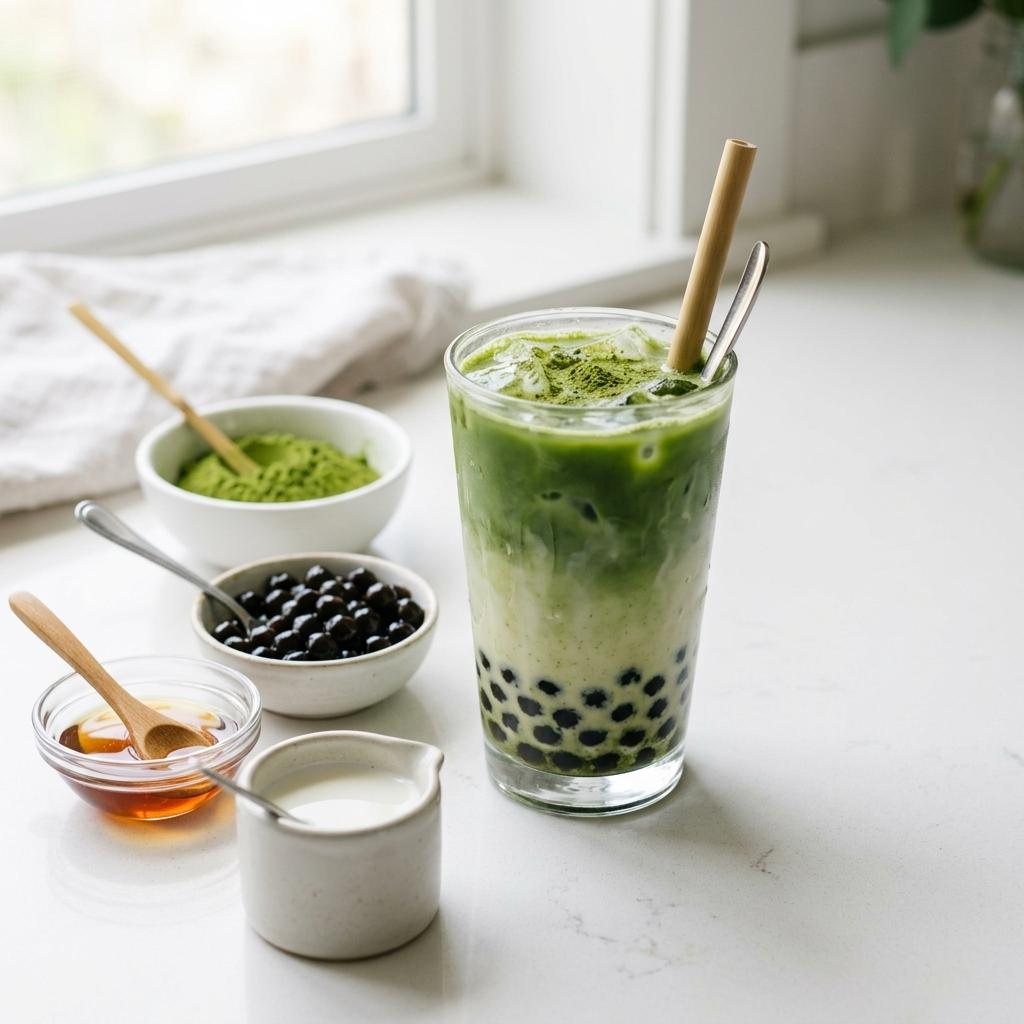
Milk choice, syrup levels, cup volume, and dense toppings dictate the total calorie footprint of matcha bubble tea.
Matcha Milk Tea Calorie Calculator
To estimate your total drink calories, sum each modular component:
Example 1: Classic Cafe Order
- Pure matcha powder (2 g): 10 cal
- Whole dairy milk (200 ml): 130 cal
- 100% simple syrup: 128 cal
- Standard tapioca pearls (60 g): 160 cal
- Estimated Total: ~428 calories
Example 2: Lightened Low-Calorie Order
- Pure matcha powder (2 g): 10 cal
- Unsweetened almond milk (200 ml): 35 cal
- 25% simple syrup: 32 cal
- Crystal boba (50 g): 50 cal
- Estimated Total: ~127 calories
16 oz vs 24 oz Scenario Comparison
Compare how typical drink customisations perform across standard medium and large cups:
| Drink Order | Size | Estimated Calories | Why It Changes |
|---|---|---|---|
| Pure matcha and water | 16 oz | 5 to 15 | No milk, added syrup, or chewable toppings. |
| Almond milk, no added sugar | 16 oz | 45 to 90 | Pure tea powder whisked into unsweetened plant milk. |
| Almond milk, 25% sugar, crystal boba | 16 oz | 105 to 165 | Small syrup dose combined with low-density agar pearls. |
| 2% milk, 50% sugar, tapioca | 16 oz | 280 to 420 | Balanced dairy milk, moderate syrup, and standard starch pearls. |
| Whole milk, full sugar, tapioca | 16 oz | 360 to 520 | Full dairy fat, complete syrup recipe, and sweetened pearls. |
| Oat milk, 50% sugar, tapioca | 16 oz | 300 to 470 | Oat solids and emulsifying oils elevate baseline calories. |
| Premix, creamer, full sugar, tapioca | 16 oz | 400 to 600 | High sugar in both dry premix base and station syrup. |
| Whole milk, full sugar, tapioca | 24 oz | 480 to 700 | Larger fluid volume and increased syrup pumps. |
| Whole milk, full sugar, tapioca and cheese foam | 24 oz | 650 to 900 | Heavy dairy cream foam layer combined with dense starch pearls. |
Caffeine, L-Theanine, and EGCG
A standard matcha drink prepared with 2 to 3 g of culinary or ceremonial powder delivers roughly 40 to 80 mg of caffeine. The exact amount fluctuates based on tea plant cultivar, shading duration, water temperature, and powder weight. The US Food and Drug Administration (FDA) cites 400 mg per day as a baseline upper intake not generally associated with negative side effects for healthy adults, though sensitivity varies widely.
Matcha naturally pairs caffeine with L-theanine, an amino acid that modulates neurotransmitter activity. Systematic clinical reviews indicate that the co-consumption of L-theanine and caffeine can promote calm alertness and support sustained attention. However, this does not mean matcha prevents caffeine jitters entirely or guarantees hours of crash-free energy for every individual.
Popular internet claims suggest matcha contains "over 100 times the EGCG of steeped green tea." While tencha whole-leaf suspension does provide higher catechin delivery than lightly steeped tea bags, agricultural variations, water temperatures, and storage degradation make rigid numerical claims inaccurate. Furthermore, the National Center for Complementary and Integrative Health (NCCIH) notes that green tea catechins exert only modest effects on metabolic rate and cannot be considered a standalone weight-loss solution.
Does Matcha Impair Mineral Absorption?
Tea polyphenols and tannins can bind non-heme iron from plant foods, slightly reducing absorption when consumed directly alongside meals. The practical impact depends on individual iron levels and dietary timing. Drinking matcha between meals rather than directly during iron-rich meals minimizes this effect.
How to Order a Lower-Calorie Matcha Boba
- Confirm the powder base: Ask whether the shop whisks 100% pure matcha or scoops a pre-sweetened commercial mix.
- Select 0% to 25% sweetness: Cutting station syrup saves 60 to 100+ calories per cup immediately.
- Switch to unsweetened plant milk: Opting for unsweetened almond milk saves 80 to 100 calories compared to whole milk.
- Limit to one topping: Avoid stacking multiple carbohydrate-dense toppings in a single cup.
- Choose lighter textures: Herbal grass jelly, aloe vera, or crystal boba offer chewy satisfaction with far fewer calories than starch pearls.
- Request half pearls: If classic tapioca is non-negotiable, ask for a half scoop to trim 70 to 100 calories.
- Skip cheese foam caps: Dairy-rich milk caps add 150 to 220 calories of saturated fat and sugar.
- Stick to 16 oz: Sizing down from 24 oz curbs fluid volume, sugar, and milk calories systematically.
Low-Calorie Homemade Matcha Boba Recipe
Prepare a refreshing, barista-quality 16 oz iced matcha boba at home containing only 90 to 150 calories:
Ingredients
- 2 g ceremonial or high-grade culinary matcha powder
- 60 ml hot water (75°C to 80°C / 167°F to 176°F)
- 180 ml unsweetened almond milk or light soy milk
- 5 to 10 ml pure maple syrup or liquid stevia (optional)
- 40 to 50 g drained crystal boba or homemade agar pearls
- 1 cup clean ice cubes
Method
- Sift 2 g of matcha through a fine mesh strainer into a small bowl to prevent clumping.
- Pour in 60 ml of warm water. Whisk vigorously in a "W" motion using a bamboo chasen or electric frother until a frothy micro-foam appears.
- Place 40 to 50 g of drained crystal boba at the base of a 16 oz tall glass.
- Add maple syrup if desired, then fill the glass with ice cubes.
- Pour in 180 ml of chilled unsweetened almond milk.
- Slowly pour the whisked vibrant green matcha over the milk to create a clean layered aesthetic. Stir thoroughly before enjoying.
Bottom Line: Matcha Milk Tea Calories
Matcha milk tea spans a wide spectrum from an 80-calorie functional beverage to a 700-calorie dessert drink. Pure matcha green tea powder itself contains negligible calories and rich concentrations of polyphenols and L-theanine. The overwhelming majority of calories come from non-dairy creamers, whole milk, flavored station syrups, and starch boba pearls. Asking the cafe whether they use pure matcha or a sweetened mix—and adjusting the syrup level to 25% or choosing agar boba—allows you to enjoy authentic matcha flavor with complete nutritional control.
Frequently Asked Questions
How many calories are in regular matcha milk tea?
A standard 16 oz cafe matcha milk tea without boba typically contains 220 to 350 calories. If prepared with commercial pre-sweetened matcha powder, non-dairy creamer, and 100% syrup, the count can reach 400 to 450 calories.
How many calories are in matcha milk tea with boba?
A 16 oz matcha milk tea with a standard scoop of tapioca pearls contains between 360 and 520 calories. A standard 60 g scoop of brown-sugar-soaked tapioca pearls contributes roughly 140 to 200 calories on its own.
How many calories are in a 24 oz matcha boba?
A large 24 oz matcha boba with full syrup and tapioca pearls typically contains 480 to 700 calories. If customized with rich cheese foam or brown sugar tiger drizzle, the calorie count can exceed 800 to 900 calories. For complete control over sweeteners and dairy fats, prepare your drink from scratch using our matcha milk tea home recipe.
Does 0% sweetness mean sugar-free?
No. The 0% sweetness setting only removes the station syrup added by the barista. Dairy milk naturally contains lactose sugar, commercial matcha latte premixes contain pre-blended cane sugar, and tapioca pearls are steeped in brown sugar syrup.
Which milk has the fewest calories?
Unsweetened almond milk is consistently the lowest-calorie option, contributing only 25 to 45 calories per 200 ml serving. Light coconut milk beverages and skim dairy milk also sit significantly below whole milk and oat milk.
Is oat milk lower in calories than whole milk?
Not always. Standard oat milk delivers 85 to 150 calories per 200 ml, while whole dairy milk averages 120 to 135 calories. Barista-grade oat milks contain added vegetable oils to facilitate foaming, often yielding 110 to 170 calories per serving.
Is matcha milk tea good for weight loss?
Matcha milk tea does not trigger weight loss. While green tea catechins and caffeine offer mild metabolic support, conventional boba drinks supply substantial carbohydrate and calorie loads. A lighter preparation (pure matcha, unsweetened almond milk, no sugar) can easily fit within a calorie-conscious diet.
Does matcha have more caffeine than coffee?
Generally, no. A typical 2 g serving of matcha delivers 40 to 80 mg of caffeine, whereas an 8 oz cup of brewed drip coffee contains roughly 95 to 165 mg. However, matcha provides L-theanine, which promotes sustained alertness without the sharp spike associated with coffee.
Can matcha milk tea fit a ketogenic diet?
Standard matcha boba is high in carbohydrates and unsuitable for keto. However, a custom drink made with pure unsweetened matcha, unsweetened almond milk or heavy cream, zero station syrup, and no tapioca pearls contains under 3 g of net carbohydrates.
Does matcha break a fast?
Milk, syrups, and boba toppings deliver energy and definitively break an intermittent fast. Pure matcha whisked solely in hot water contains only 5 to 10 calories; whether this breaks a strict fast depends on whether your protocol permits minimal caloric intake.
How many calories are in a Starbucks matcha latte?
A standard Grande (16 oz) Iced Matcha Tea Latte with 2% milk at Starbucks US contains approximately 200 calories and 28 g of sugar. Starbucks uses a pre-sweetened matcha powder blend where sugar is listed as the primary ingredient.
Is brown sugar boba higher in calories than regular pearls?
Yes. Brown sugar pearls are simmered and coated in a concentrated muscovado or brown sugar syrup, contributing 180 to 250 calories per serving compared to 140 to 200 calories for traditional drained tapioca pearls.
Sources and Nutritional References
- USDA FoodData Central: Standard Reference Legacy and FNDDS Nutrient Profiles for Green Tea Powder & Milks.
- US Food and Drug Administration (FDA): Spilling the Beans: How Much Caffeine is Too Much? Guidance.
- National Center for Complementary and Integrative Health (NCCIH): Green Tea Clinical Research Review (NIH Catechin Health Parameters).
- Systematic Review on L-Theanine and Caffeine (2025): Randomized Controlled Trials on Neurotransmitter Modulation & Alertness.


Comments