

Taro milk tea calories can range from about 200 to more than 700 per cup. The total depends on the cup size, taro base, milk choice, added syrup, and toppings. A typical 16 oz drink with sweetened taro powder and tapioca pearls often falls near 400 to 550 calories, though cafe recipes can vary significantly beyond that baseline.
Quick Answer: Taro Milk Tea Calories
Quick answer: A standard 16 oz taro milk tea typically contains 350 to 500 calories without toppings, and reaches 400 to 600 calories when paired with traditional tapioca pearls. Ordering a 16 oz drink made with real cooked taro root and unsweetened almond milk drops the energy total to roughly 180 to 260 calories, while a 24 oz large order with boba and cheese foam can reach 700 to 950 calories. The menu name alone cannot tell you the exact calorie count because commercial taro powder often contains built-in non-dairy creamer and added sugars.
Nutritional Analysis & Reference Standards: Calorie estimates and macronutrient breakdowns are evaluated against USDA FoodData Central reference values, cafe beverage operational data, and FDA food labeling regulations (reviewed September 2026).
Taro Milk Tea Calorie Estimate at a Glance
The menu name alone cannot give you an exact number. Some shops use a sweetened powder that already contains powdered creamer. Others cook fresh taro root and let you control the milk and sweetness. Use the benchmark estimates below as a practical planning guide:
| Drink Type (16 oz unless stated) | Estimated Calories |
|---|---|
| Fresh taro, unsweetened almond beverage, light sweetener, no topping | 180 to 260 |
| Sweetened taro powder, milk, no extra syrup, no topping | 280 to 400 |
| Sweetened taro powder, milk, regular syrup, no topping | 350 to 500 |
| Standard taro milk tea with tapioca pearls | 400 to 600 |
| 24 oz taro milk tea with pearls | 550 to 800 |
| 24 oz drink with pearls and cheese foam | 700 to 950 |
Note: These working ranges reflect operational differences in powder scoop weights, creamer fat percentages, and boba portions across cafes.
Why the Calorie Count Varies So Much
Five primary components dictate the final energy total in every taro drink:
- Taro base: Real cooked taro root and commercial dry taro premixes have completely different ingredient lists, moisture contents, and caloric densities.
- Milk or creamer: Whole dairy milk, barista oat milk, coconut beverage, and powdered non-dairy creamers introduce widely varying fat and sugar loads.
- Added sweetener: Dispensed simple syrup, fructose syrup, brown sugar, honey, and sweetened condensed milk add pure carbohydrate energy.
- Toppings: Starch-dense tapioca pearls, egg custard pudding, cheese foam caps, sweet red bean, and agar jellies dramatically shift the calorie profile.
- Cup size: A 24 oz cup holds greater volumes of base, liquid, syrup pumps, and topping displacement compared to a standard 16 oz cup.
Plain brewed tea and water contribute negligible calories. The taro formulation, milk, sweetener, and toppings account for virtually all of the drink's caloric value, as detailed in our comprehensive bubble tea calorie guide.
Real Taro Root and Commercial Taro Powder
Taro is the starchy root tuber of Colocasia esculenta. Cooked fresh taro supplies dietary fibre, potassium, complex carbohydrates, and essential micronutrients. Fresh taro beverages typically blend boiled or steamed taro paste with milk or plant milk, water, and optional sweetener.
Commercial taro powder, by contrast, is an engineered food product. A typical premix contains sugar, glucose or corn syrup solids, hydrogenated non-dairy creamer, maltodextrin, processed taro powder, synthetic flavouring, and food colourings (FD&C Blue 1 and Red 40). A bright purple colour does not indicate high fresh taro content.
| Point of Comparison | Fresh Cooked Taro Root | Commercial Taro Premix |
|---|---|---|
| Main ingredient | 100% cooked taro root flesh | Sugar, creamer solids, maltodextrin |
| Colour | White, grey, or pale lavender with natural flecks | Uniform, vibrant pastel purple |
| Added sugar | Controlled entirely during preparation (can be zero) | Pre-formulated directly into the dry blend |
| Fat content | Negligible in plain cooked root | Derived from hydrogenated palm or coconut oils |
| Dietary fibre | Preserved naturally from the root corm | Minimal or refined away in processing |
| Calorie tracking | Weigh cooked root, milk, and added sweetener | Check package label and dry scoop weight |
Why 0% Sugar May Still Contain Sugar
In bubble tea terminology, selecting "0% sugar" means the barista will not dispense liquid station syrup into your cup. However, this does not make the beverage sugar-free. If the recipe uses sweetened taro powder, condensed milk, or regular cow's milk, significant sugar remains in the cup.
| Ingredient in a "0% Sugar" Order | Example Total Sugar Contribution |
|---|---|
| Sweetened taro powder portion (35 g) | 18 g added sugars |
| 180 ml whole dairy milk | 9 g natural lactose sugar |
| Station simple syrup (0% setting) | 0 g added sugar |
| Sweetened tapioca pearl scoop (60 g) | 12 g brown sugar syrup |
| Estimated Drink Total | 39 g total sugar (30 g added sugar) |
The US Food and Drug Administration (FDA) establishes a Daily Value (DV) of 50 g of added sugar for a standard 2,000-calorie diet. A single cafe taro boba ordered at "0% sugar" can still deliver 60% of that recommended daily limit.
Calories from Milk and Plant Beverages
Milk and creamer choices significantly influence both caloric load and mouthfeel. Compare typical 180 ml portions:
| Liquid Base (180 ml) | Common Calorie Range | Check Before Ordering |
|---|---|---|
| Unsweetened almond beverage | 20 to 40 | Tree nut allergen, added gums |
| Unsweetened coconut beverage | 30 to 60 | Sweetener level, saturated fat content |
| Skim dairy milk (0%) | 60 to 70 | Milk allergen, natural lactose |
| Soy beverage (standard/original) | 70 to 120 | Added cane sugar, soy allergen |
| Whole dairy milk | 105 to 125 | Milk allergen, dairy fat (3.25%) |
| Barista oat beverage | 100 to 150 | Vegetable oil emulsifiers, oat carbohydrates, gluten handling |
Calories from Boba and Other Toppings
Toppings can contribute more calories than the tea and milk base combined. Consider standard shop scoop portions:
| Topping | Estimated Calories per Shop Serving | Main Source |
|---|---|---|
| Grass jelly (herbal jelly) | 20 to 80 | Plant jelly with light sweetening syrup |
| Aloe vera jelly | 30 to 100 | Natural aloe cubes in light cane syrup |
| Crystal boba (agar / konjac) | 50 to 120 | Konjac flour, agar, and packing syrup |
| Sweet red bean (adzuki) | 80 to 160 | Whole adzuki beans simmered with cane sugar |
| Egg custard pudding | 100 to 180 | Milk powder, egg yolks, sugar, and gelatin |
| Traditional tapioca pearls | 120 to 250 | Dense cassava starch and holding syrup |
| Cheese foam / milk cap | 120 to 250 | Heavy whipping cream, cream cheese, milk, and sugar |
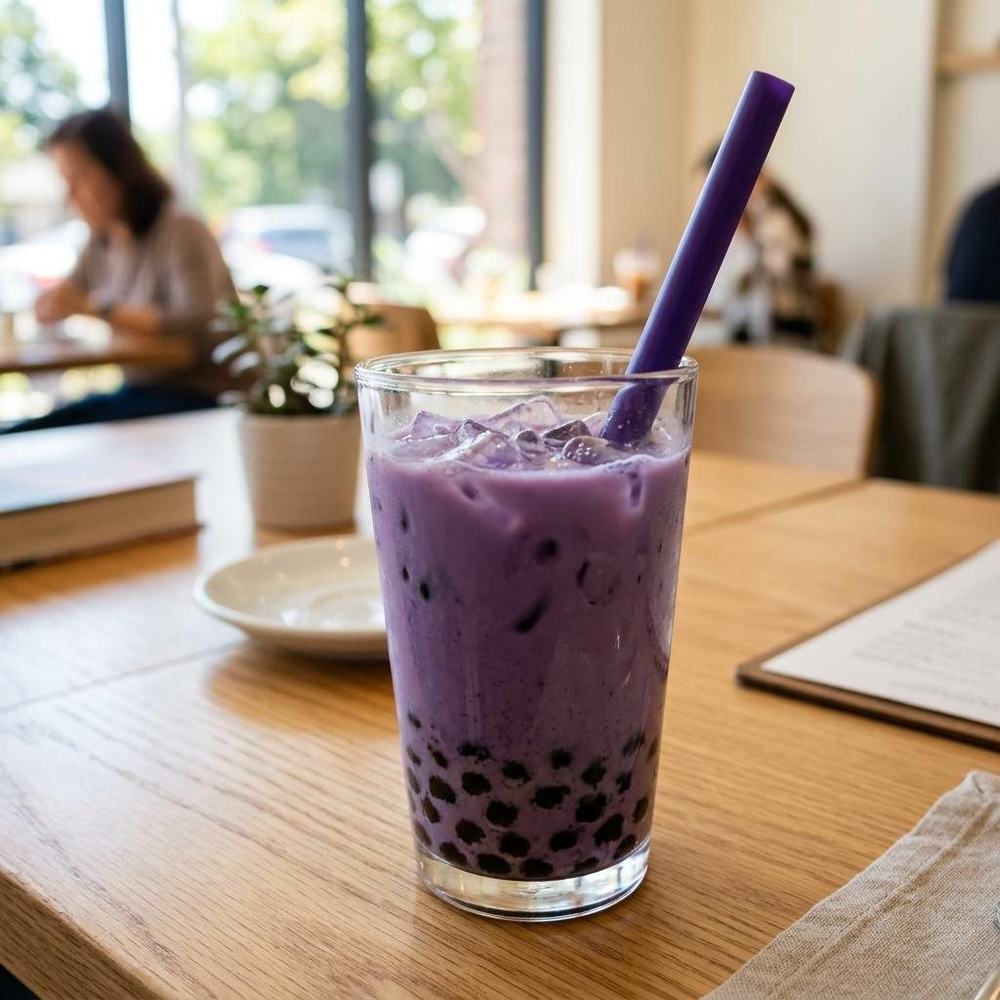
Taro milk tea calories change dramatically depending on whether fresh root or commercial powder is used, alongside milk and topping choices. For pre-packaged convenience with standardized nutrition, explore our shelf-stable canned taro milk tea.
Taro Milk Tea Calories by Size
Stepping up from a 16 oz to a 24 oz cup increases fluid volume and syrup pumps. Compare how typical drink builds compare across both sizes:
| Example Order Build | 16 oz Estimate | 24 oz Estimate |
|---|---|---|
| Fresh taro, unsweetened almond beverage, light sweetener, no topping | 180 to 260 | 260 to 390 |
| Sweetened powder, milk, no extra syrup, no topping | 280 to 400 | 400 to 580 |
| Sweetened powder, milk, regular syrup, pearls | 400 to 600 | 550 to 800 |
| Sweetened powder, milk, syrup, pearls, cheese foam | 550 to 800 | 700 to 950 |
How to Calculate Your Own Cup
To accurately compute your drink's energy profile, use this formula:
Example calculation for a fresh homemade 16 oz taro boba:
- 100 g cooked taro root: 140 cal
- 180 ml unsweetened almond beverage: 30 cal
- 1 tsp pure maple syrup: 17 cal
- Tea, water, and ice: 0 cal
- 50 g drained crystal boba: 60 cal
- Estimated Total: ~247 calories
Carbohydrate, Fat, Protein, and Fibre
The vast majority of calories in taro bubble tea originate from carbohydrates. Starch from cooked taro or cassava pearls, maltodextrin from powders, and sucrose from simple syrups all drive total carbs. Milk and cheese foam contribute saturated fats and modest protein. Real taro provides beneficial insoluble dietary fibre, whereas commercial instant powders lack natural fibre.
Does Taro Milk Tea Have Caffeine?
Pure taro root flesh contains zero caffeine. A taro drink only contains caffeine if the cafe blends the taro paste or powder with brewed black tea, jasmine green tea, or oolong tea. The FDA lists standard brewed teas at roughly 37 mg (12 oz green) to 71 mg (12 oz black) of caffeine. Always ask your barista whether your taro drink is built with a tea base or pure milk and water.
Is Taro Milk Tea Dairy-Free or Vegan?
Ordering oat milk or almond milk does not guarantee a 100% dairy-free drink. Most commercial taro powder blends incorporate non-dairy creamer that contains sodium caseinate, a milk-derived protein fraction. Custard egg pudding and cheese foam also contain dairy. Those with milk allergies or strict vegan diets should verify package labels directly.
How to Order a Lower-Calorie Taro Milk Tea
- Stick to 16 oz: Restricting serving volume prevents excessive fluid and carbohydrate intake.
- Ask for fresh taro root: Whenever available, choose real cooked taro over pre-sweetened commercial powder.
- Select 0% to 25% sweetness: Removing station syrup saves 60 to 100+ calories per cup instantly.
- Switch to unsweetened almond milk: Saves 70 to 90 calories compared to whole milk.
- Opt for crystal boba or grass jelly: Agar-based toppings provide pleasant chew with half the calories of tapioca pearls.
- Omit cheese foam and pudding: Eliminates 120 to 250 calories of saturated fat and sugars.
- Check nutrition sheets: Request the shop's allergen and nutrition guide for exact brand formulations.
Fresh Taro Milk Tea Recipe with a Calorie Worksheet
To prepare a delicious version with fresh root rather than artificial creamer powders, follow our step-by-step fresh taro milk tea recipe:
Ingredients
- 100 g peeled fresh taro root
- 180 ml unsweetened almond milk or oat milk
- 60 ml hot water or light jasmine green tea
- 1 to 2 tsp maple syrup or pure cane syrup (optional)
- 50 g drained crystal boba or homemade agar pearls
- 1 cup clean ice cubes
Method
- Peel the taro root wearing gloves and cut into small cubes.
- Steam or boil the cubes for 20 minutes until completely tender throughout. Never consume raw taro.
- Mash the hot taro with 30 ml of almond milk until smooth and creamy.
- Place 50 g of crystal boba at the bottom of a 16 oz glass.
- Layer the mashed taro paste around the interior glass walls.
- Fill with ice, pour in remaining 150 ml almond milk and tea/water, and stir well before sipping.
Raw Taro Safety
Raw and undercooked taro corms contain microscopic needle-shaped calcium oxalate crystals (raphides). When eaten raw, these crystals cause severe mechanical micro-abrasions and intense burning sensations in the mouth, tongue, and throat. Thorough boiling or steaming breaks down and disperses these crystals, making cooked taro safe and pleasant to consume.
Taro vs Ube Calories
Taro (Colocasia esculenta) and Ube (Dioscorea alata, purple yam) are botanically distinct tubers. Cooked fresh taro yields approximately 140 calories per 100 g with an earthy, nutty profile, while purple ube yam contains roughly 120 to 130 calories with sweeter, vanilla notes. In commercial bubble teas, however, powdered creamers and syrups overshadow the natural nutritional variance of the roots.
Bottom Line: Taro Milk Tea Calories
Taro bubble tea calories vary significantly based on preparation. A standard 16 oz commercial powder drink with tapioca pearls commonly reaches 400 to 600 calories due to added non-dairy creamer, maltodextrin, and soaking syrups. Ordering fresh cooked taro root with unsweetened almond milk and crystal boba cuts the calorie footprint down to 180 to 260 calories while delivering genuine whole-root nutrition and dietary fibre.
Frequently Asked Questions
How many calories are in a 16 oz taro milk tea with boba?
A standard 16 oz taro milk tea with a regular scoop of tapioca pearls typically contains 400 to 600 calories. If made with commercial pre-sweetened powder and whole milk, it sits toward the upper end of that range.
How many calories are in a 24 oz taro boba?
A large 24 oz taro boba with tapioca pearls generally delivers 550 to 800 calories. Customising the drink with cheese foam or extra boba can push the total to 700 to 950 calories.
Can I order sugar-free taro milk tea?
Only if the shop prepares its drinks with fresh unsweetened taro root. If the cafe relies on commercial taro powder blends, sugar and corn syrup solids are pre-mixed into the dry base and cannot be omitted.
Is fresh taro lower in calories than taro powder?
Yes. Fresh cooked taro contains natural moisture and dietary fibre without hydrogenated vegetable oils or added sugars, giving you complete control over added sweeteners and milk calories.
Does taro milk tea contain tea?
Some cafes brew taro drinks with jasmine green tea or black tea, while others blend taro solely with milk and water (caffeine-free). Ask your server which recipe they follow.
Which milk option has the fewest calories?
Unsweetened almond milk is consistently the lowest-calorie choice at 20 to 40 calories per 180 ml, compared to 105 to 125 calories for whole dairy milk and 100 to 150 calories for barista oat milk.
Are crystal boba calories lower than tapioca pearls?
Yes. A 50 g serving of drained crystal boba made from agar and konjac delivers roughly 50 to 80 calories, compared to 120 to 200 calories for starch-heavy tapioca pearls.
Is taro milk tea gluten-free?
Pure taro root, dairy milk, and cassava tapioca pearls are naturally gluten-free. However, pre-mixed powders, barley additives, or non-certified oat milks may contain gluten or face shared-equipment cross-contact.
Can children drink taro milk tea?
Children can enjoy taro milk tea, particularly caffeine-free versions made without tea. Parents should consider sugar levels and note that large chewy tapioca pearls present a choking hazard for children under four.
Why is taro milk tea purple?
Natural cooked taro flesh is pale greyish-lavender. Commercial cafes achieve a vivid purple shade by adding food colorings (FD&C Red 40 and Blue 1) or blending in purple ube powder.
Sources and Reference Standards
- USDA FoodData Central: Nutrient Profiles for Cooked Taro Corm (Colocasia esculenta) & Fluid Milks.
- US Food and Drug Administration (FDA): Added Sugars on the Nutrition Facts Label – Daily Value Thresholds.
- US FDA: Serving Size Guidelines and Multi-Serving Beverage Disclosures.
- US FDA: Spilling the Beans: How Much Caffeine is Too Much? Guidance.
- Journal of Agricultural and Food Chemistry: Calcium Oxalate Crystal Density & Degradation in Cooked Taro Tubers.


Comments