

When customizing bubble tea, most drinkers focus on sweetness percentages and milk choices, unaware that the toppings sitting at the bottom of the cup can add anywhere from 25 to more than 250 calories. A single heavy scoop can easily double the total caloric density of your beverage.
Quick Answer: Boba Toppings Calories
Quick answer: Boba toppings span a wide caloric spectrum from 25 to 250 calories per standard 60-gram scoop (roughly 1/4 cup). The lowest-calorie choices are plant-derived jellies and fruits: drained aloe vera (25–35 kcal), grass jelly (30–45 kcal), aiyu jelly (35–50 kcal), and crystal boba (40–70 kcal). The highest-calorie options are starch and dairy heavy: black tapioca pearls (140–200 kcal), salted cheese foam (150–220 kcal), and brown sugar boba (180–250 kcal).
Nutritional Science & Macronutrient Review: Caloric densities, carbohydrate fractions, and lipid concentrations are verified against USDA FoodData Central entries and FDA 21 CFR § 101.9 nutritional labeling guidelines (reviewed September 2026).
Boba Toppings Ranked: Lowest to Highest Calories
The table below ranks 11 popular bubble tea toppings from lowest to highest caloric density as featured in our comprehensive master bubble tea calories guide, based on a standardized 60-gram serving (approximately one commercial perforated ladle or 1/4 cup):
| Rank | Topping | Calories (60 g Scoop) | Primary Caloric Source | Signature Mouthfeel |
|---|---|---|---|---|
| #1 | Drained Aloe Vera | 25 – 35 kcal | Light fruit holding syrup | Juicy, crisp, succulent crunch |
| #2 | Grass Jelly | 30 – 45 kcal | Sugar syrup & herbal starch | Silken, cooling, delicate herbal melt |
| #3 | Aiyu Jelly | 35 – 50 kcal | Citrus honey-sugar syrup | Fragile, slippery, light amber gel |
| #4 | Prepared Chia Seeds | 35 – 70 kcal | Seed fats, protein, and fibre | Soft mucilage coating, crunchy core |
| #5 | Crystal Boba | 40 – 70 kcal | Suspension syrup & konjac fibre | Crisp, firm, springy gelatinous snap |
| #6 | Popping Boba | 45 – 75 kcal | Sweet fruit juice/nectar core | Ultra-thin shell, explosive fluid burst |
| #7 | Nata de Coco | 50 – 80 kcal | Heavy soaking syrup & cellulose | Fibrous, firm, dense chew |
| #8 | Egg Pudding Custard | 100 – 150 kcal | Egg yolk lipids, milk, and sugar | Creamy, velvety, spoonable custard |
| #9 | Black Tapioca Pearls | 140 – 200 kcal | Cassava starch & holding syrup | Deep, resilient, elastic chew (“Q”) |
| #10 | Salted Cheese Foam | 150 – 220 kcal | Heavy whipping cream, cheese, sugar | Fluffy, dense, sweet-savory cream |
| #11 | Brown Sugar Boba | 180 – 250 kcal | Cassava starch & dense cane syrup | Warm, sticky, caramel-coated chew |
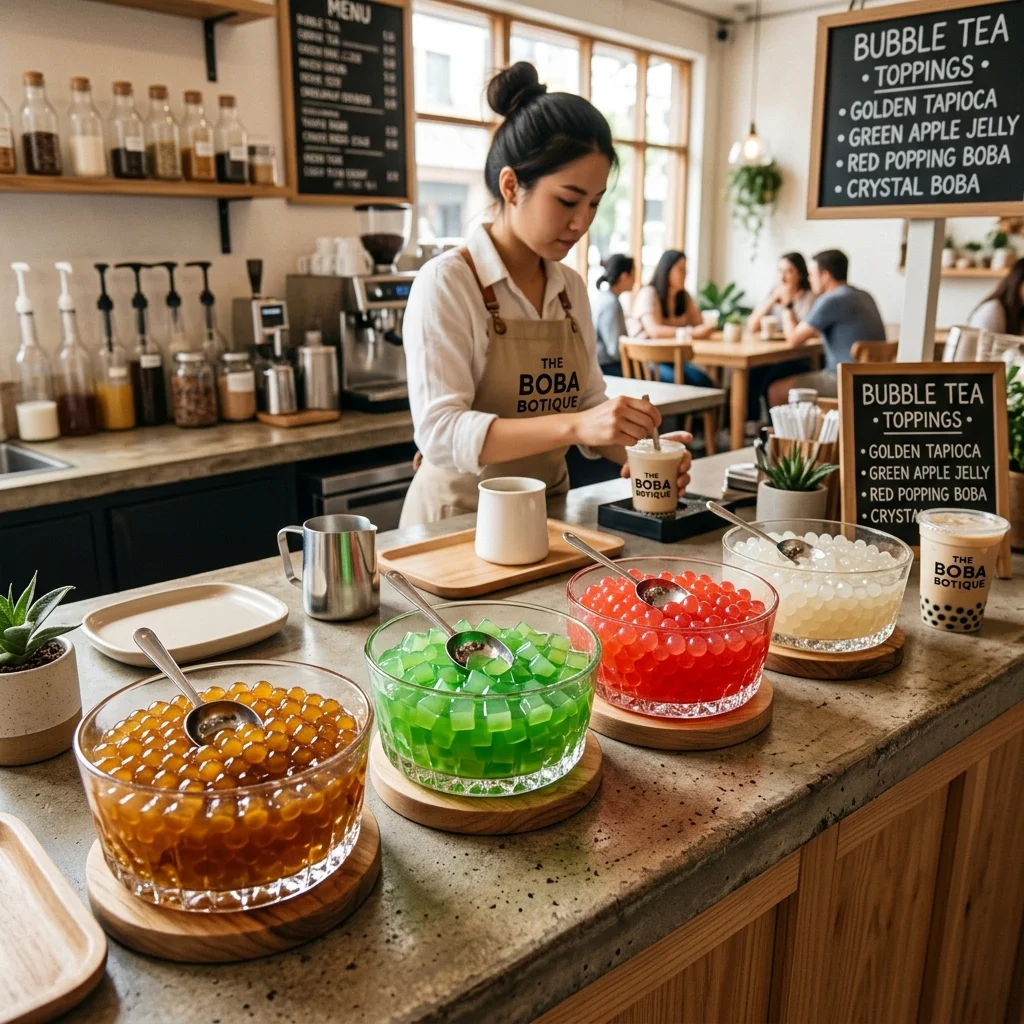
Why Do Boba Toppings Vary So Dramatically in Calories?
The vast calorie discrepancy between a 30-calorie scoop of grass jelly and a 200-calorie scoop of tapioca boils down to macronutrient composition and molecular structure. For a chewy texture with minimal carbohydrates, discover low-calorie crystal boba konjac pearls:
- Starch Gelatinization (Tapioca Pearls): Cassava starch consists of pure carbohydrate polymer chains (amylose and amylopectin). Gelatinized pearls absorb sugar syrup directly into their expanded starchy pores while resting in holding containers. Carbohydrates provide 4 calories per gram; with 35 to 50 grams of complex starch and absorbed sugars per scoop, tapioca functions nutritionally like a portion of pasta or white rice.
- Plant Hydrocolloids & Water Retention (Jellies): Grass jelly, crystal boba, aiyu jelly, and aloe vera consist of 90% to 95% bound water trapped within a rigid polysaccharide lattice. The base gelling agents contribute virtually zero usable energy; nearly all calories originate from the residual syrup coating their surface.
- Lipid Density (Cheese Foam): Fat delivers 9 calories per gram—more than double the energy density of carbohydrates or proteins. A rich cheese foam cap made with heavy whipping cream and cream cheese concentrates dairy fats, generating high caloric density even in modest 50 ml portions.
Tapioca Pearls vs Crystal Boba: Nutritional Face-Off
Because crystal boba is widely ordered as a direct alternative to black boba, comparing their nutritional profiles highlights the concrete health impact of switching:
| Nutritional Factor | Black Tapioca Pearls (60 g) | Crystal Boba (60 g) | Net Impact on Beverage |
|---|---|---|---|
| Total Caloric Content | 140 – 200 kcal | 40 – 70 kcal | Saves 100 to 130 calories per drink |
| Total Carbohydrates | 35 – 50 g | 10 – 16 g | Cuts carbohydrate load by roughly 70% |
| Dietary Fibre | < 0.5 g | 1 – 3 g | Provides beneficial prebiotic soluble fibre |
| Glycemic Impact | High (rapid starch digestion) | Moderate to Low | Significantly attenuates postprandial glucose spike |
What Counts as One Scoop? Portion Math
Commercial boba shops do not use digital scales behind the counter during peak hours. Serving portions are governed by the volume of the ladle used:
- Perforated Ladle: Strains liquid, transferring roughly 50 to 60 grams of solids.
- Solid Ladle: Transfers pearls along with 20 to 30 ml of heavy brown sugar syrup, potentially adding 40 to 60 hidden calories.
To accurately calculate calories consumed from packaged toppings at home, use the universal portion formula:
Calories Eaten = (Nutrition Label Calories ÷ Serving Size in Grams) × Grams Consumed
Smart Ordering Matrix: How to Cut 300+ Calories per Drink
You do not need to give up bubble tea to manage calorie intake. By swapping high-density toppings and moderating syrup levels, you can dramatically optimize your order:
| Drink Category | High-Calorie Standard Order | Optimized Low-Calorie Swap | Caloric Savings |
|---|---|---|---|
| Classic Milk Tea | 24 oz Brown Sugar Milk Tea + Tapioca (520 kcal) | 16 oz Assam Milk Tea (30% sugar, fresh milk) + Grass Jelly (180 kcal) | ~340 kcal saved |
| Refreshing Fruit Tea | 24 oz Mango Green Tea (100% sugar) + Popping Boba (380 kcal) | 16 oz Jasmine Green Tea (25% sugar) + Drained Aloe Vera (110 kcal) | ~270 kcal saved |
| Matcha Specialty | 24 oz Matcha Latte (Full sugar) + Red Bean + Cheese Foam (560 kcal) | 16 oz Unsweetened Matcha Latte + Crystal Boba (160 kcal) | ~400 kcal saved |
The Bottom Line
Topping choice is the single most influential variable determining whether your bubble tea is a refreshing 150-calorie refreshment or a dessert exceeding 500 calories. If weight management is your goal, swap starch-heavy tapioca pearls and high-fat cheese foam for plant hydrocolloids like drained aloe vera, grass jelly, or crystal boba, and request that the barista use a perforated ladle to leave excess holding syrup behind.
Frequently Asked Questions
Which boba topping has the lowest calories?
Drained aloe vera is the lowest-calorie boba topping, contributing roughly 25 to 35 calories per 60 g scoop. To learn about preparation methods and texture pairings, see our bubble tea toppings master guide. Grass jelly (30 to 45 calories) and aiyu jelly (35 to 50 calories) closely follow as ultra-light alternatives.
Why do tapioca pearls have so many calories?
Tapioca pearls are made from pure cassava root starch, a dense complex carbohydrate. When boiled, the starch gelatinizes and absorbs large volumes of dark brown sugar or honey syrup, yielding 140 to 200 calories per standard serving.
Does draining the syrup reduce the calories of boba toppings?
Yes. For plant jellies and aloe vera, virtually all calories come from the surrounding holding syrup. Asking the barista to strain the scoop with a perforated ladle can eliminate 30% to 50% of the topping’s total calorie content.
Is popping boba lower in calories than traditional tapioca?
Yes. A 60 g scoop of popping boba supplies roughly 45 to 75 calories, compared to 140 to 200 calories for black tapioca pearls. Popping boba contains an aqueous liquid core rather than a solid starch matrix.
How many calories does cheese foam add to a drink?
Salted cheese foam typically adds 150 to 220 calories per serving. Because it is prepared with whipping cream, cream cheese, whole milk, and sugar, its high concentration of dairy fats (9 calories per gram) elevates the overall energy count.
Are crystal boba pearls low calorie?
Crystal boba contributes 40 to 70 calories per 60 g serving—roughly half the calories of tapioca pearls. Formulated from konjac glucomannan and agar, it supplies soluble dietary fibre rather than digestible starch.
Does ordering 0% sugar make toppings calorie-free?
No. Requesting 0% sweetness removes only the adjustable liquid cane syrup added to the tea base. Tapioca pearls, pudding, red beans, and jellies still retain their own internal sugars and starches.
Can you fit bubble tea into a weight loss diet?
Yes. By selecting unsweetened brewed tea (0% sugar), using plant milk or low-fat dairy, and opting for grass jelly or aloe vera instead of tapioca pearls, a complete 16 oz beverage can be enjoyed for under 100 total calories.
Sources and Reference Standards
- US Department of Agriculture (USDA): FoodData Central – Tapioca Pearls (FDC ID 169717) and Hydrocolloid Profiles.
- US Food and Drug Administration (FDA): Title 21 CFR § 101.9 – Food Labeling: Caloric Conversion Factors.
- American Heart Association (AHA): Dietary Guidelines for Added Sugars and Daily Intake Limits.
- Journal of Food Science: Starch Gelatinization and Caloric Bioavailability in Cassava Gels.
- Sharetea Global: Official Beverage Nutritional & Allergen Standard Formulations.


Comments