
What Is Nata de Coco? Taste, Texture and Boba Uses
Nata de coco is a chewy, translucent food made by fermenting coconut water. Cellulose-producing bacteria grow a firm layer at the surface of the liquid. Producers harvest this layer, wash it, cut it into cubes and often pack it in sweet syrup.
Quick answer: Nata de coco is a Filipino fermented coconut-water product. Acetic acid bacteria, often from the genus Komagataeibacter, turn sugar in a prepared liquid into bacterial cellulose. The cellulose forms a wet sheet, which is washed, cut and usually sweetened before serving.
The finished cubes have a crisp, springy bite. Bubble tea shops use them in fruit tea, milk tea, smoothies and other cold drinks. Nata de coco is also common in Filipino desserts, fruit mixes, puddings and ice cream.
Packaged products differ in sugar, flavour, colour and serving size. Check the label before calling a product low-calorie, high-fibre, vegan, halal or gluten-free.
What is nata de coco?
The name comes from Spanish. Nata can refer to a cream or skin that forms on a liquid, and de coco means of coconut. The food appears as white or nearly clear cubes once it has been washed and cut.
Nata de coco is mainly water and bacterial cellulose before syrup is added. Cellulose is a carbohydrate found in plant cell walls, though certain bacteria can make it too.
The product is not coconut flesh set with gelatine. It begins with coconut water or another prepared growth medium. The bacteria build the solid part during fermentation.
You may also see these names on menus and labels:
- Coconut gel
- Coconut jelly
- Coconut nata
- Nata cubes
- Fermented coconut jelly
The phrase coconut jelly can also describe products made with coconut milk, agar, carrageenan or gelatine. Read the ingredients if you want nata de coco specifically.
Where did nata de coco come from?
Nata de coco comes from the Philippines. Philippine government sources describe it as a Filipino food product that grew from earlier nata made with pineapple extract (nata de piña). Coconut water later became the main growth liquid.
Reliable sources document the work of chemist Teodula Kalaw Africa on a coconut-based version, while Philippine historical material also describes nata as a traditional product originating in Laguna province.
Coconut water was once a waste stream in some coconut processing businesses. Turning it into nata gave producers another saleable food. The product later spread across Asia and into drinks sold around the globe.
Nata de coco is also used in halo-halo, a Filipino shaved-ice dessert. Other uses include yoghurt, fruit salad, confectionery and bottled juice drinks.
What is nata de coco made of?
A basic commercial formula can include:
- Coconut water
- Sugar as a fermentation feed
- A food-safe bacterial starter culture
- Food acid to control pH
- A nitrogen source for the culture (such as food-grade ammonium sulphate)
- Water for washing and processing
- Sugar syrup after fermentation
- Fruit flavour, colour or preservatives in some products
The finished cellulose came from bacterial activity, though the process started with coconut water. Much of the coconut-water liquid is drained or washed away during production.
This explains why plain nata de coco has little coconut flavour. Syrup often gives the cubes most of their sweetness and aroma.
Is nata de coco made from bacteria?
Yes. Bacteria produce the cellulose structure during fermentation.
The best-known species in research is Komagataeibacter xylinus. Older papers may call it Acetobacter xylinum or Gluconacetobacter xylinus because its scientific classification changed.
Other Komagataeibacter species can produce bacterial cellulose. A review of nata production strains also names K. nataicola. A product should not claim one exact species unless the producer can confirm the culture.
These bacteria belong to a group called acetic acid bacteria. They need oxygen, so a still culture forms cellulose at the boundary between the liquid and air.
How bacteria turn coconut water into cellulose
The bacteria use sugars in the prepared liquid as a carbon source. Inside the cells, glucose enters a series of chemical steps. One intermediate is UDP-glucose.
Cellulose synthase joins glucose units into beta-1,4-glucan chains. The bacteria send very thin fibres, called protofibrils, through sites in the cell envelope. These fibres join into wider crystalline ribbons and then form a floating sheet called a pellicle.
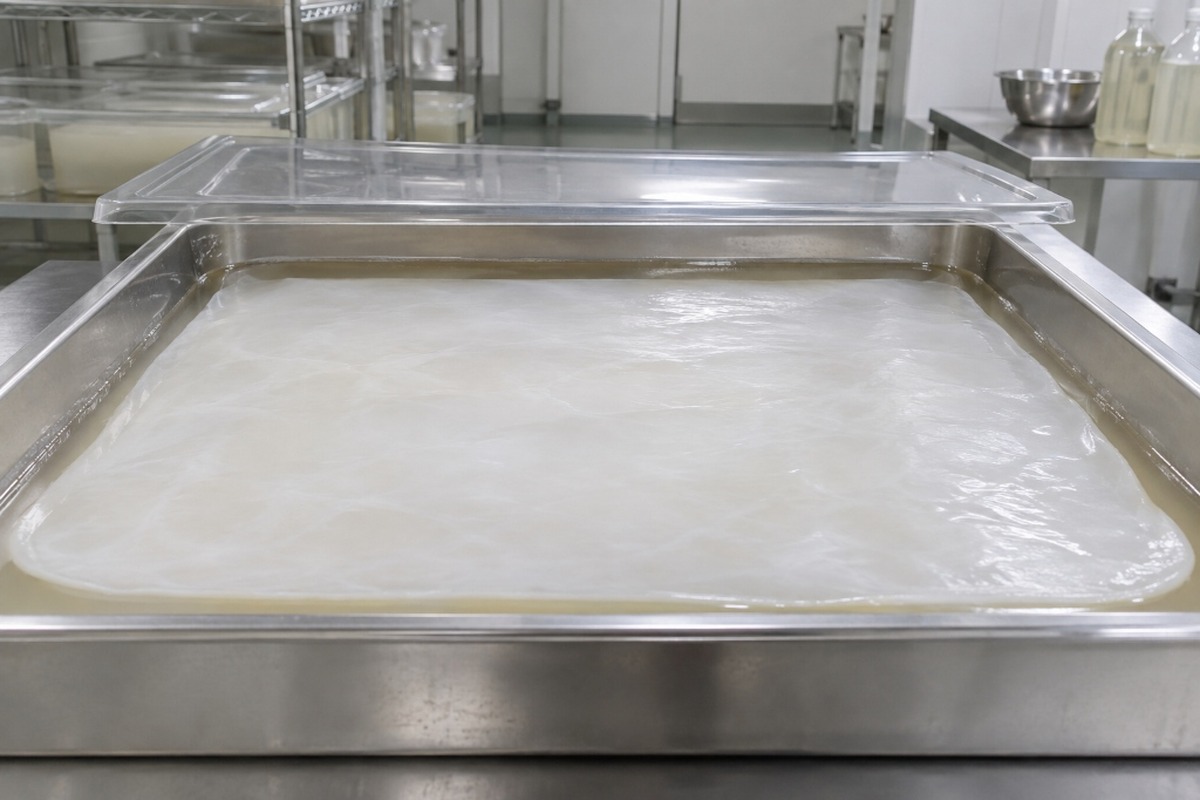
Some parts of the fibres measure at the nanometre scale. The wet pellicle is a three-dimensional cellulose network that holds a large amount of water.
The bacteria grow near the top because oxygen is available there. Researchers call this boundary the liquid-air interface. A clean, undisturbed surface supports a flat sheet. Shaking can change the form and properties of the cellulose.
What affects fermentation?
The final yield and texture depend on:
- Bacterial strain
- Sugar source and amount
- Nutrients in the liquid
- Starting acidity
- Temperature (typically 28°C to 30°C)
- Oxygen exposure
- Container depth and surface area
- Fermentation time (typically 8 to 14 days)
- Hygiene and competing microbes
Industrial producers validate the culture, food additives, sanitation and final washing method. Uncontrolled coconut-water fermentation can carry food-safety risks and give uneven results. Buying a prepared food product is the safer choice for bubble tea shops and home users.
Bacterial cellulose and plant cellulose
Bacterial cellulose and plant cellulose use the same basic beta-1,4-linked glucose structure. Their surrounding materials differ.
| Property | Bacterial Cellulose (Nata de Coco) | Cellulose in Wood / Plant Cell Walls |
|---|---|---|
| Source | Synthesised extracellularly by bacteria | Built directly into plant cell walls |
| Natural companions | High cellulose purity after washing (lacks lignin) | Commonly complexed with lignin, hemicellulose and pectin |
| Microstructure | Fine nanofibrillar network with high water retention | Coarser microfibrils varying by plant source |
| Food example | Nata de coco jelly cubes | Dietary fibre from fruits, vegetables and grains |
Commercial nata cubes are not 100% dry cellulose. They contain a large amount of water and may contain syrup, flavour and other ingredients.
Does nata de coco melt in hot tea?
Nata de coco does not melt in the same way as gelatine because cellulose does not have a normal gel melting point in water. The cubes may soften, lose flavour or change texture during long heating.
Cellulose is insoluble in boiling water under normal food conditions, though syrup, gums and added ingredients may respond to heat. Test the actual topping in the hottest drink sold by the shop. Check texture after 5, 15 and 30 minutes, and follow the manufacturer's serving directions.
What does nata de coco taste like?
Plain, washed nata de coco has very little flavour. It can carry a light fermented or coconut note, though well-washed cubes are usually mild.
Packaged nata takes most of its flavour from the soaking syrup. Mango, lychee, coconut and neutral sugar syrup are common choices.
The texture is firm, juicy and springy. It gives a clean bite and breaks more quickly than a tapioca pearl. It is often described as crunchy, though it does not have the dry crunch of a biscuit or raw vegetable.
Why nata de coco absorbs syrup
The cellulose network holds water in small spaces between its fibres. Once washed cubes sit in syrup, water and dissolved sugar move through that network via diffusion and osmotic pressure.
Commercial syrups are often measured in degrees Brix. A 55° Brix plain sugar syrup contains about 55 g of sucrose per 100 g of solution. Fruit syrup can contain acids, pulp and other dissolved solids, so soaking time, cube size and syrup concentration affect the final sweetness.
Nata de coco boba
Nata de coco boba is a bubble tea topping made from diced nata cubes. It gives fruit tea a firm bite without the dense chew of tapioca pearls.
The topping works exceptionally well with bright fruit flavours, such as:
- Mango green tea: Sweet tropical profile that matches juicy cubes.
- Passion fruit tea: Invigorating acidity balanced by sweet nata. Pair with our Passion Fruit Bubble Tea.
- Lychee drinks: Floral fruit sweetness. Explore our guide on Lychee Boba.
- Citrus smoothies: Lemon or calamansi bases.
- Jasmine green tea: Light floral contrast.
- Yoghurt and yakult drinks: Creamy, tangy tea bases.
To learn more about how toppings are categorized, see our comprehensive guide on What Is Boba?.
Portion and cube size
Start with 50 to 70 g of drained nata in a 500 ml drink. Adjust the amount after testing cost, sweetness and straw flow.
Standard 10 mm cubes pass smoothly through wide 12 mm boba straws. Test the largest cube with the exact straw before service.
Drain excess syrup if the drink recipe already includes a full sweetener portion. Count the packing syrup when calculating the drink's sugar and cost.
How to order it
Choose a fruit tea or light milk tea and add nata de coco as the topping. Ask whether the cubes are packed in syrup and whether the shop can reduce added sweetener.
If dietary needs matter, ask to see the product label to verify gluten, animal ingredients, halal status or allergens.
Is nata de coco healthy?
Nata de coco is a source of cellulose, an insoluble dietary fibre. Its nutrition depends heavily on the syrup and serving size.
Plain bacterial cellulose has little fat or protein. Sweetened commercial nata can contain a large amount of sugar. The Philippine Food and Nutrition Research Institute (FNRI) lists one sweetened nata de coco sample at 146 kcal, 36.1 g carbohydrate, 33.5 g sugar and 0.8 g fibre per 100 g.
| Nutrition Item per Serving | Nata de Coco Product | Tapioca Pearl Product | Full Prepared Drink |
|---|---|---|---|
| Serving weight | From label (e.g. 60–70 g) | From label (e.g. 50–70 g) | Measured recipe (500 ml) |
| Energy (Calories) | ~50–90 kcal (in syrup) | ~150–240 kcal (sweetened) | Calculated total (180–400 kcal) |
| Carbohydrate | 12–22 g | 35–55 g | Calculated total |
| Total sugars | 10–20 g (from syrup) | 15–30 g | Calculated total |
| Dietary Fibre | 0.5–1.5 g (cellulose) | <0.5 g | Calculated total |
For more ordering advice on managing calories and sugar, see our Boba Calories & Ordering Guide.
Fibre and digestion
Humans do not digest cellulose in the same way as sugar or starch. It passes through the digestive system as insoluble fibre.
Fibre supports normal bowel function as part of a balanced diet. Drink enough fluid and use a normal serving. Seek medical advice for a digestive condition or a prescribed low-fibre diet.
Fat, protein and cholesterol
Plain nata cellulose has little fat or protein. Plant-based foods do not contain dietary cholesterol. Added dairy or other ingredients in the full drink change its nutrition.
Is nata de coco vegan, halal and gluten-free?
Traditional nata de coco can be vegan because bacteria make the cellulose from a plant-based growth liquid. A commercial product may contain colour, flavour, processing aids or other ingredients that need checking.
Gluten is not a natural part of bacterial cellulose. Cross-contact and added ingredients remain possible. People with coeliac disease should choose a labelled gluten-free product.
Halal status needs more than a coconut origin. A certified product gives clearer evidence about ingredients, processing aids and factory controls.
Nata de coco vs coconut jelly
| Feature | Nata de Coco | Other Coconut Jelly |
|---|---|---|
| Main structure | Bacterial cellulose | Agar, carrageenan, starch, gelatine or pectin |
| Starting ingredient | Fermented coconut water medium | May use coconut water, coconut milk or flavouring |
| Texture | Firm, crisp and springy | Soft, brittle, creamy or gel-like |
| Production | Microbial fermentation, washing and sweetening | Heated mixture sets during cooling |
| Heat response | Cellulose stays insoluble in hot water | May melt or soften depending on gelling agent |
Nata de coco compared with other boba toppings
| Topping | Main Source | Texture | Usual Flavour | Common Diet Point |
|---|---|---|---|---|
| Nata de coco | Fermented coconut-water medium | Firm, juicy and springy | Mild or syrup-flavoured | Often plant-based; check label |
| Tapioca pearls | Cassava starch | Dense and chewy | Mild until sweetened | Usually served in sugar syrup |
| Grass jelly | Mesona plant extract with starch | Soft and lightly springy | Herbal and slightly bitter | Often plant-based |
| Aiyu jelly | Gel from aiyu fig seeds | Soft and delicate | Very mild | Traditionally plant-based |
| Popping boba | Flavoured liquid in a thin gel skin | Bursts when bitten | Sweet and fruity | Ingredients vary |
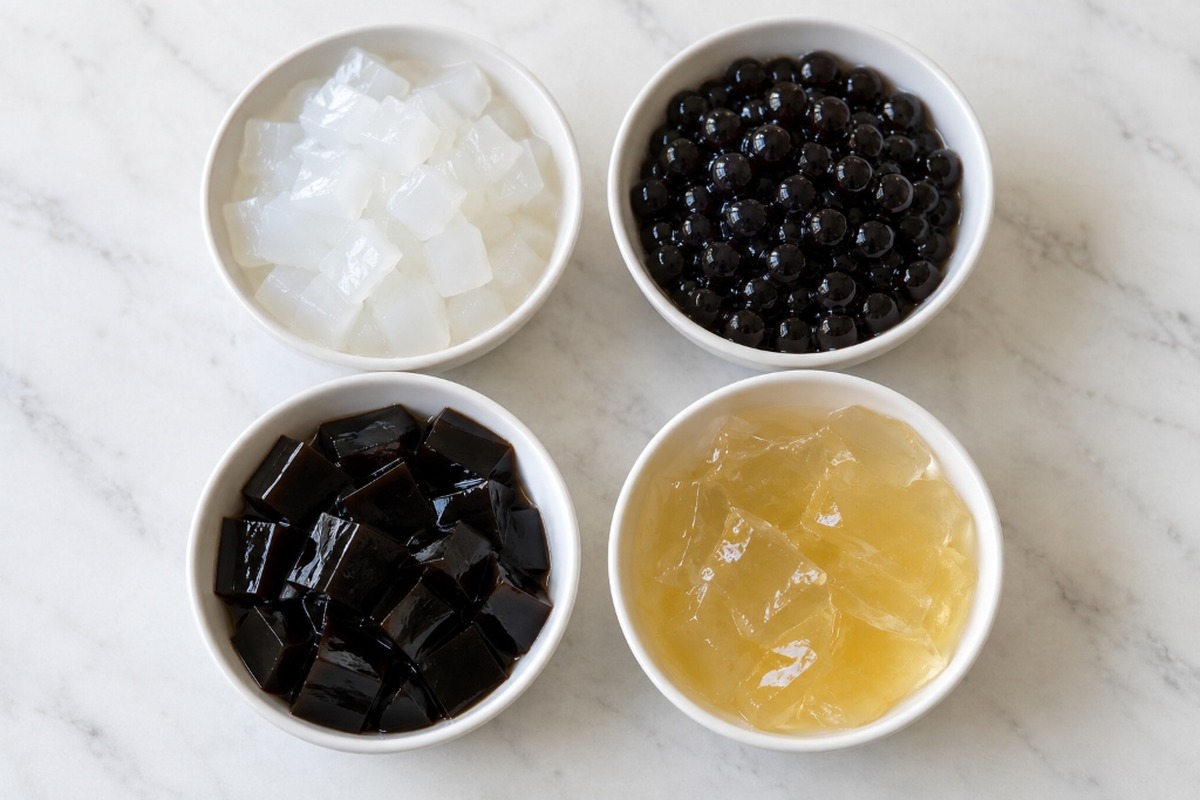
Read our dedicated guides on What Is Grass Jelly?, What Is Aiyu Jelly?, Jelly Boba, and Egg Pudding Boba for full ingredient and texture comparisons.
How nata de coco is produced
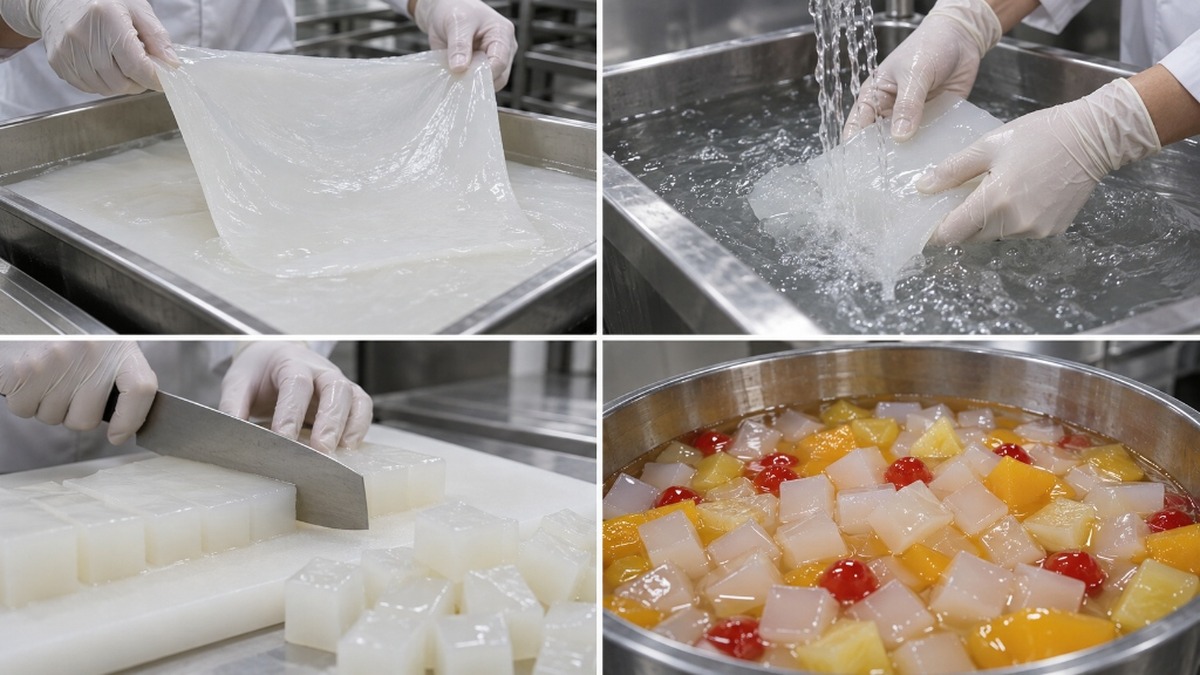
Commercial production has 5 main stages:
1. Prepare the growth liquid
The producer filters coconut water, adds a measured sugar source and adjusts the nutrients and acidity. The mixture is heated or pasteurised to reduce unwanted microbes.
2. Add the culture
A known cellulose-producing culture is added under hygienic conditions. The liquid goes into shallow trays or controlled fermentation vessels.
3. Ferment without movement
The culture sits at a controlled temperature (28°C to 30°C) with access to oxygen. A cellulose pellicle grows at the surface over 8 to 14 days until reaching desired thickness (15 to 25 mm).
4. Wash and cook
Fresh pellicle contains acid and leftover growth liquid. Producers cut and wash it, then use controlled boiling and repeated water changes until reaching a neutral pH (6.5 to 7.0).
5. Dice and sweeten
The cleaned sheet is cut into uniform cubes (usually 10 mm). Producers simmer or soak the cubes in flavoured syrup, pack them and apply a final heat treatment.
Can you make nata de coco at home?
It is possible, though uncontrolled fermentation can grow unwanted microbes. Coconut water, sugar and warm temperatures also support organisms that do not make safe nata.
A casual recipe based on smell and appearance cannot confirm safety. Use a verified food culture, a tested formula, a calibrated pH meter, sanitised equipment and guidance from a qualified fermentation teacher.
Do not use an unknown kombucha layer as a nata starter. A mixed culture can contain different yeasts and bacteria, and a successful cellulose sheet does not prove that the food is safe. Most readers will get a safer and more consistent result from a sealed commercial product.
Storage and food safety
Store unopened nata according to the pack. Shelf-stable jars need refrigeration only after opening, while chilled tubs must remain cold throughout storage.
For a bubble tea shop:
- Record the opening date and discard date
- Use clean, dedicated utensils
- Keep the topping covered and refrigerated
- Avoid mixing a new pack into an old container
- Keep the supplier lot code for tracing
- Include the packing syrup in allergen and nutrition checks
How to choose packaged nata de coco
Check these label details before buying:
- Nata de coco percentage or drained weight
- Serving size and sugar per serving
- Fibre per serving
- Fruit flavour or colour
- Preservatives and acidity regulators
- Vegan, halal or gluten-free certification when needed
- Allergen and cross-contact statement
- Storage directions before and after opening
Common nata de coco problems
The cubes block the straw
Use a wider 12 mm straw or smaller cubes. Test several cubes from each pack because sizes can vary.
The topping makes the drink too sweet
Drain the packing syrup and reduce the drink's added sweetener. Keep the same measured topping portion for cost control.
The nata tastes sour
A light acidic note may remain after processing. A strong vinegar smell can point to poor washing, a changed product or spoilage.
The cubes feel too firm
Brands use different cube sizes, cellulose density and syrup processes. Test another product rather than boiling the topping without supplier directions.
The open tub releases gas or smells unusual
Stop serving it immediately. Isolate the pack, record the lot code and contact the supplier.
Frequently asked questions
Is nata de coco made from bacteria?
Yes. Cellulose-producing bacteria create the solid network during fermentation. Komagataeibacter xylinus is the best-known species in research, though manufacturers may use other strains.
Is nata de coco the same as coconut meat?
No. Coconut meat is the solid flesh inside the fruit. Nata de coco is bacterial cellulose grown in a prepared liquid that often uses coconut water.
Does nata de coco melt in hot tea?
Cellulose does not melt in hot water in the same way as gelatine. A commercial nata cube may soften or change because of syrup and added ingredients, so test the product and follow its directions.
Is nata de coco vegan and gluten-free?
It can be vegan and gluten-free. Added flavours, colours, processing aids and cross-contact can change that answer. Check the label and certification.
Is nata de coco healthy?
Nata supplies cellulose fibre and usually little fat or protein. Sweetened products can contain a large amount of sugar. Judge the serving by its current nutrition label.
What does nata de coco taste like?
Plain nata has a mild flavour. Commercial cubes usually taste of their syrup, such as mango, lychee or coconut.
Is nata de coco a type of boba?
Bubble tea shops use boba as a broad name for toppings, so nata may be listed as coconut boba. It differs from tapioca pearls in ingredients and texture.
Does nata de coco contain gelatine?
Traditional nata gets its structure from bacterial cellulose and does not need gelatine. Check packaged products for added gelling agents.
Is nata de coco halal?
It may meet halal requirements, though the answer depends on all ingredients, processing aids and factory controls. Use a certified product when halal status matters.
How many calories are in nata de coco?
Calories vary with syrup and serving size. One official Philippine food record lists sweetened nata at 146 kcal per 100 g, while other products may differ. Use the pack label.
Is nata de coco made from coconut milk?
Traditional production commonly uses coconut water as the growth liquid. Some products or recipes may use other coconut ingredients, so read the label.
How long does nata de coco last after opening?
Follow the manufacturer's storage and use-after-opening directions. Transfer dates and lot codes to any working container used by a shop.
Sources and research notes
This pillar guide references microbiology research, industrial biotechnology and food standards from the following authorities:
- PubMed & PMC: Bacterial cellulose production by acetic acid bacteria: Biotechnology and applications.
- Frontiers in Microbiology: Characterisation of Komagataeibacter strains in fermented food matrices.
- Philippine Department of Science and Technology (DOST): Nata de coco production technology and standards.
- Philippine National Academy of Science and Technology: Historical origins and food science of nata in the Philippines.
- Philippine Food and Nutrition Research Institute (FNRI): Food composition data for fermented coconut gel.
- US Food and Drug Administration (FDA): Generally Recognized as Safe (GRAS) notices for bacterial cellulose.


 Badge-157x140.png)
Comments