
What Is Grass Jelly? Taste, Ingredients and Boba Uses
Grass jelly is a dark herbal jelly eaten across China, Taiwan and Southeast Asia. Traditional black grass jelly uses an extract from Platostoma palustre, a plant in the mint family, with starch or another setting ingredient. It has a mild herbal taste and a soft, springy texture.
Quick answer: Grass jelly is a plant-based Asian dessert and drink topping. Black grass jelly usually comes from Platostoma palustre, also called Chinese mesona. Producers cook the dried plant to draw out its soluble compounds, then use starch or another gelling method to create a dark, tender jelly.
Bubble tea shops cut the jelly into cubes or strips and add it to milk tea, fruit tea and fresh milk drinks. It gives each sip a smooth texture without the long chew of tapioca pearls.
Recipes and packaged products vary. Some contain sugar, flavouring, colour or several setting agents. Check the ingredient label if you need a vegan, gluten-free or low-sugar option.
What is grass jelly?
Grass jelly is both a dessert and a topping. It can be served in a bowl with syrup, fruit, beans or shaved ice. In bubble tea, small pieces sit at the bottom of the cup and pass through a wide straw.
The name causes some confusion. It does not come from lawn grass. The plant belongs to the Lamiaceae family, which also contains mint, basil and rosemary. Grass jelly does not taste strongly minty.
Kew Science accepts Platostoma palustre as the current botanical name. Older papers and product labels may use Mesona chinensis or Mesona palustris. Those names often refer to the same plant in food research and trade.
Black grass jelly is one regional form. Green grass jellies can use different plants and preparation methods. Check the species rather than assuming that every product called grass jelly has the same ingredients.
Where does grass jelly come from?
Platostoma palustre is native from southern China across parts of tropical Asia. Grass jelly has long been eaten in Chinese, Taiwanese and Southeast Asian food cultures.
Names differ by language and place. You may see:
- Xiancao or xian cao in Mandarin
- Leung fan (凉粉) in Cantonese
- Sian chhau in Taiwanese Hokkien
- Suong sao in Vietnamese
- Cincau hitam in Indonesian and Malaysian
Spelling changes when words move between writing systems. A menu may use herb jelly, black jelly, or a local name.
Taiwan has a strong xiancao dessert and drink tradition, though the food belongs to a wider group of regional dishes across East and Southeast Asia. A careful description gives Taiwan credit for its celebrated night-market dessert culture without assigning the entire botanical history to one region.
What is grass jelly made of?
Traditional black grass jelly can contain:
- Dried Platostoma palustre leaves and stems
- Water
- Starch, often tapioca or corn starch
- An alkaline food ingredient in some methods (such as potassium carbonate)
- Sugar or syrup, if the maker wants a sweet product
Commercial tubs and powders may contain other starches, gums, preservatives, colours or flavours. Read the label for the exact formula.
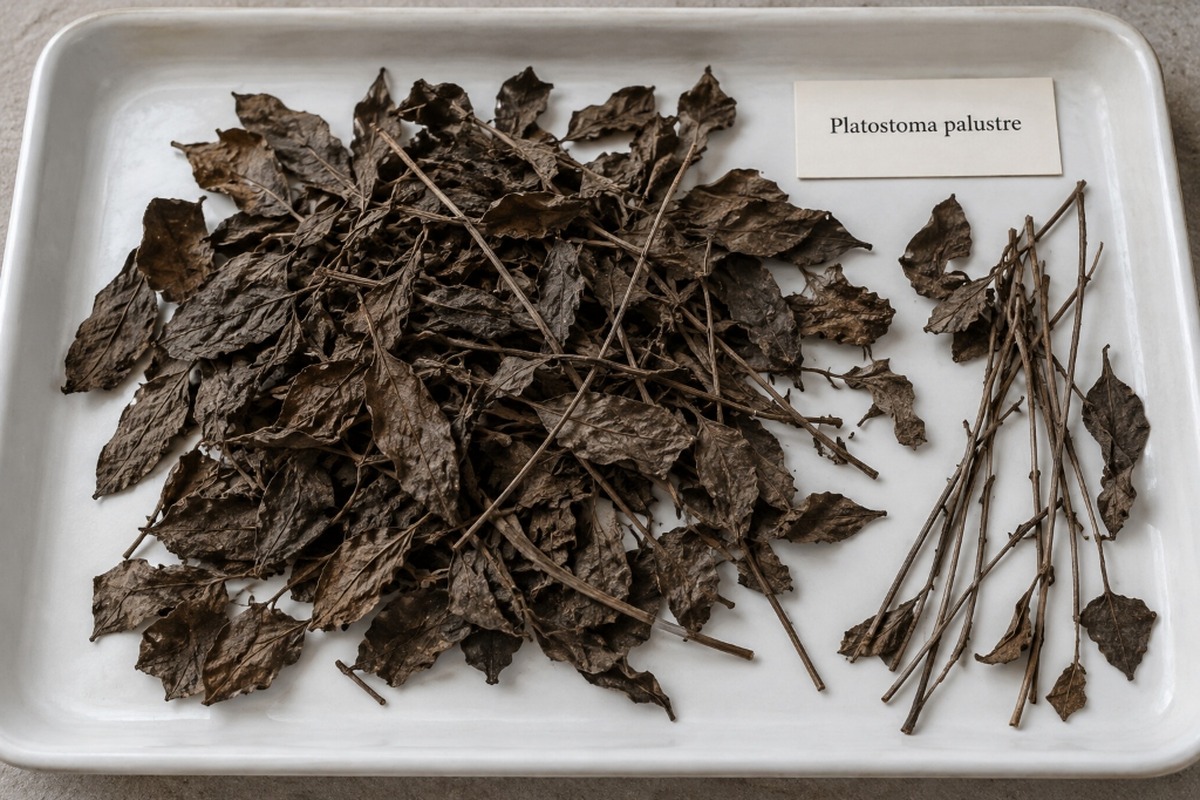
The plant extract
The dried plant releases dark colour, aroma and soluble polysaccharides during cooking. Polysaccharides are long carbohydrate molecules. Research describes mesona polysaccharide as an acidic, negatively charged plant polysaccharide that can interact with starch.
Published research shows several extraction methods, including hot water, hot alkali, enzyme-assisted and ultrasound-assisted methods. Alkali can raise extraction yield and change gel properties, though it is one method rather than a universal rule.
Laboratory studies have found rosmarinic acid, condensed tannins and other phenolic compounds in some mesona extracts. Their levels depend on the plant, storage conditions and extraction method. A finished cup of grass jelly should not be sold as a rich source of any one compound without a product test.
Drying and storage can change the plant polysaccharides. Research has compared fresh material with plants stored for 1 year and found differences in the resulting gel. This confirms that dried or aged material can behave differently, though oxidation alone does not explain every change.
Starch and gel formation
Grass jelly extract may form a weak gel by itself, depending on its concentration and preparation. Starch makes many commercial and home recipes firmer and easier to cut.
During heating, starch granules absorb water and swell. Starch molecules move into the liquid and interact with the plant polysaccharides. As the mixture cools, it develops a more stable gel structure.
Food studies show that starch type and amount change firmness, water retention and sensory quality. This explains why one grass jelly can feel soft and delicate while another has a firm bite.
The main starch molecule involved in setting is amylose. Research describes mesona polysaccharide as containing uronic acids, including galacturonic acid units. Interactions between these plant polysaccharides and starch strengthen the hydrogel network as it heats and cools.
Bloom testing was created for animal gelatine, and grass jelly studies often use other texture measurements. Publish a Bloom figure only when a named product has been tested by a stated method.
Alkaline ingredients
Some recipes use sodium carbonate, sodium bicarbonate or potassium carbonate to raise the pH during extraction. Potassium carbonate is also called E501 on UK and EU-style ingredient lists.
Use only food-grade ingredients and follow a tested food recipe or product directions. Household or laboratory chemicals may have the wrong purity. Too much alkali can give the jelly an unpleasant taste and create an unsafe formula.
Why is grass jelly black?
The dark colour develops while the dried plant is processed and cooked. Plant pigments and phenolic compounds contribute to the brown-black extract. Alkaline conditions can deepen the colour.
Plant age, drying conditions, pH, cooking time, concentration and added colour can all affect the final shade. Check packaged grass jelly for caramel colour or other added colours. A very dark product does not prove that it contains more plant extract.
What does grass jelly taste like?
Grass jelly taste is mild, earthy and herbal. Plain versions can have a light bitterness. Sweetened versions may taste mostly of syrup.
Some people notice flavours that remind them of black tea or liquorice. These notes are not present at the same level in every product. Plant source, drying, extraction and sweetener all change the flavour.
The texture is soft, smooth and lightly springy. It breaks apart more easily than tapioca pearls and needs less chewing. A high-starch product may feel firmer or slightly pasty.
Grass jelly has a quiet flavour, so it can soften the sweetness of a rich drink. It also gives a milk tea more texture without adding another strong fruit or caramel flavour.
Does grass jelly melt in hot bubble tea?
Grass jelly can soften in a hot drink. Its behaviour depends on the plant extract, starch, water level, pH and any added gums.
Research supports good thermal stability in some mesona and starch gels, though it does not support a universal guarantee for every shop product. Test the finished jelly in the hottest drink temperature used by the shop. Record its texture after 5, 15 and 30 minutes to understand its heat tolerance.
Grass jelly in bubble tea
Grass jelly bubble tea combines tea, milk or fruit flavour with pieces of chilled jelly. Shops may list it as a topping or sell a set drink such as grass jelly milk tea.
The topping works in iced drinks and some warm drinks. Heat can soften the gel, and formulas differ, so a shop should test its own product before adding it to a hot menu.
Good tea pairings
Roasted teas suit the herbal flavour well. Recommended pairings include:
- Roasted oolong milk tea: Adds toasted, nutty notes. Use our Oolong Milk Tea Recipe to build the base.
- Assam black milk tea: Strong malty tea that balances herbal jelly.
- Wintermelon tea: Naturally sweet and caramelised, complementing the grass jelly.
- Brown sugar fresh milk: Deep caramel sweetness. Learn more in our Brown Sugar Milk Tea Guide.
- Jasmine green milk tea: Lighter floral contrast.
- Soy milk or oat drink: Nutty, plant-based dairy alternatives.
- Lightly sweetened fresh milk: Clean dairy base that lets herbal notes shine.
To explore how grass jelly compares with other classics, see our guide on What Is Boba?.
How much grass jelly should go in a drink?
Start with 50 to 70 g in a 500 ml drink, then test the balance. The right amount depends on cube size, ice level and straw width.
Cut cubes small enough to pass through the straw without blocking it. Pieces near 8 to 10 mm work with many wide boba straws. Test the exact cup, straw and jelly before service.
Drain excess packing syrup if the drink already has a set sweetness level. Include the syrup in the recipe calculation if it stays in the cup.
How to order grass jelly bubble tea
Choose a tea base and ask for grass jelly as the topping. A first order can use 25% or 50% sweetness because packaged jelly may already contain syrup.
Ask the shop these questions if diet or allergies matter:
- Is the grass jelly sweetened?
- Does it contain dairy or gelatine?
- Which starch or thickener does it use?
- Does the drink contain caffeine?
- Can the shop reduce the added syrup?
The jelly itself does not contain tea leaves, so plain grass jelly is usually caffeine-free. A grass jelly milk tea can contain caffeine from the tea base.
Is grass jelly healthy?
Grass jelly can fit into a balanced diet. Its nutrition depends on the plant concentration, starch, portion size and added sugar.
Commercial products vary widely, and syrup can change the total by a large amount. Use the package label or the shop's recipe for a sound comparison. Include the milk, creamer, syrup and other toppings in the full drink total.
Calories and sugar
Unsweetened grass jelly can be lower in calories than a similar weight of cooked, sweetened tapioca pearls. A grass jelly drink can still contain a large amount of sugar if it includes sweet milk, brown sugar syrup or sweetened jelly.
Ordering less syrup can reduce added sugar. It does not change sugar already present in a premixed powder, sweetened creamer or canned topping.
| Nutrition Item per Serving | Grass Jelly Product | Tapioca Pearl Product | Full Prepared Drink |
|---|---|---|---|
| Serving weight | From label (e.g. 60–100 g) | From label (e.g. 50–70 g) | Measured recipe (500 ml) |
| Energy (Calories) | ~30–50 kcal (unsweetened) | ~150–240 kcal (sweetened) | Calculated total (200–450 kcal) |
| Carbohydrate | 7–12 g | 35–55 g | Calculated total |
| Total sugars | 0–6 g (depends on syrup) | 15–30 g | Calculated total |
| Dietary Fibre | 1.0–1.5 g | <0.5 g | Calculated total |
For more ordering advice on managing drink sweetness, see our Boba Calories & Ordering Guide.
Fibre and carbohydrates
The plant extract contains polysaccharides, and some products contain a small amount of fibre. Added starch also supplies carbohydrate. The final amount depends on the formula.
Do not describe grass jelly as having a negligible effect on blood sugar. A small study of 15 healthy men found no significant change in glucose or insulin response when grass jelly was taken with glucose. The authors suggested that any effect may depend on the type of carbohydrate eaten with it. That study is too small to support a clinical treatment claim.
People who manage diabetes should count the whole drink, including syrup, milk and starch. Product nutrition and medical advice give a better basis for decisions than the colour or herbal origin of the topping.
Traditional cooling claims
Grass jelly has a history of use as a cooling food in Traditional Chinese Medicine. The idea is often described as qing re (清热), or clearing heat.
This is a traditional food classification, not a measured drop in body temperature. Laboratory and early human studies on mesona compounds do not prove that a normal serving prevents or treats disease. Enjoy grass jelly as food, and avoid claims that it cures heatstroke, lowers blood pressure, or controls diabetes.
Is grass jelly vegan or vegetarian?
Traditional grass jelly uses a plant extract and starch, so it can be vegan. It does not need animal gelatine to set.
Packaged products may include dairy, honey, flavour carriers or other ingredients. Preparation at a shop can also introduce cross-contact. Check the label and ask the seller if you follow a strict vegan diet.
Is grass jelly gluten-free?
Grass jelly made with tapioca or corn starch may have no gluten-containing ingredients. Wheat starch, shared equipment or added flavouring can change that answer.
People with coeliac disease should use a product labelled gluten-free and ask about cross-contact. A plant-based label does not confirm gluten status.
Grass jelly compared with other boba toppings
| Topping | Main Source | Texture | Usual Flavour | Common Diet Point |
|---|---|---|---|---|
| Grass jelly | Mesona plant extract with starch | Soft, smooth and lightly springy | Mild, herbal and slightly bitter | Often vegan; check label |
| Tapioca pearls | Cassava starch | Dense and chewy | Mild until sweetened | Usually vegan; served in syrup |
| Aiyu jelly | Gel from aiyu fig seeds | Soft and delicate | Very mild | Traditionally plant-based |
| Nata de coco | Fermented coconut water | Firm and crisp | Light coconut or syrup flavour | Usually vegan |
| Agar jelly | Red algae extract | Firm and clean-cutting | Neutral | Plant-based |
| Popping boba | Juice/syrup in sodium alginate skin | Bursts when bitten | Sweet and fruity | Ingredients vary by brand |
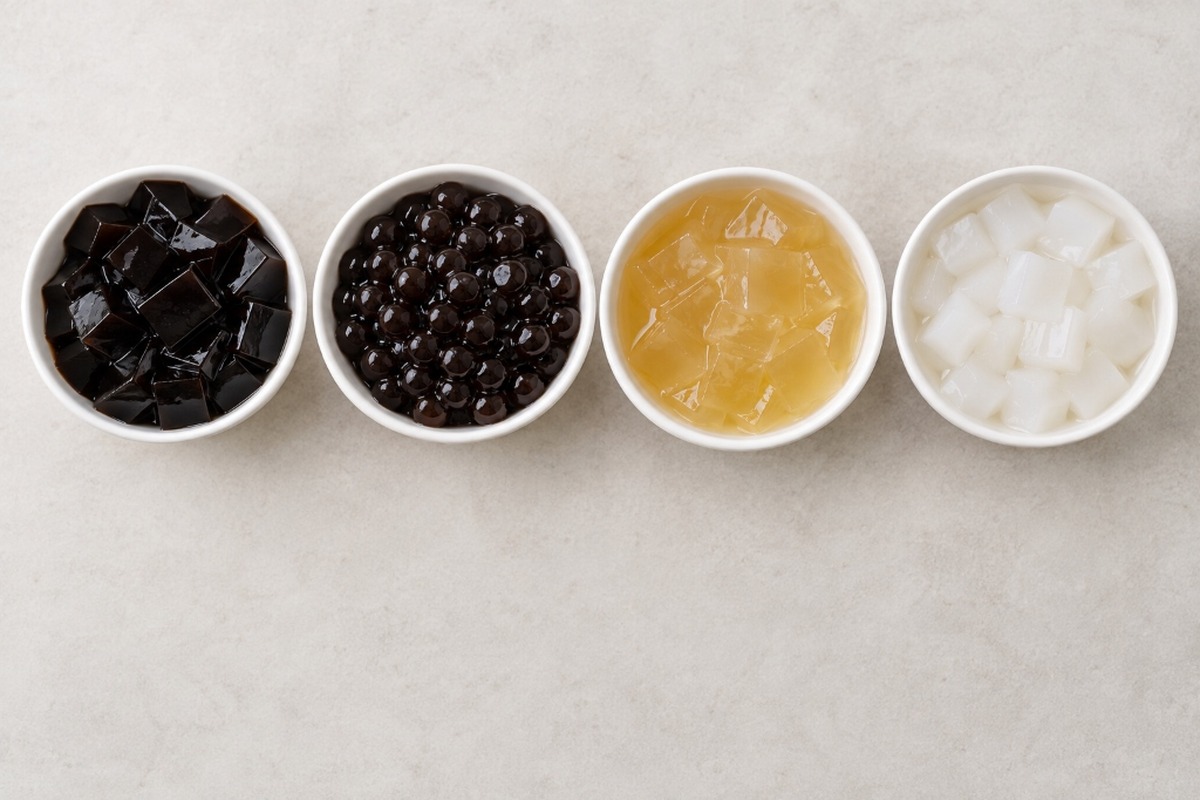
Grass jelly suits customers who want a softer topping with a restrained flavour. Tapioca suits customers who want a long chew. Nata de coco has a firmer bite, while Aiyu Jelly is more delicate. You can also explore Jelly Boba (Agar-Based), Crystal Boba, and Egg Pudding Boba in our topping guides.
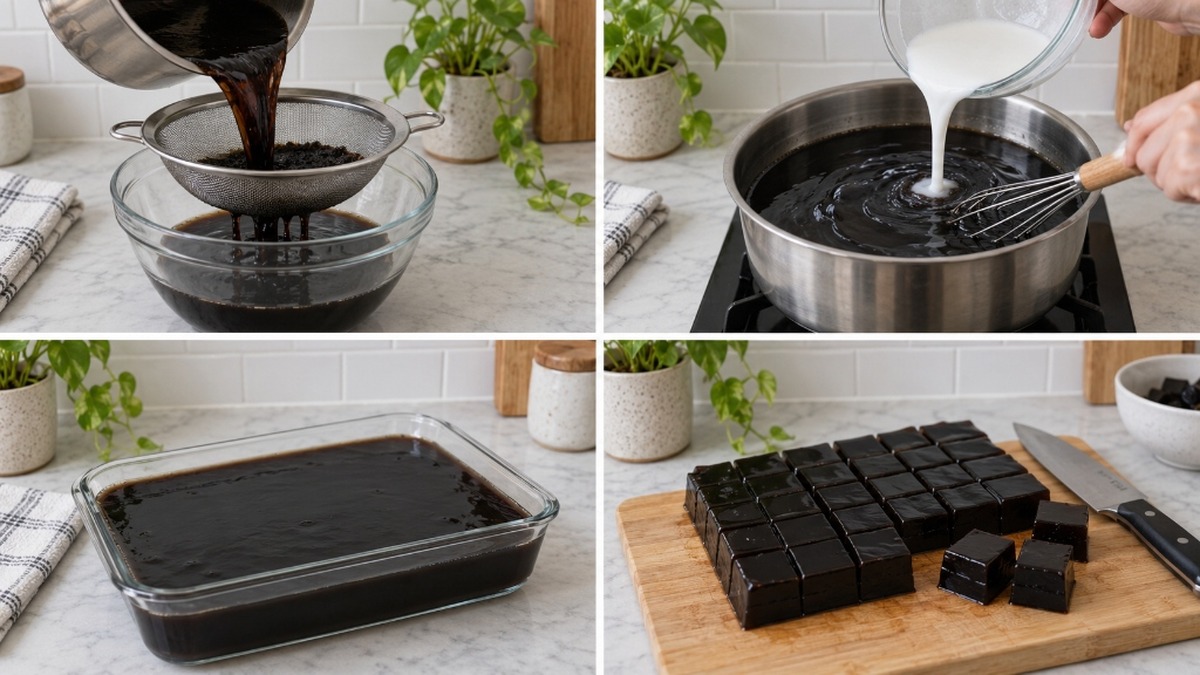
How grass jelly is made
The basic process has 4 parts: extraction, straining, thickening and cooling.
1. Extract the dried plant
Rinse food-grade dried Platostoma palustre. Simmer it in water according to a tested recipe. Some formulas add a small measured amount of food-grade alkali during this stage.
Cooking draws colour, flavour and soluble polysaccharides into the water. Time and pH affect yield, so follow the supplier's method rather than guessing.
2. Strain the liquid
Pass the dark liquid through a fine food-safe filter. Remove all tough leaves and stems. Pressing the material can increase yield, though very fine particles may make the jelly cloudy or rough.
3. Add the setting ingredient
Mix starch with cold water before adding it. A cold slurry reduces lumps. Stir it into the hot extract and heat it for the time stated in the recipe.
Tapioca starch often gives a springy result. Corn starch can produce a different firmness and flavour release. Research confirms that starch type changes gel strength and sensory scores.
4. Cool and cut
Pour the hot mixture into a clean, heat-safe tray. Cool it safely, then refrigerate until fully set. Cut it into even cubes with a clean knife.
For a food business, add the batch time, storage temperature and discard time to the label. Use the shelf life set by the manufacturer or the business's approved food-safety system.
A grass jelly recipe for home testing
This recipe follows traditional kitchen methods with added safety limits. Dried herb strength varies, so the result may need testing.
| Ingredient | Quantity | Role & Notes |
|---|---|---|
| Dried Platostoma palustre | 50 g | Food-grade dried leaves and stems |
| Water (for simmering) | 1.5 litres | Clean filtered water |
| Brown sugar | 30 g (or to taste) | Softens herbal bitterness |
| Tapioca starch | 30 g | Provides springy gel matrix |
| Cold water (for starch slurry) | 60 ml | Dissolves starch smoothly without lumps |
| Food-grade potassium carbonate | Optional (supplier guided) | Only if tested supplier formula requires it |
Method
- Rinse the dried plant under clean running water.
- Put it in a stainless-steel pot with 1.5 litres of water.
- Add a measured food-grade alkaline ingredient only when the tested recipe calls for it.
- Cover and simmer gently for about 2 to 2.5 hours, adding safe hot water if needed to prevent the plant from drying out.
- Strain through a fine food-safe cloth or filter. Return the liquid to a clean pot.
- Stir in the brown sugar.
- Mix the tapioca starch with 60 ml cold water until smooth.
- Pour the slurry into the hot extract in a thin stream while stirring.
- Bring the mixture back to a full simmer and cook until thick and glossy, following the starch directions.
- Pour it into a clean heat-safe dish.
- Cool it promptly and refrigerate at 5°C or below once steam has reduced. Do not leave it at room temperature for longer than needed.
- Cut the cold jelly into 8 to 10 mm cubes.
Taste a small finished piece before serving. A harsh alkaline flavour, unexpected smell or failed set means the batch should be discarded.
Easier method with grass jelly powder
A commercial grass jelly powder gives more consistent results because the plant extract and gelling ingredients are already measured. Follow the pack's water ratio, heating time, cooling directions and storage period.
Do not assume every powder is vegan or gluten-free. Check its starches, gums, flavours and factory allergen statement.
Storage and food safety
Homemade grass jelly is a cooked, moist food. Keep it covered and chilled. The UK Food Standards Agency recommends setting a fridge at 5°C or below, while the legal limit for chilled food in England, Wales and Northern Ireland is 8°C or below.
Cool a large tray in shallow portions so heat can leave faster. Keep raw plant material, chemicals and dirty tools away from the cooked jelly.
Use clean utensils for each service. Do not leave a scoop sitting in the topping. Avoid topping up an old container with a new batch because the new food can inherit the old discard time.
For a business, set shelf life through the product label, supplier data and food-safety plan. Smell and appearance cannot prove that stored food is safe.
How to choose packaged grass jelly
Read the label before comparing brands. Check:
- Percentage or position of grass jelly extract in the ingredient list
- Type of starch or gelling agent
- Added sugar and serving size
- Preservatives, colours and flavours
- Vegan and gluten-free statements
- Allergen warnings
- Storage directions before and after opening
- Country of origin and drained weight
A short ingredient list does not always mean better texture. Choose the formula that suits the drink, diet needs and service method.
Common grass jelly problems
The jelly does not set
The extract may be weak, the starch amount may be low or the mixture may not have reached the needed cooking temperature. Use weighed ingredients and follow the starch directions.
The jelly is too firm
Reduce the starch in the next test batch. Do not change a commercial food recipe until the revised shelf life and handling method have been checked.
The jelly tastes bitter
Some herbal bitterness is normal. Excess plant material, a long extraction or too much alkaline ingredient can make it harsh. Sweetener can soften light bitterness, though it cannot repair a badly measured batch.
The jelly releases water
Gel structure can weaken during storage. Starch type, concentration, freezing and repeated temperature changes can cause water separation. Make smaller batches and follow the storage limit.
The straw keeps blocking
Cut smaller, even cubes (8 to 10 mm) and test the largest piece with the straw. Do not force a blocked straw while drinking.
Frequently asked questions
Is grass jelly made from real grass?
No. Black grass jelly usually comes from Platostoma palustre, a plant in the mint family. The name refers to the dried herb and the finished jelly, not lawn grass.
What does grass jelly taste like?
Grass jelly has a mild earthy and herbal flavour with light bitterness. Sugar syrup makes commercial versions sweeter.
Is grass jelly vegan?
Traditional grass jelly can be vegan because it uses plant extract and starch instead of animal gelatine. Check packaged products for dairy, honey and other added ingredients.
Why is grass jelly black?
The dried plant creates a dark extract when cooked. Plant pigments, phenolic compounds, pH, concentration and any added colour affect the final shade.
What is grass jelly made of?
Traditional black grass jelly uses water and an extract of Platostoma palustre. Many recipes add tapioca or corn starch. Some also use a food-grade alkaline ingredient and sugar.
Is grass jelly healthy?
It can be a lower-calorie topping when it contains little sugar. Nutrition varies by recipe, and a sweet milk tea can still contain a large amount of sugar. Grass jelly has no proven role as a medical treatment.
Does grass jelly contain gelatine?
Traditional recipes do not require gelatine. Packaged formulas differ, so check the ingredient list if you avoid animal products.
Is grass jelly the same as herbal jelly?
Black grass jelly is often sold as herbal jelly. The name herbal jelly can also cover products made from other plants, so check the ingredient list.
Does grass jelly have caffeine?
Plain grass jelly is usually caffeine-free because it does not contain tea leaves. A grass jelly milk tea can contain caffeine from black, green or oolong tea.
Can grass jelly go in hot bubble tea?
Some grass jelly works in warm drinks, though heat can soften it. Test the product and follow its serving directions. Avoid claiming that every formula remains firm at a fixed temperature.
Is grass jelly gluten-free?
It may be gluten-free when made with tapioca or corn starch. Wheat starch and cross-contact are possible, so people with coeliac disease should choose a product labelled gluten-free.
What is the difference between grass jelly and boba?
Grass jelly is a soft herbal gel. Tapioca boba consists mainly of cassava starch and has a dense, chewy texture. Both can be used in the same drink.
Sources and research notes
This pillar guide references botanical classifications, polysaccharide hydrogel research and food safety standards from the following authorities:
- Royal Botanic Gardens, Kew: Platostoma palustre (Blume) A.J.Paton taxonomic record.
- Food Production, Processing and Nutrition: Research on mesona polysaccharide extraction and starch interactions.
- Food Hydrocolloids: Gelation mechanisms, amylose-mesona hydrogel networks, and texture profiling.
- PubMed Central: Clinical evaluation of herbal mesona extracts and glycaemic responses.
- UK Food Standards Agency (FSA): Chilled food temperature control regulations and safe storage thresholds.


 Badge-157x140.png)
Comments