
What Is Aiyu Jelly? Taste, Recipe, Benefits & Bubble Tea Uses
Unlike most fruit jellies that require gelatin, agar, or boiling heat to solidify, authentic aiyu jelly sets entirely at room temperature through natural plant enzymes and cold mineral water. That unique botanical chemistry makes it one of the most refreshing, delicate, and historic toppings in Taiwanese bubble tea and dessert culture.
Quick answer: What is aiyu jelly? Aiyu jelly is a soft, pale-gold dessert made by washing dried aiyu seeds in water. The seeds come from Ficus pumila var. awkeotsang. Natural pectin, a methylesterase enzyme and calcium ions work together so the liquid can set at room temperature without gelatin or cooking. [1][2]
Aiyu is closely tied to Taiwanese food culture and is often served cold with lemon, honey or syrup. Taiwan tourism material describes lemon-and-honey aiyu as a popular summer jelly. [6]
The accepted botanical name is Ficus pumila var. awkeotsang (Makino) Corner. Kew lists its native range as Taiwan and southeastern China. [3]
What is aiyu jelly made from?
Traditional aiyu jelly starts with dried aiyu seeds and water. During washing, the seed surface releases pectin-rich material and a natural methylesterase enzyme. Research on aiyu gel formation shows that calcium ions then bind with the pectin and create the gel network. [1][2]
This explains one of aiyu's most unusual features: it can set at room temperature. Many fruit jellies need heat, added sugar or acid to form a firm gel, while fresh aiyu can set after the seeds are rubbed or kneaded in suitable water. [1]
Traditional hand-washed aiyu does not need animal gelatin. Plain aiyu made from seeds and water is plant-based. If it is served with honey, the finished dessert is no longer vegan.
Why does aiyu jelly set without cooking?
Aiyu contains pectin and a natural methylesterase. The enzyme changes parts of the pectin so calcium can join nearby pectin chains. Food-science papers describe this calcium-linked structure using the egg-box model. [1][2]
The chemistry can sound technical, but the practical point is simple: the seeds supply the pectin and enzyme, while the water must supply enough suitable minerals for the gel to form.
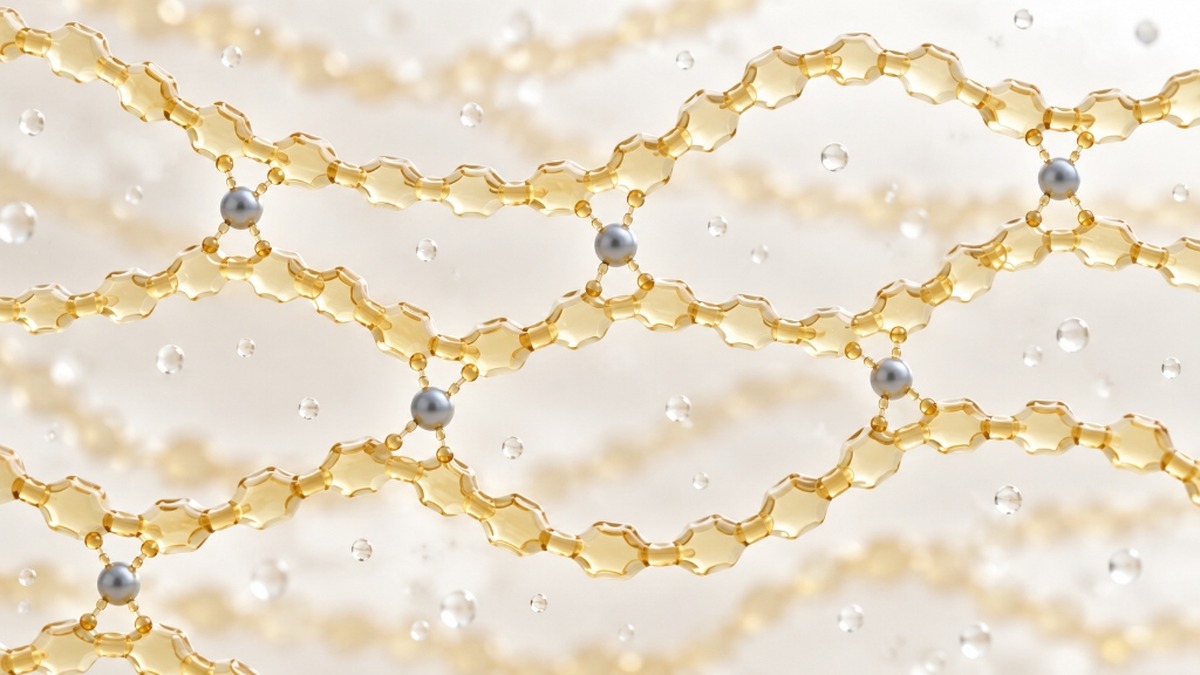
| Topping / Gelling Agent | Gelling Mechanism | Heat Required? | Texture Profile |
|---|---|---|---|
| Aiyu Jelly | Enzyme-demethylated pectin + Calcium cross-linking | No (Cold mineral water) | Soft, slippery, melt-in-mouth |
| Agar Agar Jelly | Polysaccharide double-helix thermal network | Yes (Boiled above 85°C) | Firm, brittle, clean bite |
| Konjac Jelly | Glucomannan alkaline thermal gelation | Yes (Heat + alkali) | Dense, bouncy, highly chewy |
| Animal Gelatin | Collagen triple-helix reformation on chilling | Yes (Dissolved in hot water) | Elastic, melts at body temp |
Why water choice matters
Distilled water is a poor choice for fresh aiyu because it lacks the metal ions needed for reliable gel formation. The Hong Kong Science Museum advises using boiled water or mineral water at room temperature and warns against distilled water. It also notes that calcium and magnesium in water take part in the setting process. [4]
Very low-mineral reverse-osmosis water can also give a weak or failed set. Water sources differ, so avoid treating one fixed mineral number as a universal rule. Hard tap water or a mineral-rich spring or bottled water is a safer starting point.
If a batch fails with one bottled water, try another water source with a known calcium and magnesium content before changing the seed ratio.
Aiyu jelly recipe
The research report supplied for this article uses 20 g of aiyu seeds with 1.2 L of cold mineral-rich water. That ratio is close to public science guidance that uses about 1 g of seeds per 50 ml of water. [4]
| Ingredient / Tool | Quantity | Purpose / Practical Role |
|---|---|---|
| Dried Aiyu Seeds | 20 g | Source of pectin and pectin methylesterase enzyme |
| Cold Mineral-Rich Water | 1.2 L (1,200 ml) | Supplies calcium and magnesium ions for cross-linking |
| Clean Cotton / Nut-Milk Bag | 1 piece | Holds seeds while allowing pectin extraction (100% grease-free) |
| Fresh Lemon Juice | To taste (15–30 ml) | Provides refreshing acidity for traditional serving |
| Honey or Sugar Syrup | To taste (15–30 ml) | Balances lemon tartness with natural sweetness |
| Ice & Chilled Jasmine Green Tea | Optional (150–200 ml) | Base liquid for bubble tea and iced summer drink format |
1. Prepare the bag and bowl
Place the seeds in the cotton bag and tie it securely. Wash your hands and make sure the bag, bowl and utensils have no grease or soap residue. The Hong Kong Science Museum warns that grease can interfere with gel formation. [4]
2. Wash the seeds in water
Submerge the bag in 1.2 L of cold water. Gently rub and knead it for about 7 to 10 minutes. The liquid should become pale gold and feel slightly thicker.
Avoid aggressive or very long rubbing. Public science guidance suggests roughly 10 to 15 minutes and warns that over-rubbing can cause problems with setting. [4]
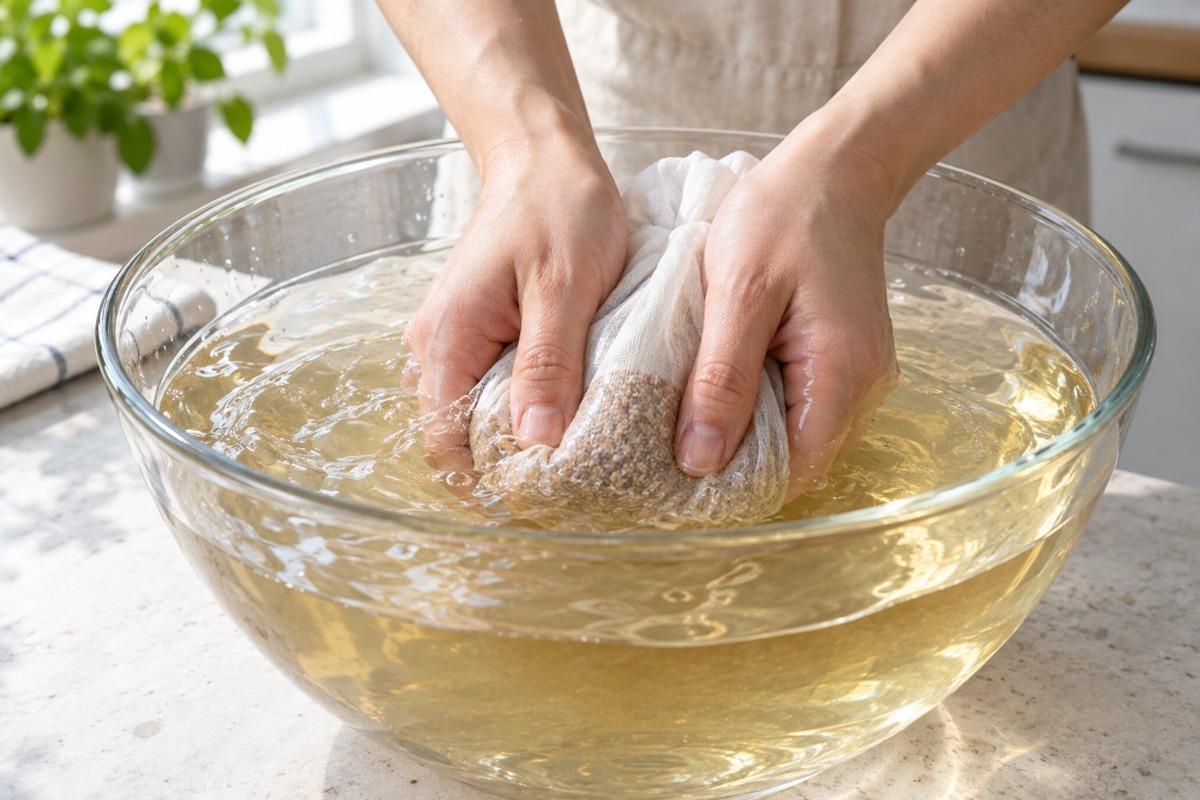
3. Let the liquid set
Lift out the bag and let the liquid rest without stirring. A practical setting window is about 30 to 45 minutes at room temperature. The Hong Kong Science Museum gives a similar 30 to 40 minute rest. [4]
4. Cut and serve
Once set, cut the jelly into cubes or spoon it into a glass. Serve it cold with lemon juice and a small amount of honey or sugar syrup. Add ice or chilled tea if you want a drink rather than a bowl dessert.
Why didn't my aiyu jelly set?
A failed batch usually points to the water or the washing method. Check these points before trying again:
- Use water with enough calcium and magnesium: Distilled water is unsuitable, and very low-mineral RO water may also fail.
- Keep equipment grease-free: Keep hands, bowls and the washing bag completely free from grease or detergent film.
- Rub gently: Rub gently for the recommended time rather than squeezing excessively hard for an extended period.
- Leave undisturbed: Leave the extracted liquid completely still while it sets at room temperature.
- Maintain correct ratios: Use the seed-to-water ratio consistently (roughly 1 g seeds per 50–60 ml water) so the mixture is not overly diluted.
Why fresh aiyu can release water
Fresh aiyu can slowly release water after it sets. Food scientists call this syneresis. A rheology study on aiyu observed syneresis after the gel reached its mature stage. [1]
For the best texture, keep fresh aiyu refrigerated and use it soon after preparation. Taiwan agriculture guidance also advises refrigerating prepared aiyu and eating it promptly. [7]
What does aiyu jelly taste like?
Plain aiyu has a very mild taste. Most of the character comes from its soft, slippery texture and from what you serve with it. Lemon adds acidity, while honey or syrup adds sweetness.
That mild base also makes aiyu easy to use in tea drinks. Jasmine green tea, lemon green tea and passion-fruit tea can carry the main flavour while the jelly adds texture.
Aiyu jelly benefits and nutrition
Plain aiyu jelly is mostly water and very low in calories. Taiwan's Ministry of Agriculture lists 100 g of plain aiyu jelly at 2 kcal, with 99.3 g of water, 0.4 g of carbohydrate and 0.3 g of dietary fibre. [5]
| Nutrient (per 100 g serving) | Plain Aiyu Jelly [5] | With Honey & Lemon (Standard Bowl) |
|---|---|---|
| Energy (Calories) | 2 kcal | 60–110 kcal |
| Water Content | 99.3 g | ~85–90 g |
| Carbohydrates | 0.4 g | 15–28 g (from honey/syrup) |
| Dietary Fibre | 0.3 g | 0.3–0.5 g |
| Fat & Protein | 0.0 g | 0.0 g |
Those figures apply to plain aiyu jelly. Lemon syrup, honey, sugar and sweetened tea can raise the calorie and sugar content by a large amount.
For a food page, the safest benefit claim is the one the data clearly supports: plain aiyu is a water-rich, low-calorie jelly. Medical claims need stronger human evidence and should be kept out of consumer copy unless a qualified reviewer and suitable sources support them.
Lemon aiyu bubble tea
Lemon and aiyu are a long-standing pairing in Taiwan. Taiwan tourism material describes aiyu pectin mixed with lemon juice and honey as a popular summer treat. [6]
For a tea-shop style drink, add fresh aiyu to a glass, then add lemon juice, a small amount of honey or sugar syrup, ice and chilled jasmine green tea. Stir gently so the jelly keeps its soft texture.
This citrus-forward preparation pairs naturally with tart drink bases like Lemon Bubble Tea or lightly sweetened green tea infusions.
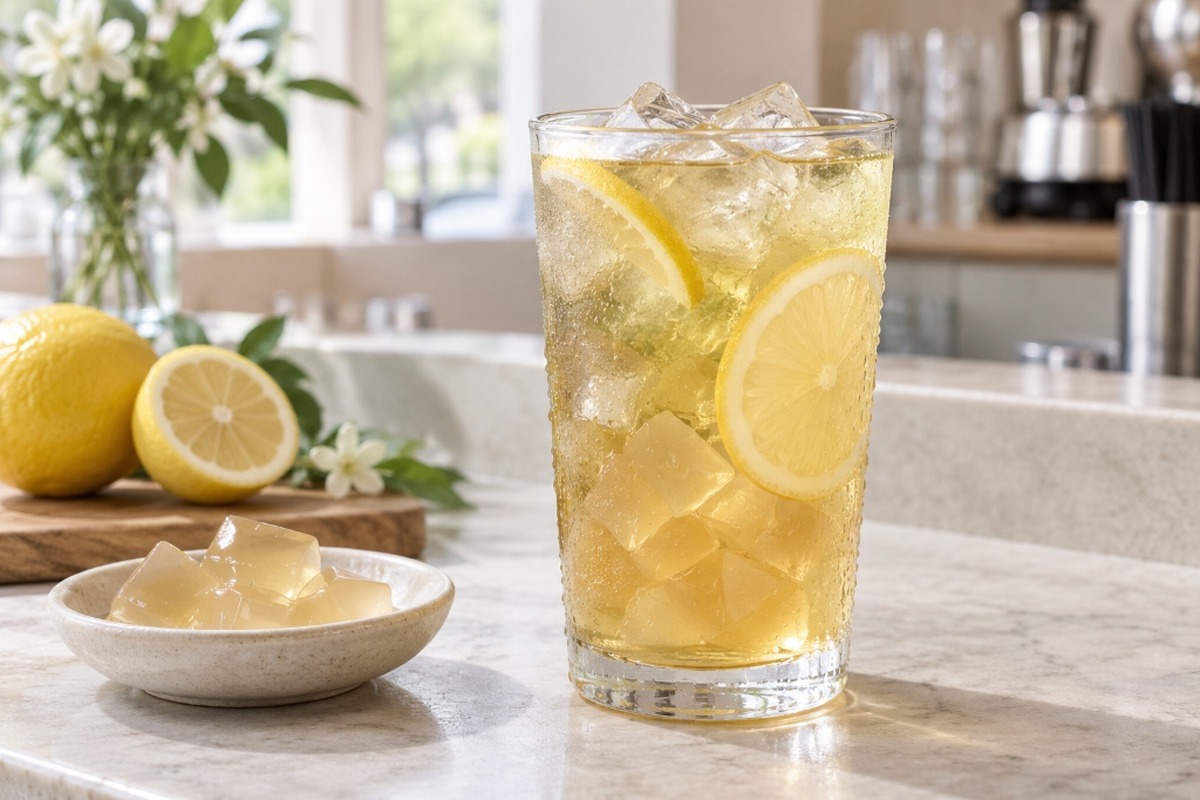
Other drink pairings
The supplied research report recommends fresh lemon green tea, kumquat-calamansi tea and passion-fruit green tea as pairing ideas. These are useful directions for aiyu because the jelly itself is mild.
Pairing aiyu with tropical, tangy fruit teas such as Passion Fruit Bubble Tea provides an invigorating harmony between lively fruit acids and silky, cooling jelly chunks.
Aiyu jelly in Taiwanese food culture
Aiyu has a strong connection with Taiwan, even though the accepted plant range extends into southeastern China. Taiwan's agriculture ministry has published cultivation guidance for the crop, and national tourism material presents aiyu fig jelly as a familiar summer food. [3][6][8]
This cultural section is a better place for factual history than an unverified folk story. If you later add the popular naming legend, cite a source that records the story clearly and label it as a legend rather than established history.
Aiyu jelly and other bubble tea toppings
Readers who are comparing toppings across different drink styles can explore our comprehensive guides to Bubble Tea Toppings, Jelly Boba (Agar-Based), Crystal Boba, and Coffee Jelly Boba to understand how different gelling agents affect chewiness, texture, and flavour pairing.
Frequently asked questions
What is aiyu jelly made of?
Traditional aiyu jelly is made from dried aiyu seeds and water. Pectin, a natural methylesterase and calcium ions take part in the setting process. [1][2]
Does aiyu jelly contain gelatin?
Traditional hand-washed aiyu does not need gelatin. Its gel comes from pectin and mineral-ion cross-linking. [1][2]
Why can't I use distilled water?
Distilled water lacks the metal ions needed for reliable setting. Public science guidance recommends boiled water or mineral water and warns against distilled water. [4]
Can I use reverse-osmosis water?
Very low-mineral RO water can give a weak or failed set. If you use RO water, check its mineral content or switch to a water source with calcium and magnesium.
How long does aiyu jelly take to set?
About 30 to 45 minutes at room temperature is a practical target. Public science guidance gives a similar 30 to 40 minute rest. [4]
Why does aiyu jelly turn watery later?
Fresh aiyu can release water over time through syneresis. This behaviour has been observed in food-science research on aiyu gels. [1]
What does aiyu jelly taste like?
Plain aiyu is mild. Lemon, honey, syrup and tea usually provide most of the flavour.
Is aiyu jelly healthy?
Plain aiyu is very low in calories and mostly water. Taiwan's Ministry of Agriculture lists 2 kcal and 99.3 g of water per 100 g. Sweetened drinks can contain far more sugar and calories. [5]
Is aiyu jelly vegan?
Plain aiyu made from seeds and water is plant-based. A serving made with honey is not vegan, so use sugar syrup or another plant-based sweetener if needed.
Can aiyu jelly go in bubble tea?
Yes. Its mild flavour works well with chilled tea, lemon and fruit flavours. Use fresh cubes or spooned jelly as a topping.
Source notes
- Wang, F.-W. et al. Rheo-chemistry of gelation in aiyu (fig) jelly. Food Hydrocolloids, 2022.
- Probing the Stoichiometry Dependence of Enzyme-Catalyzed Junction Zone Network Formation in Aiyu Pectin Gel. Polymers, 2022.
- Royal Botanic Gardens, Kew. Ficus pumila var. awkeotsang (Makino) Corner.
- Hong Kong Science Museum. The Science Behind Aiyu Jelly.
- Taiwan Ministry of Agriculture, Food and Agricultural Education Platform. Aiyu nutrition data.
- Taiwan Tourism Administration. Food x Travel: The Taiwan Guide to Vegan & Vegetarian Dining.
- Taiwan Council/Ministry of Agriculture knowledge portal. Fresh aiyu storage guidance.
- Taiwan Ministry of Agriculture. Aiyu cultivation guidance.
- Yoast. Why you should use your focus keyphrase in your introduction.
- Yoast SEO Analysis and keyphrase checks.
- Yoast. How to use headings on your site.
- Google Search Central. Creating helpful, reliable, people-first content.
- Google Search Central. Recipe structured data.
- Google Search Central. Changes to HowTo and FAQ rich results.


 Badge-157x140.png)
Comments