
Coffee Jelly Boba: Recipe, Caffeine and Milk Pairings
Coffee jelly boba is a milk or milk tea drink filled with small cubes of coffee-flavoured jelly. The jelly adds a roasted, bittersweet taste and a firm bite that differs from chewy tapioca pearls.
You can make the jelly with brewed coffee, sugar and agar powder. Cut it into 10 mm cubes so the pieces pass through a wide boba straw, then serve them with cold milk, milk tea or brown sugar fresh milk.
Coffee strength changes the taste and caffeine. Agar controls the texture, while cube size decides whether the jelly passes through the straw.
What is coffee jelly boba?
Coffee jelly boba is a bubble tea drink or topping made with coffee jelly cubes. The cubes usually sit in sweetened milk, iced milk tea or a coffee drink.
Japanese coffee jelly is often called kohii zerii or kohi zeri in English spelling. It is commonly served as a dessert with cream, milk or syrup. Bubble tea shops adapt it by cutting the jelly small enough for a wide straw.
Coffee jelly is different from tapioca boba. Tapioca pearls are round and chewy. Agar coffee jelly is cut into cubes and has a clean, firm bite. Some shops use both toppings in one drink.
Quick answer: Coffee jelly boba combines small cubes of coffee jelly with cold milk or milk tea. Brewed coffee gives the cubes their roasted taste and caffeine, while agar sets them firmly enough to pass through a boba straw.
What does coffee jelly boba taste like?
Coffee jelly boba tastes sweet, creamy and roasted. The jelly can carry light caramel, cocoa or nutty notes from the coffee. Milk softens the bitter edge, while condensed milk adds sweetness and a thicker texture.
The taste changes with the roast. Medium roast coffee can taste brighter or more acidic. Dark roast usually gives a deeper, more bitter cup that remains clear after milk and ice are added.
The texture also matters. Agar makes a firm jelly that breaks cleanly when you bite it. Gelatin makes a softer, springier jelly that begins to melt near body temperature.
Coffee jelly boba ingredients
This recipe makes about 5 topping portions and 1 assembled 16 oz drink.
For the coffee jelly
- 400 ml strong brewed dark roast coffee
- 4 g agar powder
- 35 g sugar, or enough for your taste
For 1 drink
- 80 g coffee jelly cubes, about 1/3 cup
- 150 ml cold whole milk or oat milk
- 60 ml cold water, milk tea or extra milk, as needed
- 15 to 30 ml sweetened condensed milk (a practical starting amount for 1 drink; source report lists up to 60 ml for very sweet drinks)
- 1 cup ice
Choose the right coffee
Use fresh brewed coffee rather than 400 ml of undiluted cold brew concentrate. Concentrates vary in strength and can contain far more caffeine than regular brewed coffee.
A Vienna or French roast gives a deep roasted taste. Any dark roast can work. Brew it slightly stronger than your usual drinking coffee because sugar, milk and ice will soften it.
Instant coffee is useful when speed matters. Fresh brewed coffee usually gives a fuller aroma. If you use instant coffee, follow the jar directions and avoid making the mixture needlessly strong.
Choose agar powder, not agar flakes
This recipe uses agar powder. Flakes and bars do not measure the same way and may need different amounts or more cooking time. Discover more gelatin-free techniques in our guide to how to make jelly boba at home.
Agar comes from red algae and is suitable for many vegan diets. Check the package if allergy, factory handling or certification matters to you.
How to make coffee jelly for boba
- Prepare the dish: Use a shallow glass or metal dish. An 8 x 8 inch dish works well. Lightly wet the inside with water so the set jelly releases more easily.
- Mix the agar and coffee: Pour 400 ml of brewed coffee into a saucepan. Sprinkle in 4 g of agar powder while whisking to reduce lumps. Check the agar package before cooking, as some brands need a different ratio or boiling time.
- Boil the mixture: Bring the coffee and agar to a full boil while stirring. Boil for 90 seconds, or follow the package directions if they require longer. Agar needs enough heat to dissolve. Stir across the bottom of the pan so powder does not collect there.
- Add sugar: Whisk in 35 g sugar until it dissolves, then remove the pan from the heat. Taste with care because the liquid is hot.
- Pour and set: Pour the mixture into the dish. Let it cool at room temperature for about 20 minutes, then refrigerate for 1 hour. Agar often begins to set near 30 to 40°C and remains firm at room temperature. Scoop off surface bubbles with a spoon before the jelly sets. If condensation forms during chilling, place a clean paper towel beneath the lid without touching the jelly.
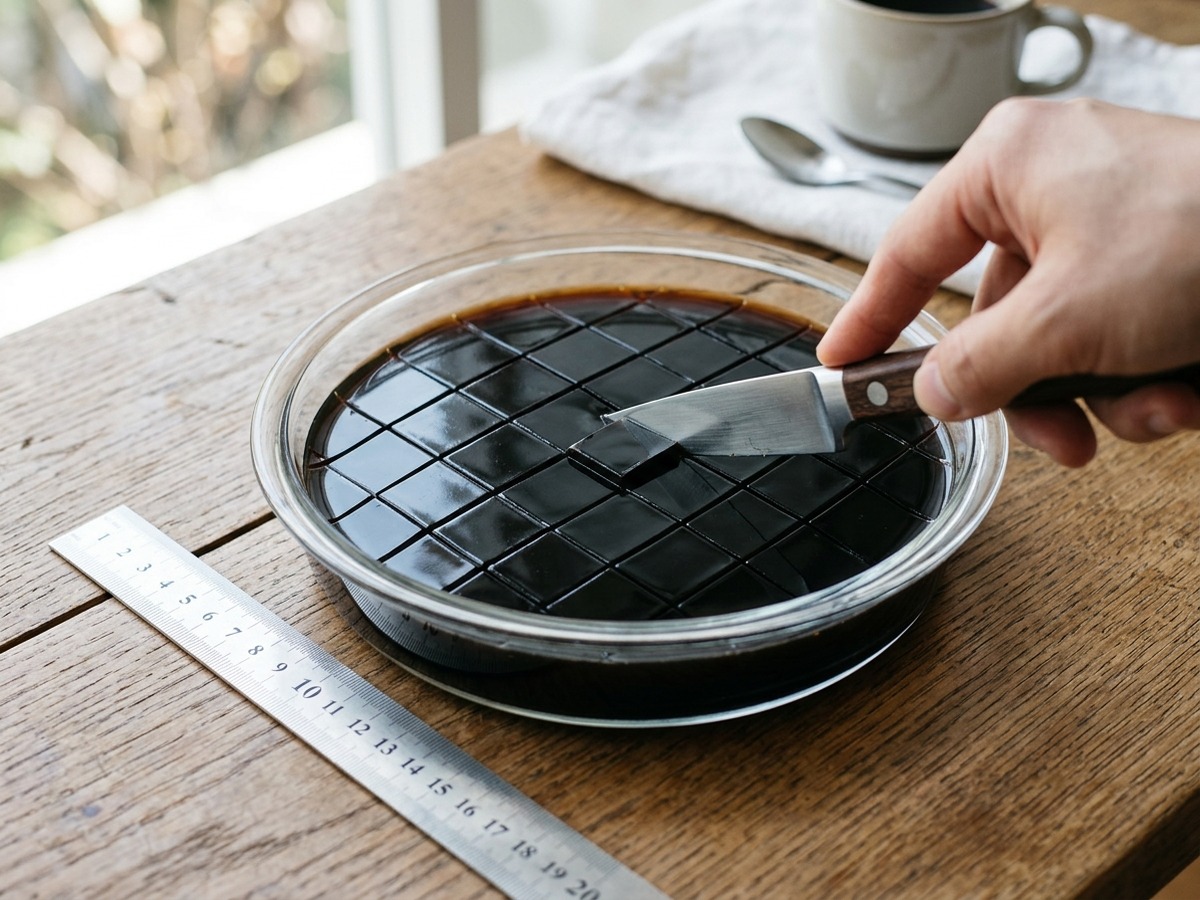
- Cut 10 mm cubes: Run a sharp knife through the jelly in a 10 mm grid. Turn the dish and cut the other direction. Cut once across the depth if the jelly layer is thicker than 10 mm. Small, even cubes travel through the straw more easily. A 12 mm straw gives a little space around a 10 mm cube. Test 2 or 3 cubes before serving the full drink.
- Assemble the drink: Spoon about 1/3 cup of coffee jelly into a 16 oz glass. Add 15 to 30 ml condensed milk, then fill the glass with ice. Pour in cold milk and stir well. Add more milk or a small amount of cold water if needed. Serve with a 12 mm or wider boba straw.
Why agar works well in bubble tea
Agar contains agarose, which forms a gel as the cooked liquid cools. Research describes the formation of double-helix structures as part of this setting process.
Agar gel commonly sets between about 28 and 40°C and melts near 85 to 90°C. Exact temperatures depend on concentration and the product. This wide gap between setting and melting temperatures is called thermal hysteresis.
For bubble tea, the result is a firm cube that holds its shape in a cold drink. Agar can also stay firm in a warm drink. Very hot liquid can soften or melt it.
Syneresis means liquid leaking from a gel after it sets. A well-made agar jelly should keep a clean shape, though storage time, freezing, formula and agar brand can still cause water release.
Agar compared with gelatin
| Feature | Agar powder | Gelatin |
|---|---|---|
| Source | Red algae | Animal collagen |
| Texture | Firm with a clean break | Soft, springy and elastic |
| Setting | Often sets near room temperature | Usually needs chilling |
| Heat response | Stays firm until a high temperature | Softens near body temperature |
| Boba straw use | Clean 10 mm cubes pass well | Soft pieces may stick or break |
| Vegan | Usually suitable | No |
Gelatin still works if you prefer a softer jelly. Use a recipe written for gelatin, since you cannot swap equal weights and expect the same result. Explore more topping comparisons in our bubble tea toppings guide.
Coffee flavour and roasting
Roasting changes the acids and aroma compounds in coffee. Dark roasting reduces some chlorogenic acids, often shortened to CQA, and forms other compounds, including chlorogenic acid lactones and phenylindanes. These changes affect bitterness and acidity.
Roasting also creates pyrazines, including alkylpyrazines, linked with roasted and nutty aromas. Bean type, roast time, brewing method and freshness all affect the final cup, so a dark roast will not taste the same across every brand.
Milk fat, also called butterfat, can soften how bitter coffee feels. Oat milk brings its own sweetness and grain taste. You can choose either based on the drink you want.
Coffee jelly milk tea pairings
Coffee jelly milk tea works best when the tea or milk has enough body to support the roasted topping.
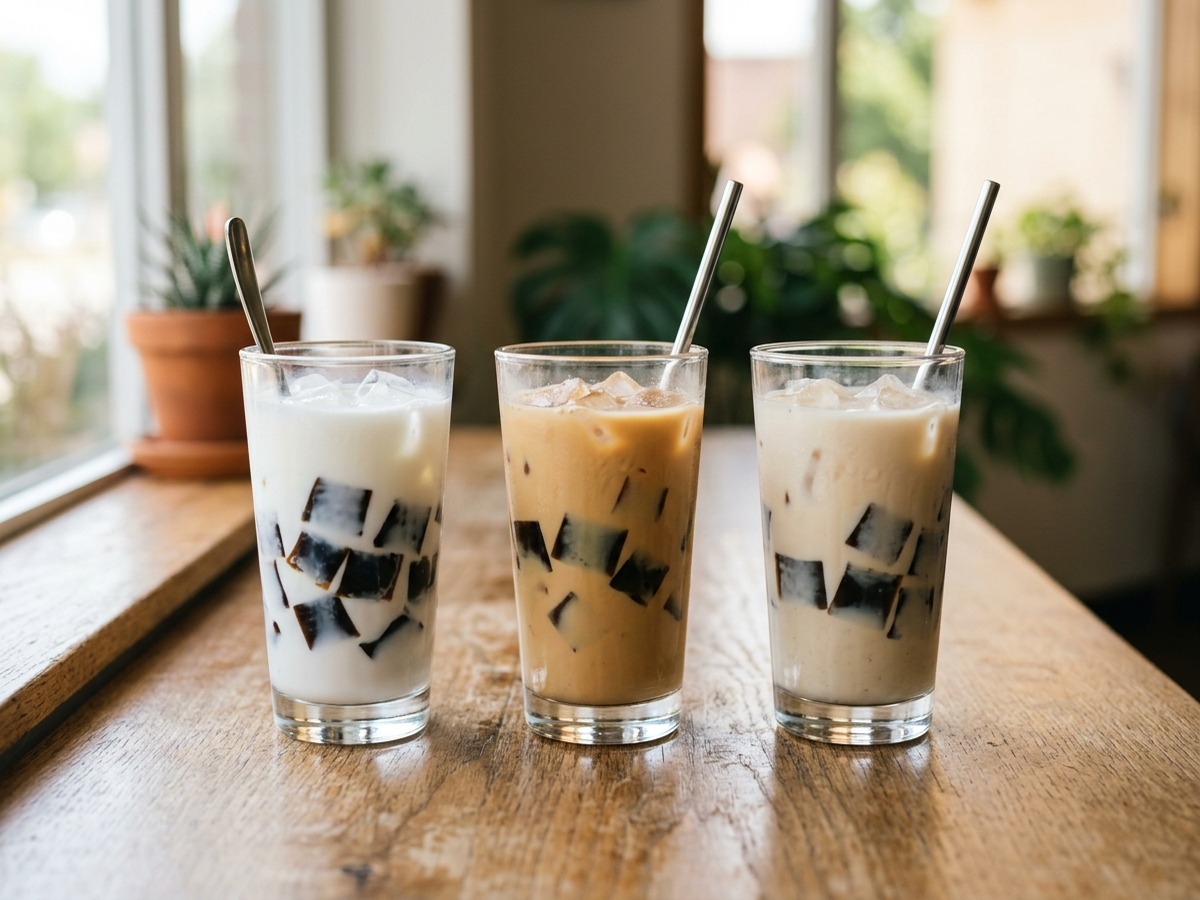
- Brown sugar fresh milk: Brown sugar adds caramel notes that suit dark roast coffee. Start with less syrup because the jelly and condensed milk already contain sugar. See how it pairs in our brown sugar milk tea recipe.
- Black milk tea: Assam or English breakfast milk tea gives the drink a stronger tea base. This pairing contains caffeine from both coffee and tea.
- Vanilla black milk tea: Vanilla softens the bitter edge of coffee and makes the drink taste sweeter even when the sugar stays the same.
- Hazelnut oat milk: Hazelnut and roasted coffee share similar nutty notes. Use a light hand with syrup so it does not cover the coffee.
- Hokkaido milk tea: Hokkaido-style milk tea is rich and sweet, so coffee jelly gives it a darker roasted taste. Check the full drink's sugar and caffeine before ordering. Learn more in our Hokkaido milk tea guide.
- Thai tea: Thai tea is sweet, creamy and strongly flavoured. Coffee jelly adds bitterness and a second source of caffeine. Explore our authentic Thai milk tea recipe.
- Plain fresh milk: Cold dairy milk or oat milk keeps the drink simple and avoids caffeine from tea. It is a useful choice later in the day, though the coffee jelly still contains caffeine.
Does coffee jelly boba have caffeine?
Yes, coffee jelly made with regular coffee contains caffeine. The amount depends on the beans, roast, brewing method, coffee strength and portion size.
The source report estimates 35 to 50 mg of caffeine in one jelly serving. Treat that as a planning range. The finished recipe has not been tested in a lab.
The US Food and Drug Administration gives 80 to 100 mg as a common range for 8 oz of coffee and 113 to 247 mg for a typical 12 oz brewed coffee. A 400 ml batch can therefore contain a wide range before it is divided into portions.
Caffeine stacking
Coffee jelly in fresh milk contains caffeine from the jelly. Coffee jelly in black milk tea contains caffeine from both coffee and tea. Espresso, coffee milk tea or extra jelly can raise the total again.
The report estimates 80 to 115 mg for coffee jelly with black milk tea. A shop drink may contain more or less.
Use decaf coffee for a lower-caffeine jelly. Decaf coffee can still contain a small amount. For a caffeine-free topping, choose grass jelly or fruit jelly made without tea or coffee and check the product label.
Ask a qualified medical professional about caffeine if you are pregnant, react strongly to caffeine, take medicine that may interact with it or are choosing a drink for a child.
Coffee jelly boba calories and sugar
Calories depend on the jelly portion, sugar, milk, condensed milk, syrup and any tea base. The source report gives these estimates for a 16 oz drink:
| Drink | Sweetness | Estimated calories | Estimated carbs | Estimated caffeine |
|---|---|---|---|---|
| Coffee jelly fresh milk | 50% sweet | 210 kcal | 32 g | 45 mg |
| Coffee jelly black milk tea | 50% sweet | 235 kcal | 36 g | 95 mg |
| Coffee jelly oat milk | 30% sweet | 165 kcal | 26 g | 45 mg |
| Coffee jelly only, 60 g | Standard | 35 kcal | 8.5 g | 45 mg |
These are planning estimates, not tested nutrition data. The report's 45 mg caffeine estimate for a 60 g jelly portion appears high for this recipe. Recipe analysis or lab testing is needed before publication.
To reduce sugar, use less condensed milk, cut the sugar in the jelly, skip extra syrup or choose unsweetened milk. Reducing the sugar may make the coffee taste more bitter. Check out our boba calories guide and bubble tea sugar level guide for full nutrition breakdowns.
Is coffee jelly boba vegan?
Coffee jelly made with coffee, sugar and agar is usually vegan. A finished drink may contain dairy milk, condensed milk, cream, gelatin or a non-vegan creamer.
Use oat or soy milk and a plant-based condensed milk for a vegan version. Check every packaged ingredient rather than relying on the menu name.
Nutritional Disclaimer: Calorie and caffeine values provided are estimates based on standard recipes and ingredient databases. Exact figures vary based on coffee roast, brewing method, sweetener level, and dairy choices.
Common problems and fixes
- The jelly did not set: The agar may not have dissolved, the liquid ratio may be too high or the product may need more agar. Bring the mixture to a full boil and follow the package ratio. Acidic ingredients can weaken some gels. Plain coffee should work, though added fruit juice may change the result.
- The jelly has agar lumps: Sprinkle the powder in slowly while whisking. Break up dry pockets before the liquid boils.
- The jelly is too hard: Reduce the agar slightly in the next batch. Small changes matter. Keep enough structure for clean cubes.
- The jelly is too soft for the straw: Use the full 4 g of agar, boil it as directed and allow enough setting time. Cut a test cube and push it through the straw before assembly.
- The drink tastes too bitter: Use a smoother coffee, shorten the brew time or add a little more milk. A small amount of condensed milk can soften the taste.
- The cubes block the straw: Cut them to 10 mm or smaller and use a 12 mm or wider straw. Uneven pieces are the usual cause.
- The drink is too sweet: Reduce condensed milk first. The jelly already contains sugar, and some milk tea bases contain syrup.
Storage and food safety
Keep coffee jelly covered in the fridge and use it within 2 days for the best quality. Keep it separate from milk until you make the drink.
Refrigerate milk drinks promptly. Discard a milk drink left at room temperature for more than 2 hours, or more than 1 hour when the temperature is above 32°C (90°F).
Do not freeze agar jelly if you want clean cubes. Freezing and thawing can damage its texture and release water.
Coffee jelly boba variations
- Decaf coffee jelly boba: Use decaffeinated brewed coffee. Check the label if you need to track small amounts of caffeine.
- Mocha coffee jelly milk: Add 1 teaspoon of cocoa to the milk and sweeten to taste. Cocoa can add a small amount of caffeine.
- Vietnamese-style coffee jelly milk: Use a dark coffee and a small amount of condensed milk. This version can become very sweet, so begin with 15 ml.
- Coffee jelly with tapioca pearls: Use half coffee jelly and half tapioca pearls. This gives both a clean jelly bite and a chewy pearl texture.
- Coffee jelly dessert cup: Cut larger cubes and serve them in a bowl with milk or cream. Use a spoon rather than a boba straw.
- Coffee jelly strips: Cut the jelly into short, slim strips if your straw opening is narrow. Test a few pieces before filling the glass because long strips can fold and block the straw.
- Vegan coffee cream: Mix plant-based condensed milk with coconut cream or oat cream. Add a small spoonful over the jelly and adjust the sweetness after tasting.
Frequently Asked Questions
Does coffee jelly boba have caffeine?
Yes. Regular brewed coffee gives the jelly caffeine. The report estimates 35 to 50 mg per serving, though coffee strength and portion size can move the total outside that range.
Is agar or gelatin better for coffee jelly?
Agar is usually better for a boba topping because it makes firm cubes that stay stable in a cold drink. Gelatin gives a softer jelly and is not vegan.
What does coffee jelly boba taste like?
It tastes roasted, bittersweet and creamy. Dark coffee stands out against sweet milk, while the jelly adds a firm bite.
How do you cut coffee jelly for a boba straw?
Cut the set jelly into cubes about 10 mm wide. Use a 12 mm or wider straw and test a few cubes before serving.
What is coffee jelly made of?
The basic recipe uses brewed coffee, sugar and agar powder. Some recipes use gelatin in place of agar.
Can I use instant coffee?
Yes. Mix it according to the package directions and make it slightly stronger than a normal cup. Fresh brewed coffee often has a fuller aroma.
Can I use cold brew concentrate?
Dilute it according to the label before measuring 400 ml. Using 400 ml of undiluted concentrate can make the jelly too bitter and high in caffeine.
Can I put coffee jelly in hot milk tea?
Agar jelly can stay firm in a warm drink, though very hot liquid may soften it. Gelatin jelly softens at a much lower temperature.
Is coffee jelly boba gluten-free?
Coffee, sugar and plain agar do not usually contain gluten. Check flavoured coffee, creamers, syrups and factory labels if you have coeliac disease or a wheat allergy.
How long does coffee jelly last?
Covered coffee jelly keeps for up to 2 days in the fridge. Its texture and aroma are best when fresh.
Sources and Editorial Notes
This page uses the Bobalicious Coffee Jelly Boba Deep Research report as its main content brief. Caffeine context comes from the US Food and Drug Administration. Food-safety timing comes from FoodSafety.gov. Agar setting context comes from published food and polymer research. Recipe markup follows Google Search Central guidance.
- US Food and Drug Administration (FDA): Spilling the Beans: How Much Caffeine is Too Much?
- FoodSafety.gov: Four steps to food safety (Clean, Separate, Cook, Chill).
- Agarose gelation study: Mechanism of thermal gelation and double-helix network formation.
- Food Hydrocolloids Research: Setting temperature and syneresis behavior of agar hydrogels.


 Badge-157x140.png)
Comments