
How to Make Popping Boba: Fruit Juice Recipe and Science Guide
Making popping boba at home looks like culinary magic, but it often frustrates beginners when drops turn into flat puddles, dissolve into cloudy water, or clump into rubbery balls before they ever reach a glass. Getting the fruit juice acidity, powder ratios, and bath timing right is what transforms ordinary fruit juice into delicate, juice-filled spheres that burst with flavour on the first bite.
Quick answer: You can make popping boba at home through direct spherification by blending 1 g food-grade sodium alginate into 100 ml strained fruit juice, resting it to remove air bubbles, and dripping it into a 1.0% calcium lactate bath (5 g in 500 ml distilled water). Leaving the droplets in the bath for 60 to 75 seconds creates a thin, flexible gel membrane while keeping the centre entirely liquid. Rinse the pearls in clean water and serve them in cold fruit tea or dessert within a few hours.
Accurate weights matter just as much as ingredient quality. So do the natural acidity of your fruit juice, the mineral content of your water, and the exact seconds each pearl cures in the setting bath. This complete guide provides tested starting ratios, direct and reverse spherification methods, an agar-agar oil-drop alternative, practical storage advice, and scientifically backed fixes for every common mistake.
Read next: Compare texture and calorie differences in our guide to popping boba vs tapioca pearls and explore our full breakdown of bubble tea toppings.
How to Make Popping Boba in 5 Steps
- Blend the alginate into the juice: Sprinkle 1 g food-grade sodium alginate into 100 ml smooth, strained fruit juice and blend with an immersion blender until fully dissolved.
- Rest to degas: Cover and refrigerate the juice mixture for 1 hour so trapped micro-bubbles rise to the surface and escape.
- Prepare the calcium setting bath: Dissolve 5 g food-grade calcium lactate in 500 ml distilled water in a wide, deep bowl until completely clear.
- Drop and cure: Fill a culinary syringe or squeeze bottle and release steady drops into the bath from 4–5 cm height. Cure each batch for 60 to 75 seconds.
- Rinse and serve: Lift the pearls out with a slotted spoon, rinse gently in a bowl of clean distilled water, and transfer to light syrup or cold fruit tea.
The method above is direct spherification. It works best with thin, low-calcium juices that are not excessively acidic (ideal pH 4.0 to 4.5).
What Is Popping Boba?
Popping boba (also called bursting boba, popping pearls, or juice balls) is a translucent, juice-filled sphere with an ultra-thin edible gel skin. Unlike traditional tapioca pearls, which are chewy, dense, and solid all the way through, popping boba bursts under gentle tooth pressure, releasing an instant rush of sweet fruit juice into the mouth.
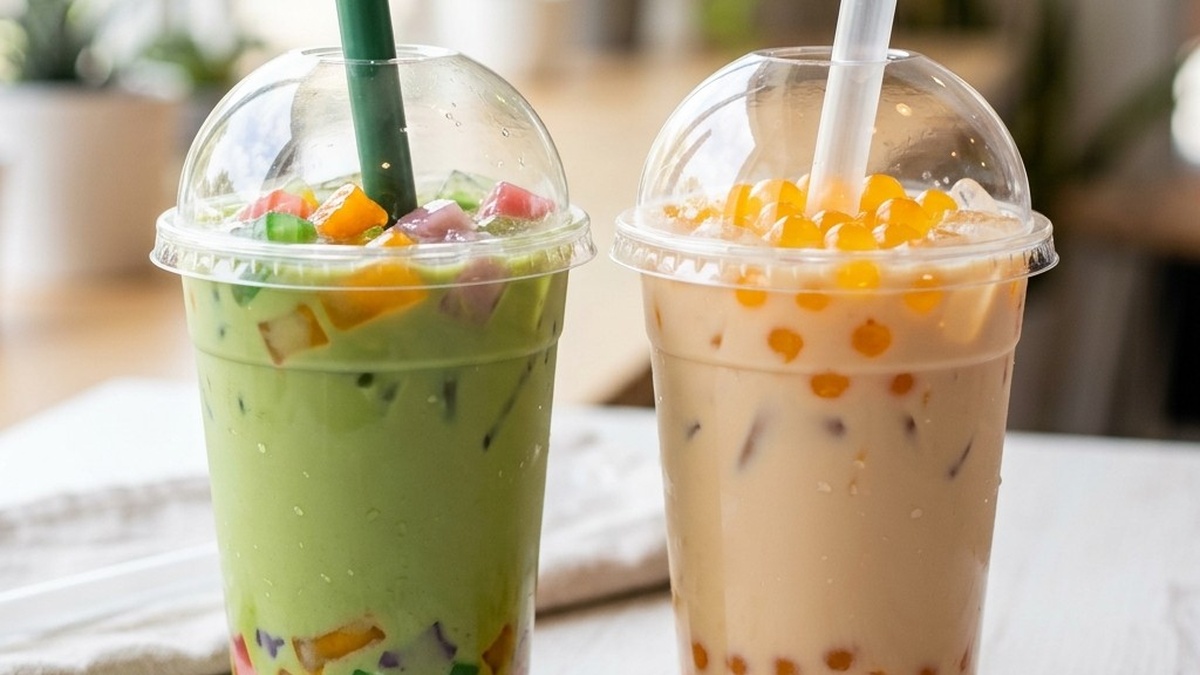
Bubble tea cafes pair popping pearls with fruit teas, iced green teas, lemonades, yogurt drinks, smoothies, and frozen desserts. While commercial popping boba contains fruit juice concentrates, water, sugar, acidity regulators, artificial colourings, and preservatives to achieve shelf stability, homemade popping boba can be crafted with simple pure fruit juices and food-grade hydrocolloids for fresh, vibrant flavour.
To explore how popping pearls stack up against alternative jellies, read our comparison on jelly boba vs popping boba and learn about translucent crystal boba ingredients.
How Spherification Works: The Food Science
The technique behind popping boba was pioneered in molecular gastronomy and relies on calcium-dependent alginate gelation.
- Sodium Alginate: A natural polysaccharide extracted from the cell walls of brown seaweeds (class Phaeophyceae). Its molecular structure consists of linear copolymer chains made up of beta-D-mannuronate (M blocks) and alpha-L-guluronate (G blocks).
- Calcium Cross-Linking (The "Egg-Box" Model): When sodium alginate comes into contact with divalent calcium ions ($Ca^{2+}$), the sodium ions are displaced. Calcium ions fit precisely into folded pockets formed between adjacent guluronate (G) chains, binding them together like eggs in an egg carton.
- Hydrogel Skin Formation: This ionic cross-linking forms an insoluble calcium alginate hydrogel membrane instantaneously at the outer boundary where the droplet touches the calcium bath. Because the calcium ions diffuse inward through the membrane over time, the skin gradually thickens as long as calcium remains available.
This timing explains why direct spherification must be carefully managed: a brief 60–75 second cure creates a paper-thin skin with a flood of liquid inside, whereas a prolonged soak (over 3–5 minutes) allows calcium to migrate into the core, transforming the delicate pearl into a solid, rubbery bead.
Popping Boba Ingredients & Tools
Always use ingredients certified as food-grade. Technical powders sold for dental moulding, crafts, or cosmetic manufacture are not refined for culinary consumption.

| Ingredient | Job in the Recipe | Buying & Usage Note |
|---|---|---|
| Sodium Alginate | Forms the gel skin when cross-linked with calcium | Buy pure food-grade powder; hydrates best with a stick blender |
| Calcium Lactate | Supplies calcium ions ($Ca^{2+}$) in the setting bath | Mild, clean taste; far less bitter than calcium chloride |
| Sodium Citrate | Buffers and raises pH in highly acidic juices | Food-grade; use only if juice pH is below 3.6 |
| Distilled Water | Prevents premature gelation from minerals | Essential for bath and rinse bowl in hard-water regions |
| Smooth Fruit Juice | Forms the flavourful liquid centre | Must be strained free of pulp, seeds, and added calcium |
Essential Kitchen Equipment:
- 0.1 g Precision Digital Scale: Kitchen measuring spoons are too coarse for 1 g and 5 g measurements. Precision weighting is essential.
- Immersion / Stick Blender: Sodium alginate powder tends to clump when hand-whisked; shear force from a motor is necessary for hydration.
- Culinary Syringe or Squeeze Bottle: Allows controlled, uniform droplet size (4 mm to 8 mm).
- Slotted Spoon / Spherification Spoon: Perforated spoon for lifting delicate pearls without draining all the bath liquid.
- Fine Mesh Strainer: For removing pulp and straining the degassed juice.
Popping Boba Recipe: Mango Pearls (Direct Spherification)
This master recipe produces approximately 150–200 fresh mango popping pearls—enough for 2 to 3 generous bubble tea servings.
Ingredients:
- 100 ml smooth mango nectar (strained, low-calcium)
- 1.0 g food-grade sodium alginate (1.0% w/v ratio)
- 500 ml distilled water (for the calcium bath)
- 5.0 g food-grade calcium lactate (1.0% w/v bath)
- 500 ml distilled water (in a separate bowl for rinsing)
- 50 ml light simple syrup or matching mango juice (for holding)
- 0.2 g to 0.4 g sodium citrate (optional, only if pH is below 3.6)
Step 1: Check Juice Acidity and Calcium Content
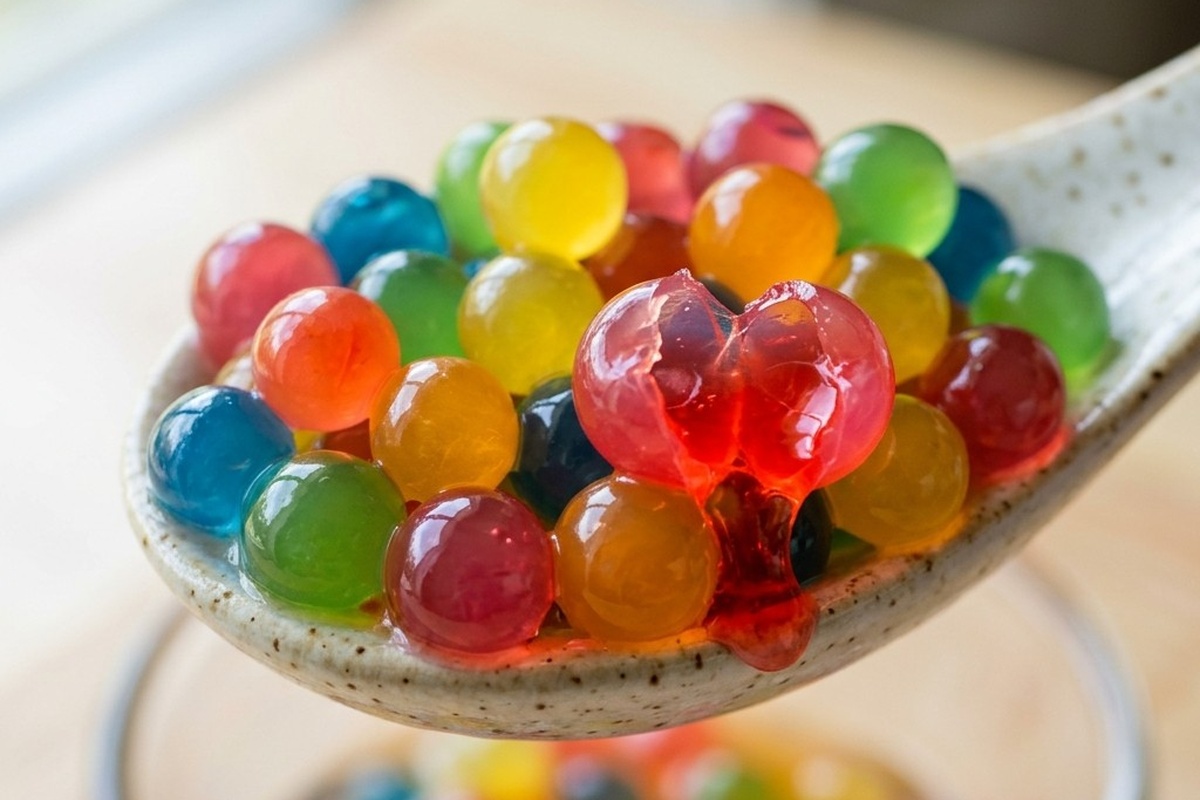
Inspect the nutrition label to ensure the juice is not calcium-fortified. Measure the juice pH with food-safe pH strips or a digital meter. Sodium alginate hydrates and gels reliably between pH 4.0 and 6.0. If your juice is highly acidic (pH < 3.6, typical of passion fruit, lemon, or sour cranberry), whisk in 0.2 g of sodium citrate per 100 ml to buffer the acidity. Avoid adding excess citrate, which can sequester calcium and weaken the skin.
Step 2: Hydrate the Sodium Alginate & Degas
Pour 100 ml of strained mango juice into a tall container. Start the immersion blender on low speed and sprinkle the 1 g of sodium alginate into the vortex in a slow, steady stream. Blend for 60 to 90 seconds until the powder is completely incorporated with no lumps.
Blending introduces micro-bubbles that make droplets float on top of the bath instead of sinking into spherical beads. Cover the mixture and refrigerate for at least 1 hour (or overnight) until all air bubbles have risen out and the liquid is clear and glossy.
Step 3: Prepare the 1% Calcium Lactate Bath
Pour 500 ml of room-temperature distilled water into a wide, flat-bottomed bowl. Add 5.0 g of calcium lactate and whisk for 60 seconds until dissolved into a crystal-clear solution. Ensure the bowl has at least 5–6 cm of liquid depth so sinking drops don't flatten against the base.
Step 4: Form the Droplets
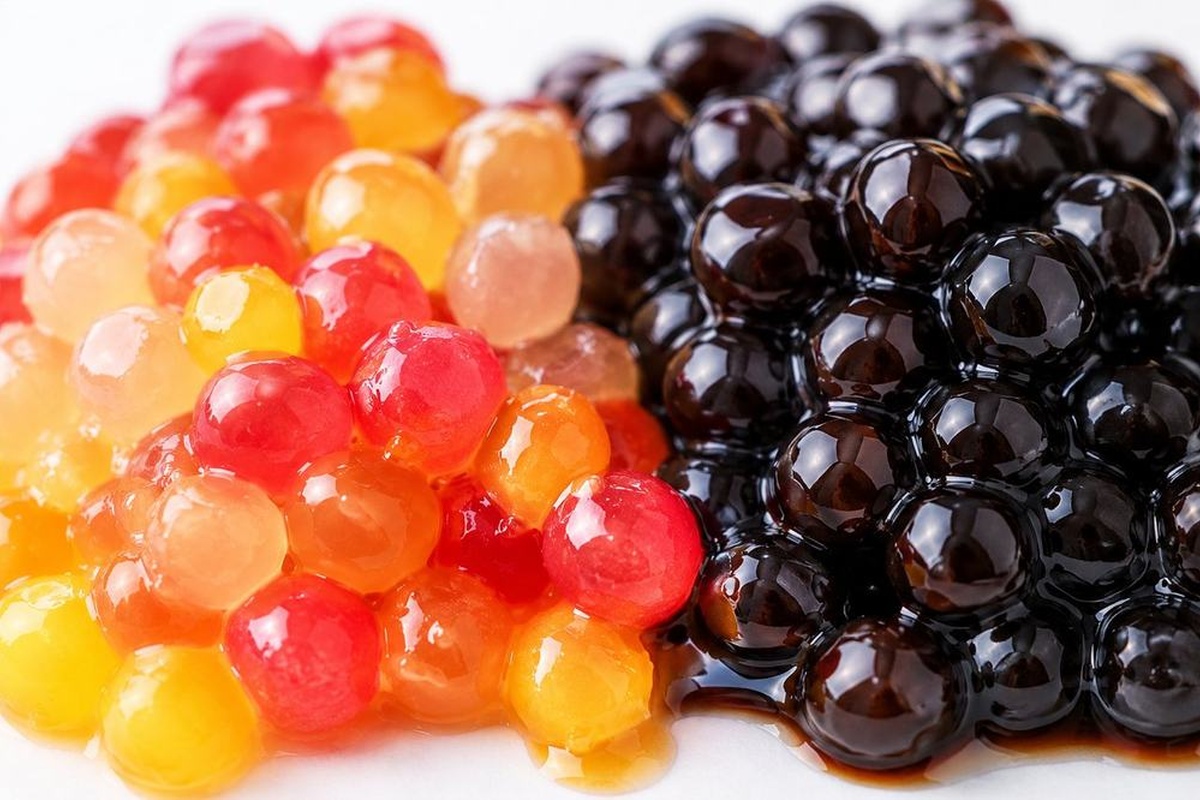
Draw the degassed mango juice into a culinary syringe or squeeze bottle. Hold the nozzle steadily 4 to 5 cm above the surface of the calcium bath. Squeeze gently to release individual, even drops into the liquid. Move your hand around the bowl to prevent drops from landing on top of each other. Work in batches of 20 to 30 pearls.
Step 5: Cure and Rinse
Allow the pearls to cure in the calcium bath for 60 to 75 seconds. Swirl the liquid gently with a spoon if pearls settle together. Lift them out with a slotted spoon and plunge them immediately into the bowl of clean distilled water. Rinsing washes excess calcium ions off the surface and prevents unrinsed bath fluid from imparting an astringent aftertaste.
Step 6: Holding and Serving
Drain the rinsed pearls and transfer them to a small container with a few spoonfuls of light sugar syrup (around 25° Brix) or matching mango juice. Serve in iced green tea, fruit soda, or fresh boba drinks within 2 to 4 hours for maximum juicy burst.
Direct vs Reverse Spherification
Direct spherification and reverse spherification are the two primary techniques used in modern boba production, differing in where the alginate and calcium components are placed.
| Feature | Direct Spherification | Reverse Spherification |
|---|---|---|
| Alginate Location | Dissolved in flavoured juice (0.8%–1.0%) | Dissolved in the water bath (0.5%) |
| Calcium Location | Dissolved in the water bath (1.0%) | Mixed into the flavoured liquid (2.0%) |
| Best Suited For | Clear, low-calcium fruit juices & teas | Dairy, yogurt, plant milks & calcium juices |
| Membrane Behaviour | Gels inward; thickens over storage hours | Gels outward; core stays completely liquid |
| Typical Sphere Size | Small pearls (4 mm to 8 mm) | Medium to large spheres (10 mm to 25 mm) |
| Make-Ahead Window | Best served within 2 to 6 hours | Maintains liquid centre for 24 to 48 hours |
Reverse Spherification Starting Formula
If you want to make bursting pearls with yogurt, milk, or calcium-fortified juice, use reverse spherification:
- Filling: 100 ml liquid + 2.0 g calcium lactate gluconate (or use yogurt/dairy directly).
- Alginate Bath: 2.5 g sodium alginate dissolved into 500 ml distilled water (rested overnight to clear bubbles).
- Method: Drop spoonfuls of the calcium-rich filling into the alginate bath. Cure for 2 minutes, rinse in clean water, and store in juice or syrup.
How to Make Popping Boba with Agar Agar (Oil-Drop Method)
Agar-agar is a plant-based gelling agent derived from red algae. It produces solid, jelly-like pearls rather than true liquid-filled popping boba, but it is an accessible, additive-free method that requires no chemical baths.
- Chill the oil: Fill a tall glass with neutral vegetable or sunflower oil and place it in the freezer for 35 to 45 minutes until ice-cold but still fully liquid.
- Simmer juice with agar: Whisk 2 g of agar-agar powder into 100 ml of fruit juice in a saucepan. Bring to a gentle boil and simmer for 1 to 2 minutes while stirring constantly to fully activate the agar.
- Cool slightly: Let the hot liquid cool for 3 to 4 minutes so it is warm (around 50°C) but still fluid.
- Drop into cold oil: Use a dropper to release droplets into the cold oil. As the hot droplets sink through the cold oil column, surface tension rounds them into spheres and the agar solidifies before they reach the bottom.
- Strain and rinse: Pour the oil through a fine mesh strainer to catch the pearls. Rinse thoroughly under cold running water to remove any residual oil coating.
For a detailed breakdown on crafting fruit jellies, read our guide on how to make jelly boba at home.
Popping Boba Troubleshooting & Problem Solving
| Problem | Root Cause | Practical Fix |
|---|---|---|
| Pearls have tails or flat shapes | Dropper held too high, or juice too thick/viscous | Lower nozzle to 4 cm above bath; dilute thick juice slightly with water; apply steady pressure |
| Juice clumps when adding alginate | Powder added too fast, hard tap water used, or pH < 3.6 | Use distilled water; sprinkle alginate into blender vortex slowly; buffer sour juice with sodium citrate |
| Pearls rupture during rinsing | Cure time too short or calcium bath too weak | Extend cure time by 15–20 seconds; re-check calcium lactate weight (1.0% ratio) |
| Pearls turn solid and rubbery | Direct spherification cured too long or stored too long | Cap cure time at 60–75 seconds; rinse promptly in distilled water; consume within 2–4 hours |
| Pearls taste chalky or bitter | Calcium chloride used or pearls poorly rinsed | Switch from calcium chloride to neutral calcium lactate; rinse thoroughly in fresh distilled water |
Storage and Food Safety Guidance
| Boba Type | Cold Storage Medium | Recommended Shelf Life |
|---|---|---|
| Direct Spherification (Home) | Light syrup (25° Brix) or fruit juice in fridge | 2 to 6 hours (membrane thickens progressively) |
| Reverse Spherification (Home) | Submerged in matching juice or sugar syrup | 24 to 48 hours (refrigerated at < 4°C) |
| Commercial Sealed Tubs | Original factory syrup packing solution | Follow manufacturer date (usually 12–18 months unopened; 7–14 days refrigerated once opened) |
Child Safety Warning: Popping boba pearls, tapioca pearls, and jelly cubes are small, slippery spheres that can pose a choking hazard for toddlers and children under 4 years of age. Always supervise children and serve boba only to individuals who can chew and swallow gelatinous foods safely.
Popping Boba Calories & Nutritional Comparison
Fruit popping boba is naturally lower in calories and carbohydrates than traditional cooked tapioca pearls because its core is primarily fruit juice or flavoured water rather than dense cassava starch.
| Nutritional Metric (per 50 g serving) | Fruit Popping Boba | Traditional Brown Sugar Tapioca |
|---|---|---|
| Calories | 30 to 45 kcal | 125 to 140 kcal |
| Carbohydrates | 8 to 11 g | 31 to 34 g |
| Sugars | 7 to 10 g | 12 to 16 g |
| Soluble Fibre (from Alginate) | 0.5 to 1.0 g | < 0.2 g |
| Fat | 0 g | 0 g |
| Protein | 0 g | 0.1 g |
For more calorie data on popular drinks and toppings, explore our complete boba calories guide and boba toppings calories comparison.
Best Drinks and Flavour Pairings for Popping Boba
Because popping boba bursts with instant fruit juice, it pairs exceptionally well with light, crisp tea bases rather than heavy milk teas:
- Jasmine Green Tea with Strawberry Pearls: Floral, fragrant green tea perfectly balances the sweet tartness of ripe strawberry boba.
- Passion Fruit Tea with Mango Pearls: A tropical pairing where zesty passion fruit acidity enhances rich mango sweetness.
- Sparkling Fruit Lemonade with Lychee Pearls: Effervescent bubbles combined with the perfumed burst of lychee boba create an ultra-refreshing summer drink.
- Cold Brew Oolong with Peach Pearls: Roasted, woody oolong tea provides an earthy foundation for delicate stone fruit flavours.
Note on Dairy: Rich milk teas can work with gentle fruit pearls like blueberry or vanilla, but highly acidic citrus popping boba can cause dairy curdling or taste disjointed when paired with whole milk. Learn more about classic milk bases in our guide to the best milk tea flavours.
Is Popping Boba Vegan and Gluten-Free?
Yes, base popping boba is naturally vegan and gluten-free.
- Vegan: Sodium alginate is derived exclusively from brown seaweed (algae), and calcium lactate is the salt of lactic acid produced via carbohydrate fermentation (it contains no milk or dairy products).
- Gluten-Free: Neither seaweed alginates nor mineral lactate salts contain wheat, barley, or rye grains.
However, commercial brands may occasionally use food colourings or flavouring agents produced on shared production lines. Always verify ingredient labels if managing severe allergies or celiac disease.
Frequently Asked Questions
Can I make popping boba with agar agar?
Agar-agar makes solid jelly pearls when dripped into cold oil. While colourful and pleasantly chewy, it cannot create the thin calcium alginate membrane and liquid-filled centre found in true bursting popping boba.
Why did my popping boba turn into solid rubber?
In direct spherification, calcium ions continue diffusing inward into the pearl over time. If pearls cure in the bath for more than 75 seconds or are stored for many hours, the calcium completely cross-links the interior alginate into a solid ball. Shorten bath time to 60–75 seconds, rinse promptly, and consume within a few hours.
Is popping boba egan and glutenfree?
Plain food-grade sodium alginate from seaweed and fermented calcium lactate contain no gluten or animal ingredients. Homemade batches made with pure fruit juice are 100% vegan and gluten-free.
What does popping boba taste like?
The thin calcium alginate membrane has a completely neutral, clean taste. Biting the pearl releases an immediate flood of the sweet, tangy fruit juice sealed inside.
Can you make popping boba without food addities?
True liquid-centred popping boba requires hydrocolloid spherification with sodium alginate and calcium salts. For a whole-food alternative with no modern additives, you can make solid agar-agar fruit pearls or classic starch-based tapioca boba.
Can I use tap water for popping boba?
Tap water often contains dissolved calcium and magnesium minerals that can cause sodium alginate to clump prematurely during blending. Distilled or demineralized water ensures consistent, spherical pearls.
Why does sodium alginate clump in fruit juice?
Alginate powder clumps when added too quickly without high shear, when juice contains natural calcium, or when juice pH is below 3.6. Use an immersion blender, add the powder slowly, use distilled water, and buffer acidic juices with sodium citrate.
How long does homemade popping boba last?
Direct-spherified popping boba is best consumed within 2 to 6 hours. Reverse-spherified pearls keep their liquid centre for 24 to 48 hours in the refrigerator. Store in sugar syrup or fruit juice to prevent dehydration.
Sources and Scientific References
- PubMed Central Food Science Review: Calcium-dependent alginate gelation and the egg-box model (PMID: 32564839).
- National Institutes of Health (NIH) Hydrocolloid Research: Influence of pH and calcium binding on alginate hydrogels (PMC9502916).
- US Food and Drug Administration (FDA): Generally Recognized as Safe (GRAS) status of sodium alginate and calcium lactate.
- NHS Early Years Health Guidance: Safe preparation of round foods and choking prevention.


 Badge-157x140.png)
Comments