

Ube and taro are 2 completely different plants. Ube is a true yam called Dioscorea alata. Many ube varieties have purple flesh and a sweet, vanilla-like flavor widely celebrated in Filipino desserts. Taro is the subterranean corm of Colocasia esculenta. Its flesh is naturally white, cream or pale grey, occasionally carrying faint purple flecks, with a mild, nutty and starchy taste. On bubble tea menus, the distinction is often blurred because cafes use ube jams, powders, artificial syrups or dyed taro premixes. Color alone cannot prove what is inside your cup.
Quick answer: Ube tastes sweeter and is linked with vanilla-like, nutty and coconut-like notes. Taro tastes mild, earthy, nutty and starchy. Purple ube gets its rich color from natural anthocyanin pigments. Fresh taro flesh is naturally pale cream or grey; a bright purple taro drink gets its color from added food dyes (such as FD&C Red 40 and Blue 1), so check the ingredient list or ask the shop.
Notice & Food Safety Warning: Never consume raw or undercooked taro. Raw taro tissues contain microscopic needle-like calcium oxalate crystals (raphides) that cause severe itching, burning, and throat swelling. Always cook taro until completely tender throughout the center. Commercial taro premixes and powders frequently contain milk-derived sodium caseinate and certified artificial food colors.
Editorial Review: Tested across authentic Filipino ube halaya preparations, fresh steamed taro corms, commercial taro premixes, and tea pairings by the Bobalicious culinary team. Chemical aroma profiles and anthocyanin concentrations are cross-referenced with peer-reviewed food science literature.
Ube vs Taro at a Glance
| Feature | Ube | Taro |
|---|---|---|
| Scientific name | Dioscorea alata | Colocasia esculenta |
| Plant family | Dioscoreaceae (Yam family) | Araceae (Aroid / Arum family) |
| Edible plant part | Tuber of a true climbing yam | Corm, a swollen underground stem |
| Common flesh color | White to deep violet/purple | White, cream, beige or pale grey with purple flecks |
| Taste | Sweet, nutty, vanilla-like and dessert-friendly | Mild, earthy, nutty and starchy |
| Texture when cooked | Dense, smooth and fluffy when mashed | Dense, creamy and slightly sticky when mashed |
| Common foods | Ube halaya, cakes, ice cream, pastries and lattes | Poi, savory soups, curries, dim sum and milk tea |
| Bubble tea form | Jam (halaya), puree, paste or syrup | Fresh mashed paste, chunks, puree or premix powder |
| Raw food safety | Cook before eating | Cook fully before eating (destroys acrid raphides) |
| Caffeine | None on its own | None on its own |
Are Ube and Taro the Same Thing?
Ube and taro originate from entirely different botanical families. Ube is a true yam belonging to the Dioscoreaceae family. Taro is an aroid belonging to the Araceae family, which contains many tropical ornamental species characterized by broad heart-shaped leaves.
Their anatomical edible structures also differ. An ube plant forms a true botanical tuber (modified root tissue), whereas taro produces a swollen underground stem base called a corm that stores dense starch.
Both plants thrive in wet tropical climates and both yield smooth, starchy pastes when cooked and pureed. Their concurrent popularity in sweet, purple-tinted beverages is the primary cause of consumer confusion.
Ube is a True Yam
Ube is the Tagalog name for purple yam, classified botanically as Dioscorea alata. The plant grows as a vigorous climbing vine. Depending on the cultivar, tuber flesh ranges from creamy white and marbled lilac to intense, vibrant violet.
Ube holds an esteemed place in Philippine culinary tradition. Its most renowned preparation is ube halaya, a decadent sweet jam crafted by simmering mashed purple yam with evaporated milk, condensed milk, coconut milk and butter. Halaya serves as the base for Filipino pastries, ice cream (halo-halo), and modern bubble tea lattes.
Kew Science records Dioscorea alata as native across tropical Asia. Using the botanical name ensures clarity, as calling every purple-colored root "Filipino ube" obscures regional varieties.
Taro is an Aroid Corm
Taro, Colocasia esculenta, is an ancient wetland crop cultivated for its starchy corm and edible foliage. Kew Science documents its native distribution spanning tropical Asia from India through southern China to Malesia, from where it was dispersed across Polynesia and the Pacific islands.
Taro encompasses hundreds of cultivars varying in corm size, skin hairiness, and acridity. While some varieties exhibit purple vascular fibers, raw fresh taro flesh is typically white, cream, or pale grey.
Ube, Taro and Purple Sweet Potato
Purple sweet potato introduces a third distinct root vegetable to the purple boba landscape. It is Ipomoea batatas, an edible storage root belonging to the Convolvulaceae (morning glory) family. It is neither ube nor taro.
| Feature | Ube | Taro | Purple Sweet Potato |
|---|---|---|---|
| Scientific name | Dioscorea alata | Colocasia esculenta | Ipomoea batatas |
| Plant group | True yam | Aroid | Morning glory family |
| Main edible part | Tuber | Corm | Storage root |
| Typical taste | Sweet, nutty, vanilla-like | Mild, earthy, nutty | Sweet, earthy and caramel-like |
| Typical texture | Dense and smooth | Creamy, starchy, slightly sticky | Soft, dry or moist by cultivar |
| Purple pigmentation | Natural anthocyanins in purple varieties | Usually pale; purple color from dye in powders | Natural anthocyanins (peonidin/cyanidin) |
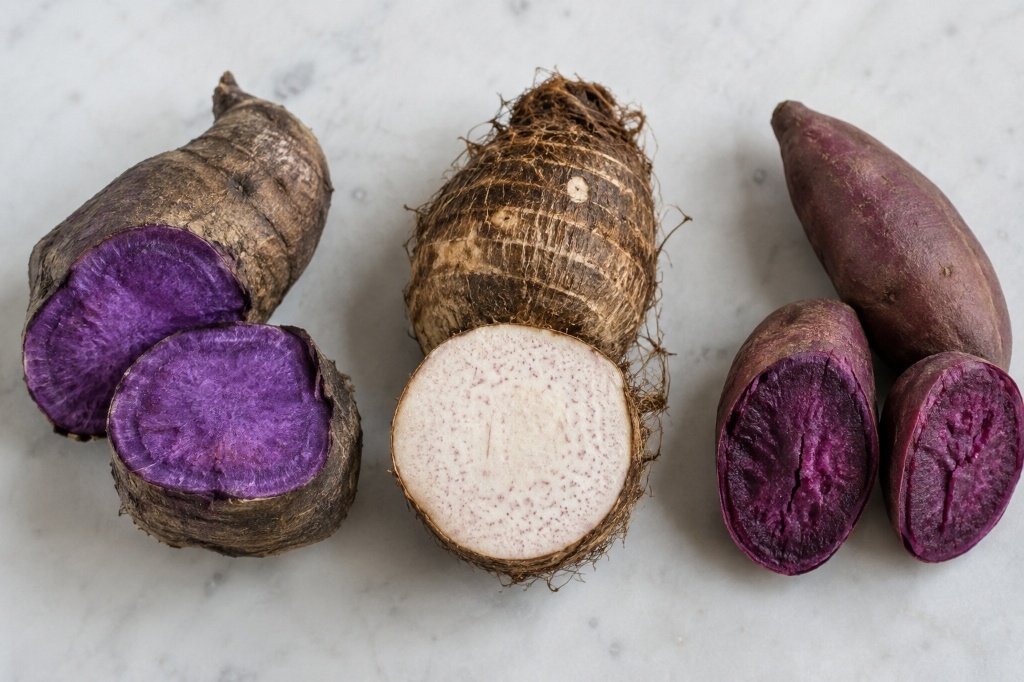
Commercial packaging frequently causes confusion. A product sold under the generic name "purple yam powder" may contain true ube, purple sweet potato, or a starch blend. Reviewing the ingredient panel is the only reliable way to confirm botanical identity. To master the preparation of taro root milk tea at home, check our taro milk tea recipe guide.
Color Differences
Why Ube is Purple
Purple ube tubers synthesize natural water-soluble anthocyanins. Phytochemical analyses of Philippine purple yam tubers have identified acylated cyanidin-type and peonidin-type glycosides as primary pigments. Natural ube purees range from muted lavender to deep royal violet.
Why is Taro Bubble Tea Purple if Taro is White?
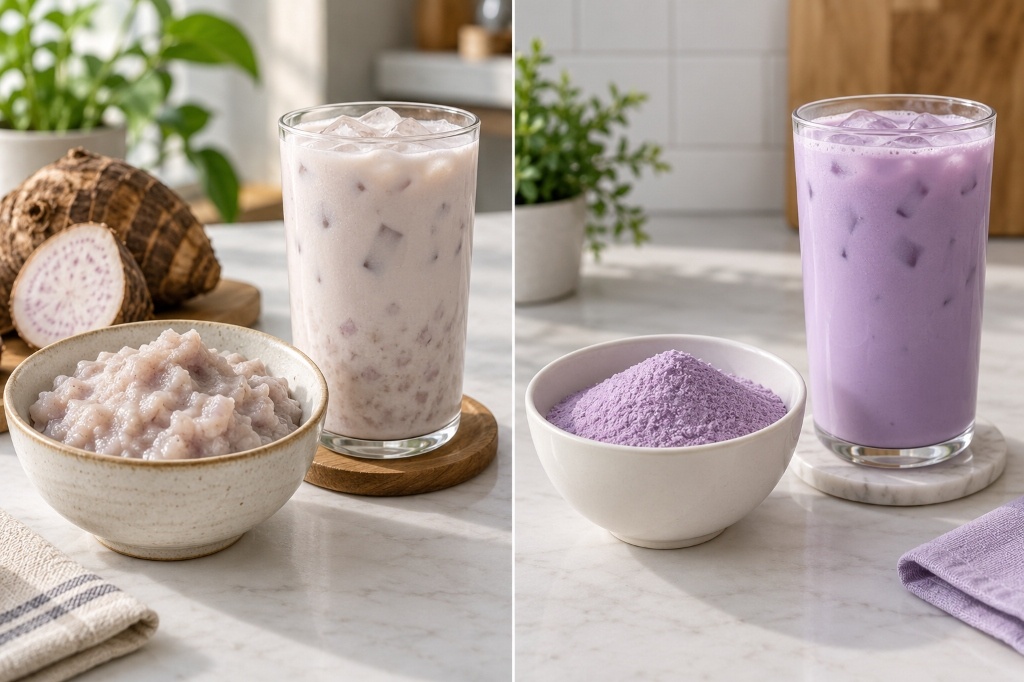
Fresh raw culinary taro flesh is naturally off-white, cream, or pale grey. When boiled and mashed into authentic paste, it yields an earthy, greyish-tan or pale lavender hue. The vivid, neon-purple shade associated with commercial taro milk tea is created by artificial certified food colorings—specifically FD&C Red No. 40 and FD&C Blue No. 1—blended into premix powders and flavored syrups.
How to Tell What a Taro Drink Contains
When ordering at a cafe, asking these direct questions will reveal whether your drink uses authentic root or commercial powder:
- Does the drink contain fresh cooked taro paste? Real taro paste leaves thick, visible streaks and textural corm fibers along the cup interior.
- Is it mixed from a commercial premix powder? Powder drinks are uniformly smooth, pastel purple, and dissolve without sediment.
- Does the powder contain sodium caseinate? Many non-dairy creamers contain milk proteins that trigger dairy allergies.
- Which food dyes are used? U.S. FDA regulations mandate that certified color additives like Red 40 and Blue 1 be declared by name on original product labels.
Ube vs Taro Taste
What does ube taste like? Cooked ube tastes mildly sweet, nutty and creamy, featuring natural vanilla-like and coconut-like flavor nuances. When incorporated into halaya or milk tea, dairy fats and cane sugar amplify its velvety dessert profile.
What does taro taste like? Fresh cooked taro tastes mild, earthy, nutty and pleasantly starchy, reminiscent of roasted chestnuts or sweet potato. Commercial taro powder tastes significantly sweeter and more candy-like due to added vanillin, sugar, and non-dairy creamer.
Which one is sweeter? Fresh ube naturally tastes sweeter than fresh taro. However, in bubble tea cafes, a powdered taro beverage often delivers significantly more added sugar than a drink made with fresh ube mash.
What Food Chemistry Can Tell Us About Flavor
Sensory research into cooked Lipu taro has isolated 2-acetyl-1-pyrroline (the same heterocyclic compound responsible for the fragrant aroma of basmati and jasmine rice) as a key aroma-active component contributing to its roasted, nutty scent.
In purple yam, the rich sensory notes of vanilla, malt, and coconut are influenced by a complex matrix of volatile organic compounds and thermal degradation of sugars during halaya simmering. Rather than a single artificial chemical, the harmonious synergy between root starch, milk lipids, and natural sugars defines the beloved ube experience.
Taro Milk Tea vs Ube Milk Tea
| Drink Style | Main Flavor | Common Texture | Natural Color | What to Check |
|---|---|---|---|---|
| Ube Latte | Sweet, nutty and creamy | Smooth or thick shake-like | Natural violet to purple | Ube percentage and added sugars |
| Fresh Taro Milk | Mild, earthy and starchy | Thick, with small soft root pieces | Cream, grey or pale lavender | Complete cooking and dairy source |
| Taro Premix Milk Tea | Sweet, vanilla-candy and nutty | Completely smooth and silky | Vivid artificial purple/lavender | FD&C dyes and sodium caseinate |
| Ube Tea Drink | Ube plus tea tannin structure | Smooth or lightly pulpy | Purple to muted lavender | Tea base type and caffeine content |
Does Ube or Taro Contain Caffeine?
Pure ube tubers and taro corms contain zero caffeine. Drinks made purely with milk, ice, sweetener, and root puree are naturally caffeine-free and suitable for evening consumption.
However, when a cafe prepares "taro milk tea" or "ube milk tea" by combining root paste with brewed black, green, or oolong tea, the beverage contains 25 to 60 mg of caffeine. Inquire whether your order uses a tea-free milk base if caffeine avoidance is desired.
Fresh Taro Paste Boba vs Taro Powder
| Point | Fresh Taro Paste Boba | Taro Powder Drink |
|---|---|---|
| Main ingredient | 100% fully cooked fresh taro corm | Starch, creamer, sugar, flavor and food dye |
| Texture | Thick, pulpy, rich root texture | Completely uniform and smooth |
| Color | Natural cream, grey or muted lilac | Vivid, bright pastel lavender |
| Sweetness | Customizable during kitchen mashing | Fixed into premix formulation |
| Preparation | Peel, steam, mash, cool and store cold | Instant dissolution in warm liquid |
Taro Food Safety
Raw or undercooked taro contains high concentrations of insoluble calcium oxalate crystals bundled into microscopic, needle-sharp raphides. Masticating raw taro causes mechanical micro-abrasions to mucous membranes, allowing acrid protease enzymes to trigger excruciating stinging, throat constriction, and edema.
Always cook taro completely: A rigid 20-minute timer cannot guarantee safety because corm dimensions and cultivar acridity vary. Test multiple pieces with a fork: the flesh must be completely fork-tender to the very core without any firm or uncooked resistance. Explore where root-vegetable drinks fit into the wider spectrum of cafe favorites in our milk tea flavours guide.
Wear food-grade gloves when peeling and cutting raw corms to avoid cutaneous oxalate dermatitis ("taro itch"). Keep raw peelings strictly away from children and household pets.
Fresh Taro Paste Bubble Tea Recipe
This authentic Taiwanese cafe-style recipe makes 2 generous 16-ounce servings using scratch-cooked taro corm, sweetened condensed milk, and floral jasmine green tea.
Handmade Fresh Taro Boba Milk Tea (Serves 2)
Ingredients for Fresh Taro Paste
- 250 g fresh raw taro corm (peeled and cut into uniform 2.5 cm cubes)
- 30 ml sweetened condensed milk
- 15 g pure cane sugar (adjust to taste)
- 40 to 70 ml fresh whole milk or barista oat milk
- Small pinch of fine sea salt
Ingredients for Drink Assembly
- 160 ml brewed jasmine green tea (chilled)
- 200 ml cold whole milk or oat drink
- 100 g cooked warm tapioca pearls
- 200 to 250 g fresh ice cubes
Method
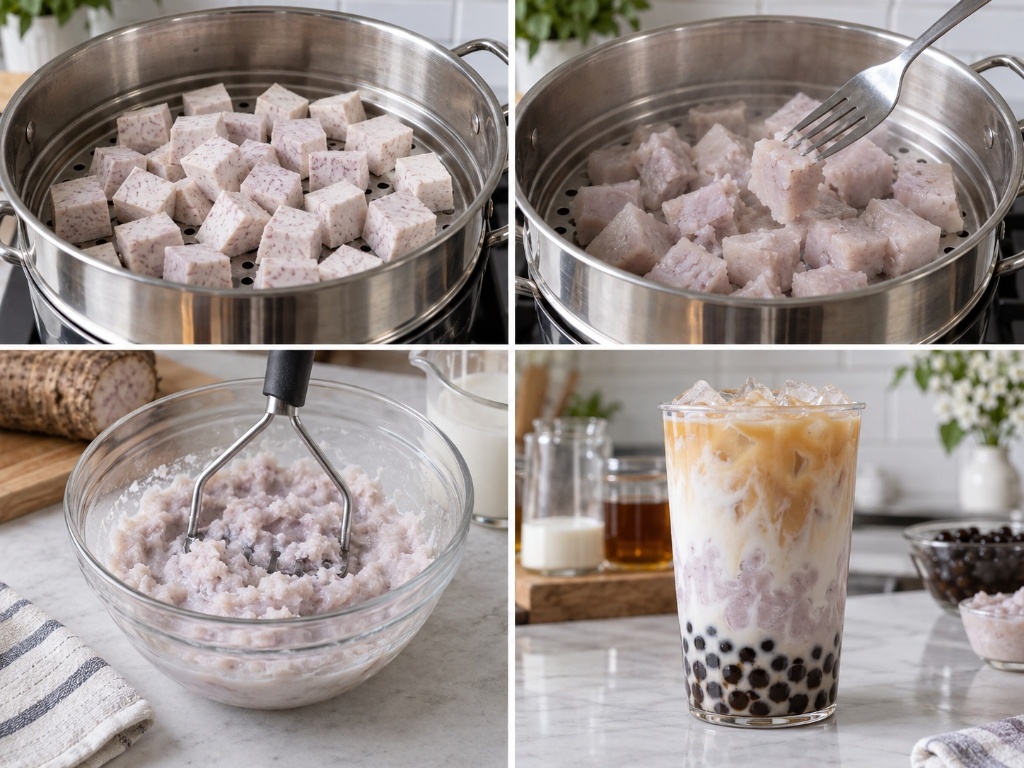
- Steam the Taro: Don gloves, peel the taro, and rinse thoroughly. Steam cubes over high heat for 25 to 30 minutes until a fork pierces effortlessly through the center with zero firm resistance.
- Mash the Paste: While steaming hot, transfer taro to a mixing bowl. Add condensed milk, cane sugar, salt and 40 ml milk. Mash thoroughly with a potato masher or fork, streaming in additional milk until the paste reaches a thick, spreadable consistency.
- Chill Promptly: Cool paste rapidly in a clean, covered container at 4°C (40°F) or below until assembly.
- Coat the Glass: Using a spatula or back of a spoon, spread half the taro paste along the inside walls of two 16 oz glasses.
- Layer & Build: Add 50 g cooked boba pearls into the base of each glass. Fill with ice cubes.
- Pour & Serve: Add 80 ml chilled jasmine green tea and 100 ml cold milk to each glass. Stir gently with a wide boba straw so the creamy paste marbles through the beverage.
Recipe Safety and Variations
Storage: Treat freshly prepared taro paste as a perishable food. Refrigerate at 4°C (40°F) or below and consume within 48 hours for optimal flavor and micro-safety.
Caffeine-free version: Omit brewed jasmine tea and substitute with additional whole milk, oat milk, or water for a comforting bedtime beverage.
Vegan version: Replace sweetened condensed milk with coconut condensed milk and use barista oat or soy milk.
Can You Substitute Ube for Taro?
Ube can replace taro in sweet drinks, layer cakes, and frozen desserts. The resulting drink will be noticeably sweeter, carry vanilla-coconut undertones, and present a natural purple hue.
However, they are poor substitutes in traditional recipes where specific starch chemistry or cultural identity is paramount. For example, Hawaiian poi relies on the unique fermented starch properties of Colocasia esculenta, while Filipino ube halaya depends on the sweet fibrous richness of Dioscorea alata.
Which One Should You Order?
- Choose Ube: When you crave a sweet, dessert-like indulgence with aromatic vanilla, coconut, and rich purple styling. Perfect paired with brown sugar boba or cream foam.
- Choose Fresh Taro: When you desire a comforting, wholesome root beverage with earthy, roasted chestnut nuances and satisfyingly thick, drinkable paste.
- Choose Taro Premix: When you enjoy the nostalgic, candy-sweet, silky-smooth profile of classic 1990s bubble tea shops.
Common Mistakes
- Using color as proof of ingredients: Natural ube varies in hue, and authentic taro is greyish-white. A bright neon purple drink always indicates added artificial dyes.
- Confusing ube with purple sweet potato: Ube is Dioscorea alata (a true yam); purple sweet potato is Ipomoea batatas (morning glory family).
- Trusting a fixed taro cooking timer: Never rely on a set 20-minute rule; always verify that taro is fully fork-tender to destroy acrid oxalate crystals.
- Assuming all milk teas contain tea: Many ube and taro cafe drinks are tea-free sweet milk lattes. Always ask if brewed tea leaves are added.
The Bottom Line on Ube vs Taro Boba
Ube is a sweet, naturally purple true yam (Dioscorea alata) famous in Filipino desserts, while taro is a mild, earthy, pale aroid corm (Colocasia esculenta). Knowing whether your boba shop uses scratch-cooked root paste or commercial dyed powder ensures you get the exact flavor, texture, and dietary ingredients you expect.
Frequently Asked Questions
What is the main difference between ube and taro?
Ube is a true climbing yam (Dioscorea alata) that is naturally purple, sweet and vanilla-scented. Taro is an underground aroid corm (Colocasia esculenta) that has pale off-white flesh and an earthy, starchy flavor.
Is ube the same as taro?
No. They belong to completely separate botanical plant families (Dioscoreaceae vs Araceae) and have different edible parts, flavor profiles, and culinary roles.
Is taro naturally purple?
Some cultivars have small purple fibers or specks, but fresh taro flesh is naturally white, cream, or pale grey. Cooked taro paste looks greyish-tan.
Why is taro bubble tea purple if taro is pale?
Most commercial taro bubble teas use premixed powders containing certified food colorings (such as FD&C Red No. 40 and Blue No. 1) to create the iconic lavender aesthetic. For creamy root-tea goodness ready to drink without cooking, explore our ready-to-drink canned taro milk tea.
What does ube taste like compared with taro?
Ube is sweeter with prominent vanilla, coconut, and nutty pastry notes. Taro is subtle, starchy, and earthy, often compared to boiled chestnuts or potatoes.
Is ube a yam or a sweet potato?
Ube is a true botanical yam (Dioscorea alata). Purple sweet potato is a completely distinct species (Ipomoea batatas) in the morning glory family.
Can you eat raw taro?
No. Never eat raw or undercooked taro. Needle-like calcium oxalate crystals (raphides) cause severe throat burning, mouth pain, and potential airway swelling.
Can you eat raw ube?
Ube must always be cooked prior to eating. Cooking gelatinizes starches, improves digestibility, and develops its tender texture.
Is ube or taro healthier?
Both are wholesome root vegetables rich in dietary fiber and complex carbohydrates. However, boba drink nutrition depends far more on added condensed milk, syrups, and non-dairy creamers than the root itself.
Does taro milk tea contain dairy?
Many taro drinks contain dairy milk or powdered non-dairy creamers that use sodium caseinate (a milk-derived protein). Always request the allergen statement if you have a milk allergy.
Are ube and taro drinks caffeine-free?
Root purees contain zero caffeine. However, cafe recipes that blend root paste with brewed black, green, or oolong tea contain caffeine (25 to 60 mg).
Can I make taro milk tea with fresh taro?
Yes. Steam fresh peeled taro cubes until fully soft, mash with milk and sugar into a paste, and layer into a glass with ice, jasmine tea, and boba.
What is fresh taro paste boba?
It is a premium bubble tea made by swirling scratch-cooked, mashed taro corm paste along the interior of the cup before pouring in milk, tea, and chewy tapioca.
Which toppings suit ube and taro?
Brown sugar boba pearls pair wonderfully with both. Coconut jelly and sago complement ube, while herbal grass jelly and egg pudding suit fresh taro.
Sources and Review Notes
The Bobalicious beverage development team validates formulation benchmarks, food safety standards, and commercial processing parameters against authoritative regulatory and academic databases:
- Royal Botanic Gardens, Kew (Plants of the World Online): Dioscorea alata L. (Purple Yam)
- Royal Botanic Gardens, Kew (Plants of the World Online): Colocasia esculenta (L.) Schott (Taro)
- USDA FoodData Central: Nutritional Profiles for Taro Corm and Purple Yam
- Food Chemistry & PubMed: Identification of Cyanidin and Peonidin Anthocyanins in Purple Yam (Dioscorea alata L.)
- Journal of Agricultural and Food Chemistry & PubMed: Characterization of Aroma-Active Compounds (2-Acetyl-1-pyrroline) in Cooked Taro
- U.S. Food and Drug Administration (FDA): Color Additives Questions and Answers for Consumers


Comments