

Sparkling boba combines chilled carbonated water with fruit, tea, syrup, ice, and boba toppings. The result is a fizzy, alcohol-free drink with a sweet or tart fruit base and a chewy or juicy topping. Popping boba and crystal boba are the easiest toppings to use. Cooked tapioca pearls can cause extra foaming, especially when loose starch remains on their surface. Rinsing them well, coating them with syrup, and adding the sparkling water slowly preserves optimal effervescence.
Quick Answer: Sparkling Boba Ratio & Assembly
Quick answer: For one 16-ounce sparkling boba, add 40 to 50 g popping boba to a chilled glass. Add solid ice, fruit or tea concentrate, and sweetener. Finish with 110 to 150 ml very cold sparkling water poured slowly down the inside wall of the tilted glass. Serve at once with a 12 mm wide boba straw.
Editorial Note: The recipe amounts below are culinary starting points. Sugar and calorie totals change with the syrup, juice, puree, and boba brand. The carbonation advice follows established beverage science, but home results vary with temperature, glass shape, ice, and pouring speed.
What is Sparkling Boba?
Sparkling boba is a carbonated fruit or tea drink served with tapioca pearls, popping boba, crystal boba, or jelly. It may also be called fizzy boba tea, popping boba soda, sparkling bubble tea, or a boba mocktail.
Most versions use 4 essential building blocks:
- A concentrated fruit puree, citrus juice, or brewed tea base
- Cold club soda, seltzer, or sparkling mineral water
- A boba topping (popping boba, crystal boba, or rinsed tapioca)
- Large, solid ice cubes
Many sparkling boba drinks contain no dairy. Check the topping and syrup labels if you need a vegan or allergen-free drink. The beverage joins ideas from Taiwanese bubble tea, fruit soda, and alcohol-free mocktails. Modern cafés often use clear glasses, colourful fruit, fresh herbs, and popping pearls so guests can see the bubbles and toppings.
How It Differs from Milk Tea and Fruit Tea
Carbonation changes beverage dynamics significantly. Here is how sparkling boba compares directly with traditional café drink formats:
| Drink Style | Main Liquid | Carbonation Level | Common Topping | Typical Taste Profile |
|---|---|---|---|---|
| Sparkling Boba | Sparkling water, soda, seltzer | High (when freshly poured) | Popping boba or crystal boba | Fizzy, fruity, tart or sweet |
| Fruit Tea Boba | Brewed tea and fruit puree/syrup | None (still) | Tapioca or popping boba | Fruity with structured tea finish |
| Milk Tea | Brewed black tea and dairy/plant milk | None (still) | Chewy tapioca pearls | Creamy, rich, sweet, and malty |
| Italian Soda | Carbonated water and flavoured syrup | High (when freshly poured) | Usually none (or cream float) | Sweet, crisp, and fizzy |
| Drink Category | Dairy Content | Approximate Calories (16 oz) | Suggested Straw |
|---|---|---|---|
| Sparkling Fruit Boba | Usually none (dairy-free) | 130 to 220 kcal | 12 mm boba straw |
| Fruit Tea Boba | Usually none (dairy-free) | 180 to 300 kcal | 12 mm boba straw |
| Milk Tea | Often contains whole milk, creamer, or condensed milk | 250 to 500 kcal | 12 mm boba straw |
| Italian Soda with Cream | Often contains heavy cream or half-and-half | 200 to 400 kcal | Standard straw unless toppings added |
*Calorie counts are general recipe ranges, not standardized menu averages. Cup size, milk type, sweetener concentration, and topping weights will shift totals.
What Does Sparkling Boba Taste Like?
Sparkling boba tastes light, fizzy, fruity, and cool. Carbon dioxide gives each sip a crisp, refreshing bite. Fruit purees and syrups add sweetness, while lemon, lime, yuzu, or passion fruit brings tart balance.
The choice of topping completely transforms the mouthfeel:
- Popping Boba: Releases an instantaneous burst of sweet fruit juice upon biting.
- Crystal Boba: Delivers a firm, crisp jelly bite with neutral sweetness.
- Tapioca Pearls: Imparts a dense, satisfying chew and subtle caramelized starch flavour.
Brewed tea concentrates introduce herbal, grassy, or malty notes. A purely fruit-and-soda version drinks like a premium craft mocktail.
Why Boba Can Make Sparkling Water Foam: The Science of Nucleation
Carbonated water holds dissolved carbon dioxide under sealed pressure. Opening the container drops that pressure, causing gas molecules to emerge from solution as bubbles. A fraction of dissolved CO₂ forms carbonic acid, granting seltzers their signature acidic prickle.
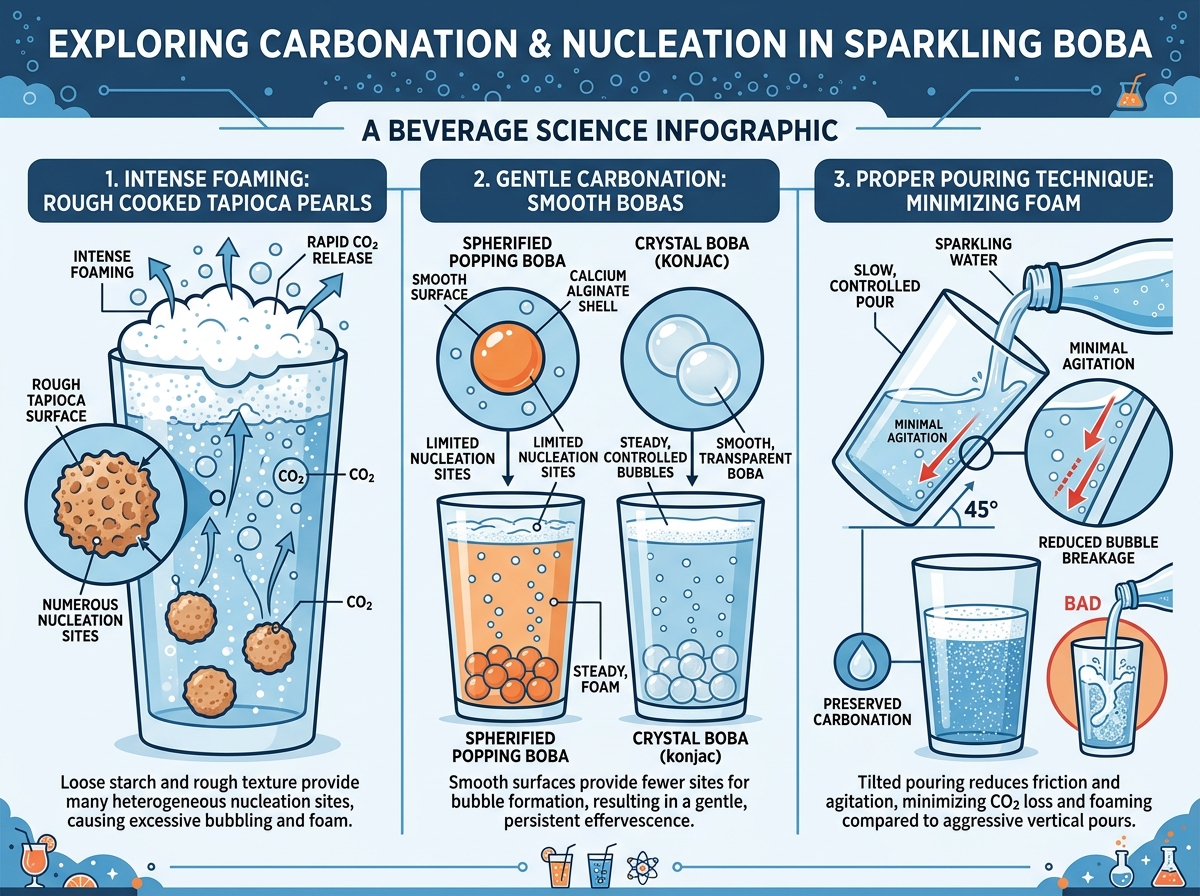
Gas bubbles form most readily around microscopic scratches, fibrous particles, and textured surfaces known as nucleation sites. In beverage science, this process is termed heterogeneous nucleation, meaning gas bubbles coalesce on external solid interfaces rather than within homogeneous liquid.
Cooked tapioca pearls often retain microscopic surface starch granules, creating countless active nucleation sites. Dropping freshly boiled tapioca into carbonated water triggers sudden, vigorous degassing and overflowing foam.
Conversely, popping boba utilizes a smooth sodium alginate / calcium salt gel membrane formed through spherification, making it a popular choice across our fruit bubble tea combinations, while crystal boba is cast from smooth konjac or agar. In kitchen trials, these hydrocolloid gel surfaces provide far fewer active nucleation sites, resulting in significantly less foaming.
How to Use Tapioca in Sparkling Water
You can successfully use traditional black tapioca pearls in fizzy drinks by following this preparation sequence:
- Cook the boba pearls according to package directions.
- Rinse away all loose exterior starch under cold running water.
- Coat the pearls in a dense sugar or honey syrup (e.g., a 2:1 simple syrup near 66° Brix).
- Allow pearls to cool completely before assembling the drink.
- Place ice and still concentrates into the glass before adding carbonated water.
- Pour chilled sparkling water gently down the inside wall of the tilted glass.
The viscous syrup barrier smooths over microscopic surface craters, dampening violent nucleation while preserving boba chew.
Best Boba Toppings for Carbonated Drinks
| Topping | Texture | Effect on Fizz | Best Flavour Pairing |
|---|---|---|---|
| Popping Boba | Thin gel skin with liquid juice core | Very low foaming | Passion fruit, mango, peach, lychee |
| Crystal Boba | Firm, crisp, translucent jelly chew | Very low foaming | Yuzu, citrus, floral honey, green tea |
| Rinsed Tapioca Pearls | Soft, dense, gelatinized chew | Moderate to high foaming | Brown sugar, white peach, bold black tea |
| Nata de Coco | Crisp, fibrous coconut gel cubes | Mild bubbling | Pineapple, lychee, citrus juices |
| Aloe Jelly | Soft, cooling, gelatinous cubes | Mild bubbling | Lemon, cucumber, jasmine green tea |
Choosing the Right Sparkling Water Base
1. Club Soda
Contains added mineral salts (potassium bicarbonate, sodium citrate) delivering a clean, crisp bite that cuts cleanly through viscous fruit purees and dense syrups.
2. Seltzer
Pure carbonated water without mineral additions. Unflavoured or subtly fruit-flavoured seltzer lets delicate tea extracts shine, making it perfect for hot weather, as seen in our summer bubble tea flavours guide.
3. Sparkling Mineral Water
Naturally effervescent with dissolved earth minerals. Best paired with bright citrus bases like yuzu, lime, and raw floral honey.
4. Tonic Water
Contains quinine and added cane sugar or sweetener. Its distinctive pleasant bitterness harmonizes with grapefruit, blood orange, rosemary, and botanical teas.
5. Lemon-Lime Soda
Pre-sweetened commercial soda produces a sweeter drink. Always omit or reduce simple syrup when using lemon-lime soda as your base.
How to Keep Sparkling Boba Fizzy
Preserving carbonation comes down to basic beverage physics:
- Keep Liquids Frigid: Cold liquids hold dissolved carbon dioxide far longer than room-temperature liquids. Pre-chill your sodas, glasses, concentrates, and toppings.
- Use Solid, Large Ice: Small or crushed ice has massive surface area and jagged edges that trigger rapid degassing and water dilution. Large solid cubes are best.
- Pour Down the Glass Wall: Tilt the serving glass to approximately 45 degrees and pour cold carbonated water gently down the interior wall. Never shake carbonated beverages in a cocktail shaker.
- Open Just in Time: Uncap carbonated mixers immediately before pouring, and seal leftovers instantly.
Simple 6-Step Assembly Order
- Place popping boba or chilled, rinsed tapioca into the bottom of a clean glass.
- Add large, solid ice cubes.
- Pour over your mixed fruit puree, citrus juice, tea concentrate, and syrup.
- Pour cold sparkling water slowly down the interior wall of the tilted glass.
- Stir gently once or twice with a long bar spoon to integrate layers.
- Serve immediately with a 12 mm wide straw.
Sweetness and Acid Balance
Dissolved carbon dioxide naturally imparts carbonic acidity. Tart ingredients such as lemon, lime, yuzu, or passion fruit intensify this acidic bite, requiring balancing with simple syrup, honey, or sweet fruit purees.
Begin with 15 to 25 ml of simple syrup for a standard 16-ounce beverage. Sample the still fruit base prior to adding soda—it should taste slightly sweeter and more intense than desired, as ice and club soda will dilute the final glass.
Brix and Commercial Batch Consistency
Brix (°Bx) measures dissolved sugar content. High-volume bubble tea bars often aim for a concentrated fruit base calibrated between 45 and 50 degrees Brix. This dense syrup concentrate stands up to ice and sparkling dilution. Home baristas can achieve consistent results simply by measuring ingredients by volume or weight and recording adjustments.
Equipment for Sparkling Bubble Tea
- 16-ounce tall glassware (leaving 1 to 2 inches of headspace for foam)
- Precision jigger or liquid measuring cup
- Long bar spoon
- Fine-mesh citrus strainer
- Cocktail shaker (for still concentrates and teas only)
- 12 mm wide boba straw
*Safety Note: Sip gently through wide boba straws. Because fluid pressure drops as carbonated liquid rises through a wide tube, dissolved gas can expand rapidly during a sip. Supervise young children when serving drinks with popping pearls or tapioca.
5 Master Sparkling Boba Recipes
1. Sparkling Passion Fruit Green Tea with Mango Popping Boba
Signature RecipeProfile: Tart, tropical, effervescent, and lightly floral.
Ingredients
- 100 ml strong jasmine green tea, chilled
- 40 ml passion fruit puree (strained of seeds if preferred)
- 15 to 20 ml simple syrup
- 120 ml cold club soda
- 50 g mango popping boba
- 140 g large solid ice cubes
- 1 fresh mint sprig (optional garnish)
Method
- Add mango popping boba and large ice cubes into a chilled 16-ounce glass.
- In a separate cup, stir together chilled jasmine tea, passion fruit puree, and simple syrup until completely combined. Pour gently over the ice.
- Tilt the glass to a 45-degree angle and pour cold club soda slowly down the inside wall. Stir once gently with a bar spoon, garnish with mint, and serve immediately.
2. Yuzu Honey Soda with Crystal Boba
Profile: Sharp Japanese citrus aroma softened by natural honey and crisp crystal boba chew. For portable pre-made boba refreshment, discover our ready-to-drink boba cups.
Ingredients
- 30 ml yuzu juice or prepared Japanese yuzu base
- 20 to 25 ml honey syrup (equal parts warm water and raw honey)
- 150 ml sparkling mineral water, chilled
- 50 g honey crystal boba
- 140 g large solid ice cubes
- 1 thin lemon or lime wheel for garnish
Method
Stir yuzu juice and honey syrup together until dissolved. Add crystal boba and ice to your glass, pour in the yuzu mixture, top slowly with sparkling mineral water, stir once, and garnish with citrus.
3. White Peach and Lavender Sparkling Boba
Profile: Velvety white peach body accented with delicate French culinary lavender notes.
Ingredients
- 50 ml white peach puree
- 10 to 15 ml culinary lavender syrup
- 10 ml fresh lemon juice
- 130 ml cold club soda
- 50 g peach popping boba
- 140 g large solid ice cubes
- 1 fresh white peach slice for garnish
Method
Place peach popping pearls and ice in the glass. Whisk peach puree, lavender syrup, and lemon juice until smooth, then pour over ice. Top gently with cold club soda and garnish with a peach slice.
4. Blood Orange and Mint Popping Boba Soda
Profile: Vivid ruby citrus sweetness with a cooling botanical spearmint finish.
Ingredients
- 60 ml fresh blood orange juice, strained
- 15 to 20 ml pure cane syrup
- 4 fresh mint leaves
- 120 ml cold seltzer
- 50 g strawberry popping boba
- 140 g large solid ice cubes
- 1 dehydrated or fresh blood orange wheel
Method
Gently muddle mint leaves with cane syrup in a small glass. Add blood orange juice and strain into a serving glass pre-filled with strawberry popping boba and ice. Slowly top with cold seltzer and stir once.
5. Butterfly Pea Lemonade Soda with Lychee Boba
Profile: Colour-morphing blue-to-violet presentation powered by natural butterfly pea anthocyanin pH shifts.
Ingredients
- 60 ml concentrated butterfly pea flower tea (steeped and chilled)
- 30 ml freshly squeezed lemon juice
- 20 to 25 ml simple syrup
- 110 ml cold club soda
- 50 g lychee popping boba or crystal boba
- 140 g large solid ice cubes
Method
Add lychee boba and ice cubes to your serving glass. Combine fresh lemon juice and simple syrup, then pour over ice. Top with club soda. Right before serving, gently float deep-blue butterfly pea tea over the top. Stir in front of guests to watch the beverage transform from indigo to vibrant purple-pink.
Sparkling Boba Calories and Sugar Guide
Fruit purees, cordials, and boba pearls provide virtually all caloric energy in sparkling boba, as plain sparkling water and seltzers contribute zero calories:
| Recipe Formulation | Estimated Calories (16 oz) | Primary Sugar Sources |
|---|---|---|
| Passion Fruit & Mango Popping Boba | 160 to 220 kcal | Passion fruit puree, simple syrup, mango popping boba |
| Yuzu Honey & Crystal Boba | 130 to 200 kcal | Honey syrup, yuzu base, crystal boba |
| Peach Lavender Sparkling Boba | 150 to 220 kcal | White peach puree, lavender syrup, popping pearls |
| Blood Orange & Strawberry Boba | 150 to 220 kcal | Citrus juice, cane syrup, strawberry boba |
| Butterfly Pea Lemonade with Lychee Boba | 140 to 210 kcal | Simple syrup, lychee boba juice |
*To reduce overall sugar intake, opt for unsweetened seltzer, dial back added syrup to 10 ml, and reduce topping portions to 30 g.
Can You Make Sparkling Boba Without Tea?
Yes. Many popular sparkling boba varieties rely solely on fruit juices, culinary purees, botanical herbs, and sparkling water with no brewed tea leaves whatsoever. These variations are completely naturally caffeine-free.
When tea is incorporated, it contributes pleasant botanical tannins and grounding bitterness. Fragrant jasmine green tea harmonizes with stone fruits and lychee, whereas concentrated black tea excels alongside dark cherry, citrus, and caramelized brown sugar.
Storage, Party Setup, and Café Ordering
Storage and Serving Principles
Always assemble sparkling boba right before serving. Carbon dioxide begins escaping immediately once containers are unsealed, and melting ice gradually dilutes syrups. Still fruit purees and tea concentrates can be batched 24 to 48 hours in advance and stored refrigerated.
Serving at Events and Parties
Pre-portion purees into pour-bottles and stage individual toppings on cold ice bars. Keep single-serving cans of club soda or seltzer buried in ice. Building drinks to order ensures guests enjoy maximum effervescence.
Ordering at a Bubble Tea Shop
Inquire whether the shop uses unflavoured seltzer or pre-sweetened lemon-lime soda. If the base contains soda, request 30% or 0% added sugar. Limit selections to 1 complementary fruit flavour and 1 topping to maintain clean taste separation.
Glassware and Garnish Presentation
Serve in tall, transparent glassware to showcase bubble streams and floating pearls. Select functional garnishes like fresh mint sprigs or thin citrus wheels, keeping herbs clear of the straw entry point to avoid creating unintended nucleation points.
Troubleshooting Sparkling Boba Drinks
| Problem | Likely Cause | Actionable Fix |
|---|---|---|
| Drink foams over instantly | Warm liquid, loose tapioca starch, crushed ice, or rapid pouring | Pre-chill all liquids, rinse tapioca thoroughly, use large solid ice, and pour slowly down a 45° glass wall. |
| Soda goes flat quickly | Can opened prematurely or drink stirred aggressively | Unseal carbonated water immediately before service; stir only once or twice with a long spoon. |
| Fruit puree sinks to the bottom | Dense puree has higher specific gravity than water | Whisk puree with a splash of tea or seltzer before pouring, or provide a long spoon for guest stirring. |
| Drink tastes overly sharp or acidic | High citrus concentration with insufficient simple syrup | Incorporate 5 ml simple syrup or honey, taste, and rebalance sweetness. |
| Drink is cloyingly sweet | Sweet soda combined with full-measure simple syrup | Switch to unsweetened club soda or seltzer, or omit simple syrup entirely. |
| Tea notes are undetectable | Tea infusion was brewed at standard dilution | Brew tea at 2x strength (double leaf dose per volume) and chill fully before assembly. |
| Straw becomes blocked | Coarse fruit pulp, citrus seeds, or oversized jelly chunks | Pass fruit purees through a fine-mesh strainer and use a 12 mm wide straw. |
The Bottom Line
Sparkling boba marries the effervescent refreshment of craft mocktails with the playful texture of bubble tea. By thoroughly chilling your ingredients, managing bubble nucleation with smooth popping or crystal boba (or rinsed, syrup-coated tapioca), and slowly pouring chilled carbonated water down the inside wall of a tilted glass, you achieve a bright, lively beverage that stays fizzy right down to the final sip.
Frequently Asked Questions
Is sparkling boba the same as bubble tea?
Yes, it is a modern, carbonated category of bubble tea. It swaps the still brewed tea or creamy milk base of traditional drinks for crisp carbonated water, club soda, or seltzer.
What is the best topping for sparkling boba?
Popping boba is the premier topping because its smooth alginate membrane creates minimal foam while delivering bursts of fruit juice. Crystal boba, coconut jelly (nata de coco), and aloe jelly are also outstanding low-foaming options.
Can you put regular tapioca pearls in sparkling water?
Yes. However, cooked tapioca must be rinsed thoroughly in cold water to strip surface starch, coated in dense sugar syrup, and cooled. Pour the carbonated water slowly to avoid triggering an overflow of foam.
Why did my sparkling boba overflow?
Overflow is caused by rapid heterogeneous nucleation. Warm liquids, loose tapioca starch, small jagged ice shards, textured glass surfaces, and rapid vertical pouring force dissolved carbon dioxide gas out of solution instantly.
How long does sparkling boba stay fizzy?
When made with pre-chilled ingredients and solid ice, sparkling boba retains vibrant effervescence for 20 to 30 minutes. Consume soon after preparation for peak bubble texture.
Can I use flavoured seltzer?
Yes. Select unsweetened fruit seltzers (like lime or peach seltzer) that harmonize with your base puree. Check brand ingredient labels to verify whether additional sweeteners are present before adding simple syrup.
Is sparkling boba alcoholic?
No. The recipes provided are completely alcohol-free mocktails made with sparkling waters, fruit purees, and culinary syrups.
Is sparkling boba dairy-free?
Yes. Traditional sparkling boba recipes contain no dairy, milk, or cream. Always verify topping labels if adhering to strict vegan or allergen guidelines.
Can I prepare sparkling boba ahead of time?
You can batch and refrigerate the fruit puree, syrup, and tea concentrates up to 48 hours in advance. Always wait to add ice, boba toppings, and carbonated water until immediately before serving.
What straw works best for sparkling boba?
A wide boba straw measuring approximately 12 mm in diameter is ideal. It allows popping pearls and jellies to flow smoothly alongside fizzy soda without suction blockage.
Sources and Editorial References
The Bobalicious beverage development team verifies gas solubility principles, topping kinematics, and Brix formulation consistency through hands-on test kitchen evaluations. Carbonation dynamics, hydrocolloid spherification, and botanical properties are corroborated using authoritative food science and public health standards:
- American Chemical Society (ACS): Unleashing Carbon Dioxide & Gas Solubility in Water — Physical chemistry of dissolved carbon dioxide, pressure thresholds, and Henry's law in beverages.
- Electronic Code of Federal Regulations (eCFR): Title 21 CFR § 165.110: Bottled Water and Carbonated Effervescence Standards — Federal definitions, carbon dioxide levels, and labeling requirements for seltzer, sparkling, and soda water.
- US Food and Drug Administration (FDA): Safe Food Handling: Temperature Controls and Perishable Beverage Storage — Critical temperature zones for chilling fruit purees, teas, and prepared toppings.
- USDA FoodData Central: Nutritional Baseline Data for Carbonated Waters, Syrups, and Fruit Juices — Caloric, sugar, and mineral baseline metrics for commercial beverage formulations.
- UK Food Standards Agency (FSA): Safer Food, Better Business: Cross-Contamination, Allergen Controls, and Hygiene — Safety standards for café prep stations, fruit handling, and beverage dispensing.
- European Food Safety Authority (EFSA): Scientific Opinions on Hydrocolloids, Sodium Alginate & Calcium Gelling Food Additives — Safety profiles and gelling mechanisms of hydrocolloids used in popping boba and crystal agar pearls.


Comments