
Mango Popping Boba: Reverse Spherification Recipe, Science and Calories

Mango Popping Boba: Reverse Spherification Recipe, Science and Calories
Mango popping boba can be hard to make at home. Thick puree forms tails, trapped air spoils the shape, and a long soak can turn a thin shell into a firm gel. Careful measurements solve most of these problems. This guide covers the ingredients, reverse spherification method, mango choices, calories, storage and drink pairings.
Quick answer: Mango popping boba contains mango liquid inside a soft gel membrane. Producers form the membrane when calcium ions meet sodium alginate, a substance made from brown seaweed. Commercial recipes vary, so the label gives the best answer for a specific product.
For culinary science and ingredient chemistry, see our comprehensive guide on how to make popping boba and compare textures with lychee boba and what is boba.
What is mango popping boba?
Mango popping boba is a juice-filled topping with a thin calcium alginate skin. Each pearl contains sweet mango liquid that bursts when chewed. It differs from tapioca boba, which uses cassava starch and has a dense, chewy texture.
Shops may also call it mango popping pearls, mango bursting boba or juice balls. Some products contain real mango puree or juice. Others rely on sugar syrup, flavouring and colour.
Mango popping pearls and tapioca boba
Both toppings fit through a wide boba straw, but they feel and taste different:
| Topping | Main ingredients | Texture | Typical 50 g calories |
|---|---|---|---|
| Mango popping boba | Mango liquid, alginate and calcium salt | Thin skin with a liquid centre | About 34 to 45 kcal |
| Tapioca pearls | Cassava starch, water and often sugar | Dense and chewy | About 135 kcal |
| Nata de coco | Fermented coconut-water cellulose and syrup | Firm and springy | About 45 kcal |
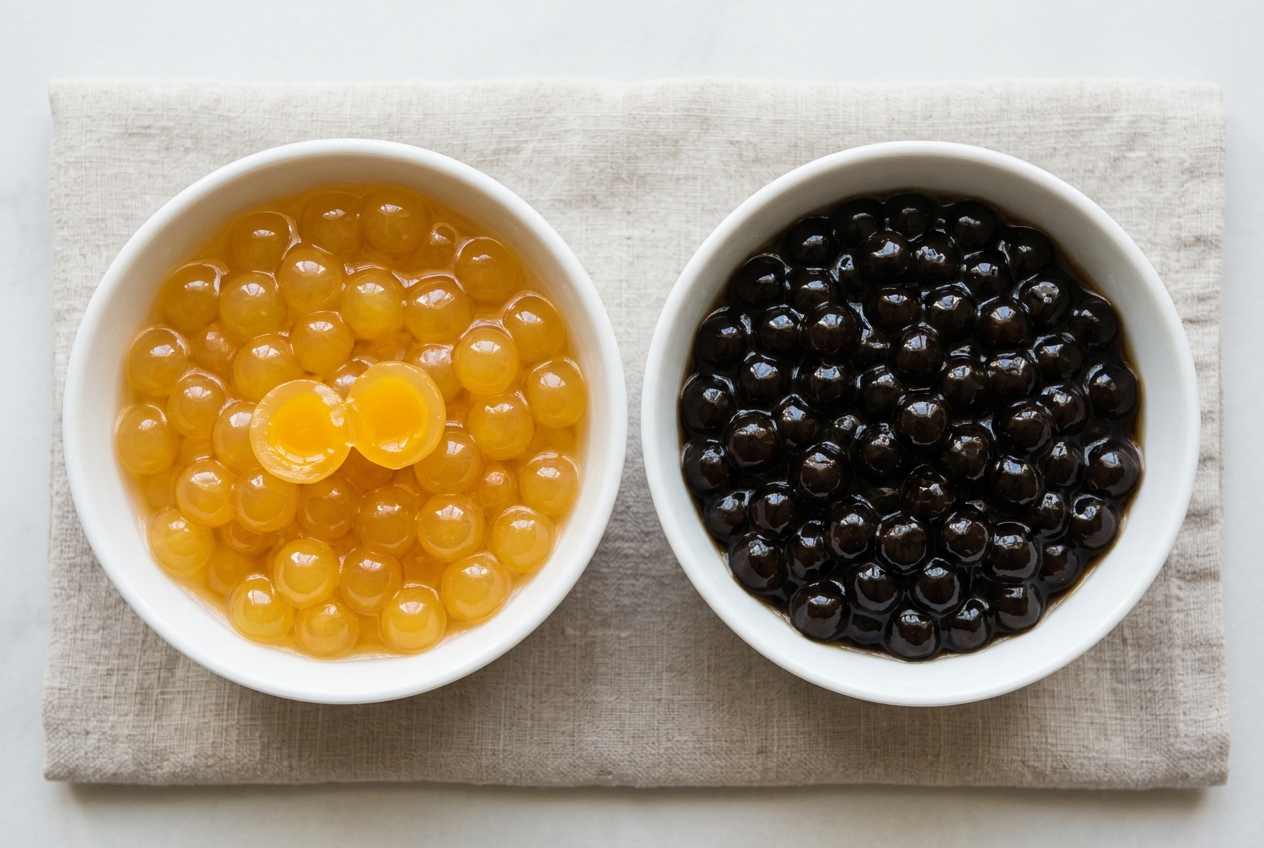
The calorie figures come from supplied research data. Brand recipes and serving sizes differ. Popping boba usually has fewer calories than the same weight of prepared tapioca. This comparison does not make every popping-boba product low in sugar. Syrup can still supply most of its calories. Compare more topping macros in our bubble tea toppings guide.
What does mango popping boba taste like?
Mango popping boba tastes sweet, fruity and tropical. The liquid centre gives a short burst of mango flavour. Its gel skin should have little taste.
Real puree can add ripe fruit notes and a thicker centre. A syrup-based product often tastes brighter and more even from batch to batch. It may also taste less close to fresh mango.
The drink base changes the result. Jasmine green tea adds a floral note. Passion fruit adds sharp acidity. Rich dairy can soften the contrast between the sweet centre and the tea.
How popping boba gets its liquid centre
The recipe below uses reverse spherification. Calcium lactate gluconate goes into the mango mixture. The cook then drops that mixture into a sodium alginate bath.
Calcium ions link alginate chains where the 2 liquids touch. This reaction forms a calcium alginate membrane around the mango centre. This cooking method is sometimes called molecular spherification. Research on edible calcium alginate bubbles confirms that salt type, concentration and setting time change membrane thickness and strength.
The report calls this ionic chelation. Cross-linking is the clearer term for this process. Calcium chloride is a calcium salt, but the reaction does not create calcium chloride. It creates a calcium alginate gel.
Reverse spherification suits mango puree because the membrane forms around a calcium-rich centre. The centre can remain liquid after rinsing. Soaking it for too long makes the skin thicker.
Direct and reverse spherification
Direct spherification puts sodium alginate in the mango liquid and drops it into a calcium bath. Reverse spherification puts the calcium salt in the mango liquid and uses an alginate bath.
Both methods can make mango popping pearls. Direct spherification often suits thin juice. Reverse spherification gives the cook more control over a liquid centre when working with thicker puree.
This distinction also explains why online recipes appear to reverse the ingredients. Check which method a recipe uses before mixing the powders.
Skin thickness and burst strength
Alginate and calcium concentration, pearl size and bath time all affect the skin. More calcium, more alginate or a longer soak can produce a thicker, firmer membrane.
The research report uses the term burst modulus, but it gives no measured target. A home cook can use a bite test: the pearl should survive rinsing and burst with light chewing.
Mango aroma and cultivar choice
Mango comes from Mangifera indica. Its aroma contains terpenes and many other volatile compounds. Research across 27 mango cultivars found alpha-pinene, beta-myrcene and beta-caryophyllene in every cultivar tested. The mix changed between cultivars. This means one fixed myrcene percentage cannot describe every mango.
The report recommends Alphonso mango, also called Hapus. Alphonso has rich colour, strong aroma and smooth flesh. Research has found that monoterpenes form a large share of its volatile mixture, with ocimene often prominent.
Ataulfo, also called Honey mango, has smooth flesh and little fibre. It is another good choice for small pearls. Tommy Atkins can have more visible fibre. Strain it well before use. Fibres can block a syringe tip, disturb the droplet and weaken the finished skin.
Ripeness, growing area and storage also change aroma and sweetness. Measure the puree rather than relying on the cultivar name alone.
Why mango pearls grow tails
Mango puree contains pectin, fibre and suspended fruit solids. These make it thicker than juice. Puree has non-Newtonian flow, which means its thickness can seem to change while it is stirred or pushed through a syringe. This shear behaviour affects how a drop separates from the tip. Surface tension, drop height and nozzle size also affect the shape.
A thick drop may stretch before it leaves the syringe. It enters the bath as a teardrop or tadpole shape. Air bubbles, a narrow syringe tip and an excessive drop height can make the problem worse.
The report recommends food-grade pectinase. This enzyme breaks parts of the pectin structure and can thin fruit puree. Pectinase cuts alpha-1,4 links within pectin's galacturonan chains. This reduces part of the structure that thickens the puree. Mango-pulp research found that enzyme source, temperature, dose and treatment time all changed the result.
Pectinase products differ in strength, working temperature and permitted dose. Follow the supplier's food-use directions. You can also strain the puree, mix in a small measured amount of mango juice, or use a smooth commercial puree. These methods change flavour or concentration, but they avoid an enzyme step.
Mango bursting boba recipe
This mango bursting boba recipe uses reverse spherification. It makes a small home batch.
The method needs a scale that reads to 0.1 g, a blender, a fine sieve, a syringe or squeeze bottle, and a slotted spoon. Use ingredients sold for food preparation.
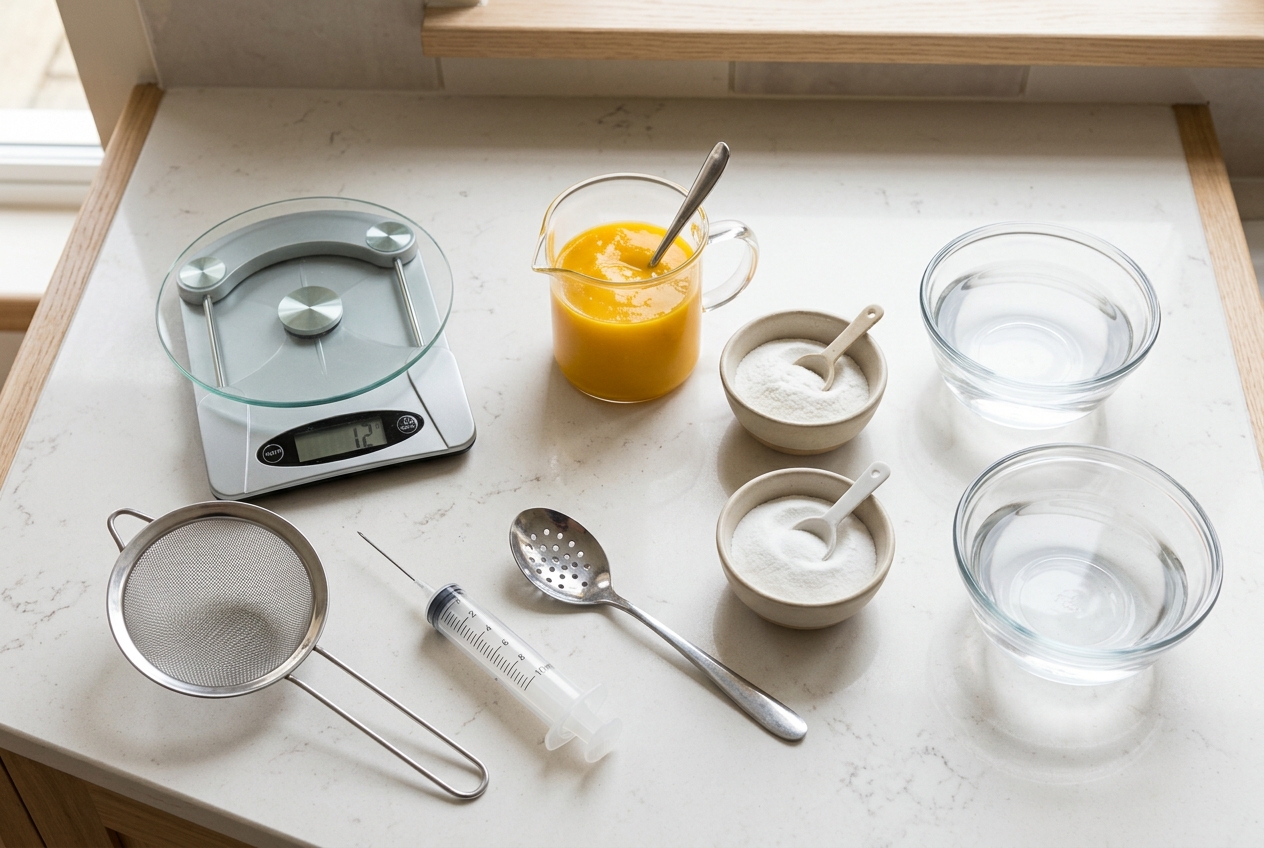
Ingredients
- For the mango centre: 150 ml smooth, strained mango puree, 2.5 g food-grade calcium lactate gluconate (and optional food-grade pectinase).
- For the setting bath: 500 ml potable distilled or low-calcium water, 2.5 g food-grade sodium alginate (0.5% bath).
- For rinsing: 500 ml clean drinking water.
- For short storage: Mango syrup adjusted close to the sweetness of the pearl centre.
Step-by-Step Instructions
- Check the puree: Blend and strain the mango. The puree should pass through the syringe without fibres or lumps. Test one drop in plain water. If it hangs from the syringe in a long thread, it needs further straining or thinning.
- Thin with pectinase if needed: Follow the enzyme label for dose and contact time, or thin with small amounts of mango juice. Cool the puree before adding the calcium salt.
- Add calcium lactate gluconate: Whisk 2.5 g calcium lactate gluconate into the mango mixture. Mix until no powder remains. Cover and chill the mixture while the alginate bath rests.
- Make the sodium alginate bath: Blend 2.5 g sodium alginate into 500 ml water. This makes a 0.5% bath. The blender traps air. Cover the bath and refrigerate it for about 4 hours, or until most bubbles have cleared. You can prepare it the day before.
- Form the pearls: Bring the cold bath to a clear work surface. Fill a culinary syringe or squeeze bottle with the mango mixture. Hold the tip about 2 inches above the bath. Drop the mixture steadily. Work in small batches so the pearls do not touch before their skins form. Let the pearls sit in the bath for about 60 to 75 seconds. A shorter soak gives a more fragile skin. A longer soak makes it firmer.
- Rinse and taste: Lift the pearls with a slotted spoon. Rinse them gently in clean water to remove alginate from the surface. Taste one pearl. Adjust the next batch by changing the soak time or drop size.
- Serve: Serve the pearls soon after making them. Add about 50 g to iced jasmine tea, passion fruit tea, lemonade or sparkling water.
Recipe time and yield
The active work takes about 30 to 45 minutes. The alginate bath needs about 4 hours to lose its trapped air. Total time is about 4 hours 45 minutes. The exact yield depends on pearl size and how much mixture stays in the equipment.
Making the recipe without pectinase
Use a very smooth mango puree. Pass it through a fine sieve twice. If it still forms tails, add mango juice 5 ml at a time. Mix, test a drop and stop when it releases cleanly. Too much juice weakens the mango taste.
Troubleshooting mango popping boba
- The pearls have long tails: Strain the puree again. Use a wider tip, lower the drop height slightly and check for air bubbles. Thin the puree in small steps.
- No skin forms: Check the measurements and ingredient names. Reverse spherification needs calcium in the mango centre and sodium alginate in the bath. Use potable distilled or low-calcium water.
- The pearls stick together: Drop fewer pearls at a time. Leave space between them and move the bath gently without breaking the new skins.
- The skin is too thick: Reduce the bath time. Rinse the pearls as soon as you remove them.
- The pearls burst during rinsing: Increase the bath time by 10 to 15 seconds. Use a gentler water bath and a smooth-edged spoon.
- The pearls taste weak: Use riper fruit or a more concentrated puree. Check the sweetness before adding calcium lactate gluconate.
Brix and short-term storage
Brix estimates soluble solids in a fruit liquid. Most of those solids are sugars. Water can move through a gel membrane when the liquid inside and outside have different concentrations. This concentration difference creates osmotic pressure:
| Storage liquid | Likely concentration difference | Possible result |
|---|---|---|
| Plain water | Hypotonic: outside has less dissolved sugar | Pearl may swell and weaken |
| Heavy syrup | Hypertonic: outside has much more dissolved sugar | Pearl may shrink or wrinkle |
| Similar-Brix mango syrup | Near isotonic: smaller difference | Pearl may hold its shape better |
Keep homemade pearls covered and cold. Make a small batch and serve it the same day. Discard pearls that smell fermented, show mould, leak badly or were left warm for an unsafe period.
Mango popping boba calories
The report gives the following estimates for a 50 g serving:
| Topping | Estimated calories | Estimated carbs | Estimated sugars |
|---|---|---|---|
| Fresh mango popping boba | 34 kcal | 8.5 g | 7.8 g |
| Commercial mango bursting pearls | 45 kcal | 11.5 g | 10.8 g |
| Cooked tapioca pearls | 135 kcal | 33 g | 13 g |
| Nata de coco coconut jelly | 45 kcal | 11 g | 9 g |
Fresh mango supplies carotenoids, but syrup dilution and serving size change the amount in the pearls. For deeper nutrition calculations, explore our mango bubble tea calories guide and boba calories hub.
Drinks that suit mango popping boba
- Jasmine green tea: Jasmine tea adds a floral aroma and a dry finish. Keep the tea lightly sweetened because the pearls already contain sugar. Pair with Bobalicious Jasmine Green Tea.
- Passion fruit tea: Passion fruit brings acidity that balances ripe mango. This pairing works well over plenty of ice. See our fruit bubble tea combinations.
- Strawberry fruit tea: Strawberry gives a familiar sweet-tart base. Use fewer pearls if the tea already contains syrup. Learn more in our strawberry milk tea guide.
- Sparkling water or lemonade: A plain sparkling base keeps the liquid burst easy to notice. Lemonade makes a sweeter, sharper drink.
Buying mango popping boba
Read the ingredients and nutrition label. Check whether the product uses mango juice, puree, concentrate or flavouring. Compare the serving size before comparing calories. A 30 g serving and a 50 g serving cannot be compared without adjusting the numbers.
Check storage directions before opening and after opening. Commercial tubs may need refrigeration after the seal breaks. Look for allergen statements and factory cross-contact warnings.
Safety Notice: Popping boba pearls are small, slippery spheres that can pose a choking risk for young children under 4 years of age. Supervise children and serve boba only to individuals who can chew and swallow safely.
Frequently Asked Questions
What does mango popping boba taste like?
It tastes sweet, ripe and tropical. The thin skin breaks during chewing and releases a short burst of mango liquid.
Why do my mango popping pearls have tails?
Thick puree stretches before it leaves the syringe. Strain it well, remove air bubbles and thin it in small measured steps.
How many calories are in mango popping boba?
The report estimates 34 to 45 calories for 50 g. Check the package because sugar, syrup and serving size differ by brand.
Is mango popping boba vegan?
Sodium alginate does not need gelatin, and calcium lactate gluconate is a mineral salt. Check the full commercial label and cross-contact statement before relying on a vegan claim.
What is mango popping boba made of?
It commonly contains a mango-flavoured liquid, sugar, water, sodium alginate and a calcium salt. Colours, acids and preservatives depend on the recipe.
Is mango popping boba the same as tapioca?
No. Mango popping boba has a liquid centre inside a gel skin. Tapioca pearls use cassava starch and have a dense chew.
Does mango popping boba contain caffeine?
The topping does not normally need caffeine. A finished drink can contain caffeine when the base uses green, black or oolong tea.
How long does homemade mango popping boba last?
Home recipes have no tested shelf life. Keep a small batch cold and serve it the same day. Follow the label for commercial products.
Sources and Scientific References
- Food Hydrocolloids: Cross-linking mechanisms in calcium alginate hydrogel beads.
- Journal of Food Science and Technology: Pectinase enzymatic liquefaction and rheological behaviour of mango puree.
- Molecules: Volatile aroma profiles and terpene distribution across Mangifera indica cultivars.
- US Food and Drug Administration (FDA): Daily Value reference intakes for dietary nutrients.


 Badge-157x140.png)
Comments