

Jelly boba is solid and chewy from edge to centre. Popping boba has a thin gel skin around a liquid centre that bursts when bitten. Understanding the physical structures, hydrocolloid ingredients, and sweetness levels of each topping makes pairing them with bubble tea seamless.
Quick Answer: Jelly Boba vs Popping Boba
Quick answer: Choose jelly boba when you want a solid, lasting chew that complements creamy milk teas, taro, and roasted oolong. Choose popping boba when you want a rapid burst of fruit juice that cuts through iced green teas, lemonades, or sparkling fruit sodas. Jelly boba relies on agar, konjac, or bacterial cellulose (nata de coco) to form a continuous gel network, whereas popping boba uses sodium alginate and calcium salts via spherification to trap liquid inside a thin membrane.
Food Science & Ingredient Standards: Hydrocolloid gelation mechanisms, food-grade spherification parameters, and allergen classifications evaluated against FDA 21 CFR regulations, USDA guidance, and published food polymer research (reviewed September 2026).
Jelly Boba vs Popping Boba at a Glance
The primary differences between jelly toppings and bursting pearls stem from their physical geometry and culinary formulation:
| Feature | Jelly Boba | Popping Boba |
|---|---|---|
| Structure | Solid gel or cellulose piece throughout | Liquid core encapsulated in a thin gel membrane |
| Texture | Chewy, crisp, firm, or tender bite | Soft yielding skin followed by a liquid splash |
| Common forms | Cubes, strips, rectangular bars, or spheres | Small uniform translucent spheres |
| Main materials | Agar-agar, konjac glucomannan, Mesona, nata de coco | Sodium alginate, calcium lactate/chloride, fruit juice |
| Flavour style | Herbal, coffee, coconut, neutral, or subtle fruit | Vibrant, punchy tart fruit flavours (mango, passion fruit) |
| Best drink matches | Milk tea, roasted oolong, matcha, taro boba | Iced green tea, sparkling lemonade, fruit coolers |
| Hot beverage use | Heat-stable (especially agar and konjac gels) | Cold drinks only; heat weakens skin and alters flavor |
| Eating action | Chew thoroughly before swallowing | Bite gently or press against the palate to release liquid |
What is Jelly Boba?
Jelly boba is an umbrella category encompassing plant-based and fermented gel toppings. Unlike starch-based tapioca pearls that require boiling and starch gelatinization, jelly toppings are formed through thermo-reversible or chemical hydrocolloid networks:
- Agar Jelly: Derived from red algae (Rhodophyta), agar forms a firm, clean-breaking gel. It sets at approximately 35°C to 40°C and resists melting up to 85°C.
- Konjac Jelly & Crystal Boba: Produced from the corm of Amorphophallus konjac, glucomannan binds hundreds of times its weight in water to create springy, translucent pearls.
- Nata de Coco (Coconut Jelly): Created via bacterial fermentation of coconut water by Komagataeibacter xylinus, yielding crisp, fibrous micro-cellulose cubes.
- Grass Jelly (Chuen Kou): An herbal gel made by simmering the oxidized stalks and leaves of Platostoma palustre (Mesona chinensis) with starch.
- Coffee & Fruit Jellies: Flavoured gelatin-free agar or carrageenan matrices infused with espresso or fruit juice concentrates.
What is Popping Boba?
Popping boba (also called bursting boba, juice balls, or pop pearls) is a product of culinary spherification. A liquid fruit juice or syrup core is encapsulated inside an ultra-thin edible membrane composed of cross-linked calcium alginate.
Sodium alginate, a natural polysaccharide extracted from brown seaweeds, reacts instantly upon contact with divalent calcium ions (calcium lactate or calcium chloride). The calcium ions form cross-links between guluronate units in the alginate polymer chains—an arrangement known in polymer science as the "egg-box model." This instantaneous surface reaction creates an elastic, tear-resistant skin that traps flavoured juice securely until masticated.
| Ingredient Parameter | Jelly Boba Formulations | Popping Boba Formulations |
|---|---|---|
| Gelling material | Agar, konjac, carrageenan, bacterial cellulose | Sodium alginate with calcium lactate or chloride |
| Core matrix | Solid hydrocolloid throughout | Liquid fruit juice, water, syrup |
| Sweetening agents | Cane sugar, fructose, or light packing syrup | High-fructose corn syrup, fruit juice, cane sugar |
| Acidulants | Minimal (common only in fruit-flavoured agar) | Citric acid, malic acid to balance fruit sweetness |
| Colour additives | Caramel colour (grass jelly) or vegetable extracts | FD&C dyes or beta-carotene, anthocyanins |
| Animal byproduct risk | Occasional commercial blends contain gelatin | Algae-derived; virtually always 100% gelatin-free |
| Allergen concerns | Coconut (nata de coco classified as tree nut under US rules) | Generally free of top-9 major food allergens |
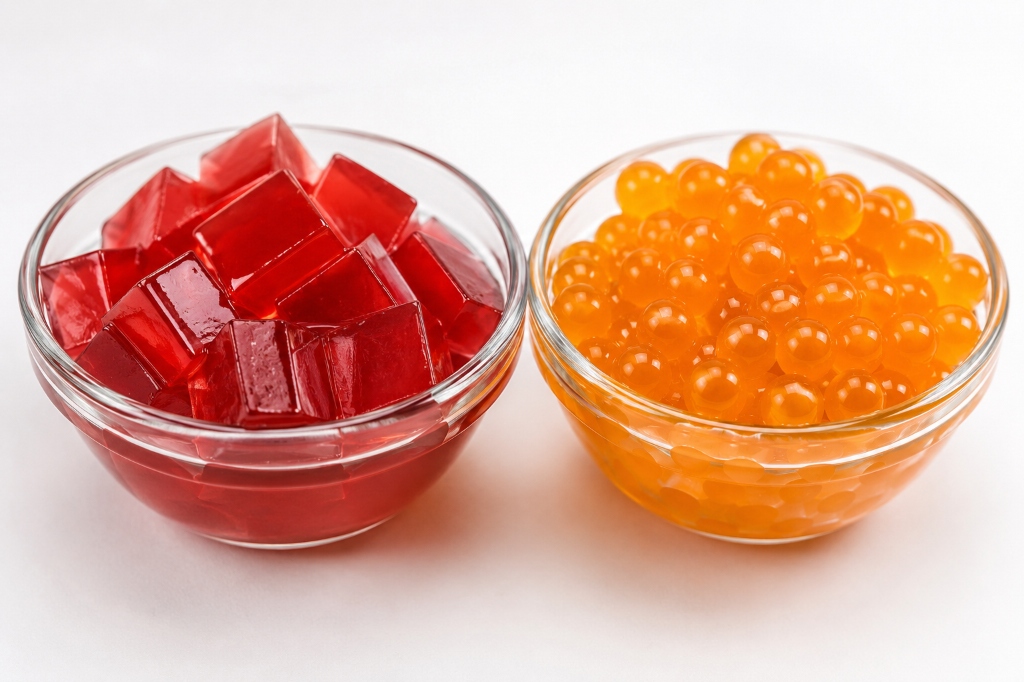
Jelly boba offers a solid, chewy resistance, while popping boba encapsulates flavoured juice inside a fragile calcium-alginate shell.
Drink Pairing Recommendations
Matching your topping to your drink base ensures the flavour and mouthfeel harmonize rather than clash. For perfectly balanced pre-packaged drinks, discover our ready-to-drink popping boba cups:
| Drink Base | Recommended Topping | Flavour Pairing | Why the Pairing Works |
|---|---|---|---|
| Passion fruit green tea | Popping boba | Mango or lychee | Liquid burst echoes the tart, tropical brightness of the green tea base. |
| Strawberry milk tea | Either | Strawberry pop or coconut jelly | Coconut jelly cuts through rich dairy, while popping boba amplifies berry notes. |
| Roasted oolong milk tea | Jelly boba | Herbal grass jelly | Earthy, bitter herbal notes balance toasted oolong charcoal aromas. |
| Matcha latte | Jelly boba | Crystal boba or nata de coco | Neutral, clean-breaking gels preserve vegetal matcha nuances without clashing. |
| Sparkling lemonade | Popping boba | Peach or strawberry | Effervescence elevates bursting juice drops without heavy chewing friction. |
| Taro milk tea | Jelly boba | Nata de coco | Crisp micro-cellulose fibers contrast pleasantly against creamy root starch. |
| Classic black milk tea | Jelly boba | Coffee jelly or grass jelly | Bold roast and malt characteristics pair naturally with roasted coffee notes. |
| Yoghurt drink | Popping boba | Passion fruit or mango | Tart cultured dairy complements tropical fruit bursts without heaviness. |
Popping Boba vs Jelly Boba vs Tapioca Pearls
Traditional cassava pearls differ significantly from both hydrocolloid alternatives. See the complete range in our guide to bubble tea toppings:
| Topping Type | Main Structure | Eating Experience | Primary Energy Source |
|---|---|---|---|
| Tapioca pearls | Cooked cassava starch | Dense, chewy, elastic bite | Starch carbs + brown sugar soak (~140 to 220 kcal) |
| Jelly boba | Solid gel / cellulose matrix | Crisp, firm, or springy resistance | Light packing syrup (~30 to 70 kcal) |
| Popping boba | Liquid core in alginate skin | Instant splash / juicy burst | Juice sugars & fructose (~45 to 75 kcal) |
Storage, Food Safety, and Handling
Both toppings must be stored according to manufacturer packaging specifications. Because toppings have water activity and sugar contents susceptible to mold or fermentation, follow standard food service controls:
- Unopened Tubs: Keep in a cool, dry area away from direct sunlight. Never use bulging, leaking, or compromised tubs.
- Opened Containers: Cover tightly in original liquid and refrigerate below 40°F (4°C). Always use dedicated clean, sanitized ladles.
- Freezing Restrictions: Do not freeze popping boba; ice crystal expansion ruptures the calcium-alginate membrane and results in complete deflation upon thawing.
- Choking Safeguards: Children under 4 years of age face heightened choking risks from small spherical foods ingested through wide-bore boba straws. Always supervise children.
Bottom Line: Jelly Boba vs Popping Boba
Jelly boba and popping boba deliver entirely distinct sensory profiles. Jelly boba provides structural chewing satisfaction throughout milk and roasted teas using plant-derived agar, konjac, or coconut cellulose. Popping boba offers an energetic burst of fruit flavour tailored for cold teas, lemonades, and sodas using molecular spherification. Both represent lower-calorie alternatives to traditional tapioca pearls when ordered with light syrups.
Frequently Asked Questions
What is the difference between jelly boba and popping boba?
Jelly boba is a solid, chewy gel from edge to centre made from ingredients like agar, konjac, or nata de coco. Explore recipes and varieties in our jelly boba guide. Popping boba is a liquid-filled sphere enclosed in a thin calcium-alginate membrane that bursts when bitten.
Does jelly boba pop in your mouth?
No. Jelly boba has no liquid core and will not pop. It provides a consistent, chewy, springy, or crisp bite depending on whether it is made from agar, konjac, or coconut cellulose.
What is popping boba made of?
Popping boba consists of a flavoured liquid core (water, fruit juice, sugar, citric acid) encapsulated by an outer skin formed from sodium alginate (derived from brown seaweed) and food-grade calcium salts.
Is popping boba considered real boba?
In colloquial bubble tea culture, "boba" has expanded to describe any drink topping served with a wide straw. Historically, authentic boba refers strictly to boiled cassava starch pearls.
Which topping has fewer calories?
Both are significantly lower in calories than tapioca pearls (140 to 220 kcal). Drained jelly boba averages 30 to 70 calories per 60 g scoop, while popping boba averages 45 to 75 calories depending on packing syrup sweetness.
Can you put popping boba in hot bubble tea?
No. Hot liquids can degrade the thin alginate membrane, causing the pearls to leak prematurely or turn rubbery. Popping boba is designed exclusively for chilled or iced beverages.
What is crystal boba compared to popping boba?
Crystal boba is a solid, translucent jelly pearl made from konjac and agar. It does not burst or contain liquid inside. Popping boba is hollow except for its liquid juice centre.
Are popping boba and jelly boba vegan?
Most commercially produced popping boba and plant jellies (agar, konjac, nata de coco) are 100% vegan. Occasionally, certain specialty jellies may incorporate animal gelatin or carmine food colouring, so verifying the ingredient label is recommended.
Are these toppings safe for young children?
Any spherical topping ingested through a wide straw poses a potential choking hazard for children under 4 years of age. Young children should always be supervised, and soft spoonable toppings are preferable for toddlers.
Why does popping boba sometimes leak in the tub?
Leaking usually occurs due to aggressive scooping with sharp metal utensils, freezing damage, extended storage beyond shelf life, or acidity imbalances in the holding liquid that soften the calcium crosslinks.
Sources and Reference Standards
- US Food and Drug Administration (FDA): Title 21 CFR § 184.1724 – Direct Food Substances Affirmed as GRAS: Sodium Alginate.
- National Center for Biotechnology Information (NCBI): Production Methods and Rheological Properties of Calcium Alginate Gel Particles.
- Journal of Food Science: Hydrocolloids as Food Thickening and Gelling Agents: Polymer Synergy in Beverage Systems.
- Applied Microbiology and Biotechnology: Bacterial Cellulose Production by Komagataeibacter xylinus in Nata de Coco Food Systems.
- US Department of Agriculture (USDA): Food Safety and Inspection Service – Danger Zone Guidelines for Perishable Ingredients.


Comments